Quantized LLMs now run on a 16 GB laptop — and close the gap with cloud models
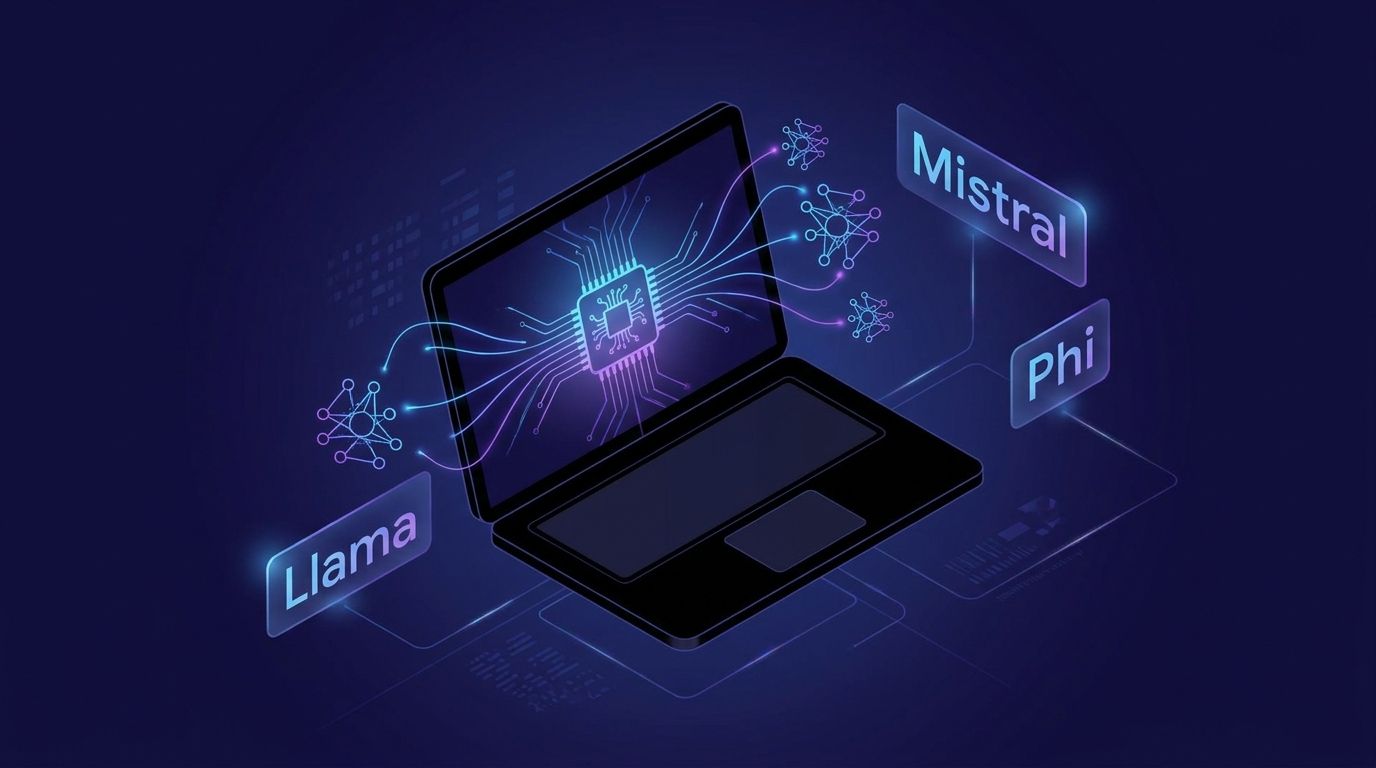
Two years ago, running a capable large language model required either a datacenter GPU or an expensive API subscription. Today, a gaming laptop with 16 GB of RAM can run a 7-billion-parameter model locally at 30–50 tokens per second — fast enough for real work. The key technology that made this possible is quantization, and it has quietly redrawn the boundary between cloud AI and edge AI.
The problem: models that could not leave the datacenter
A language model stores its intelligence in billions of floating-point numbers called weights. The original LLaMA model released by Meta in 2023 stored each weight as a 16-bit float (FP16), meaning the 7B-parameter version required roughly 14 GB of GPU memory just to load — before any inference overhead. The 13B version needed 26 GB. Consumer GPUs max out around 8–12 GB of VRAM, so running these models locally was effectively impossible for most developers and enthusiasts.
Beyond hardware constraints, cloud-only deployment created real problems: every query sent to an API is a privacy exposure, latency depends on network conditions, and costs accumulate with usage. For enterprises handling sensitive data, sending documents to a third-party API is often legally or contractually prohibited.
What quantization actually does
Quantization reduces the numerical precision of model weights. Instead of storing each weight as a 32-bit float (FP32) or 16-bit float (FP16), quantized models store weights as 8-bit integers (INT8) or even 4-bit integers (INT4). The memory savings are substantial: INT8 cuts memory use roughly in half versus FP16; INT4 cuts it by roughly 75%.
The tradeoff is accuracy. Compressing weights introduces rounding errors that can degrade output quality — but researchers discovered that large models tolerate quantization surprisingly well. A 7B model quantized to INT4 loses only marginal quality compared to its FP16 counterpart on most benchmarks, because the model has enough parameters that individual weight errors average out.
The two dominant quantization schemes are GPTQ (post-training quantization using calibration data, originally developed for GPT models) and GGUF (the file format used by llama.cpp, which supports mixed-precision quantization at 2-bit to 8-bit per weight). GGUF replaced the earlier GGML format in 2023 and has become the de facto standard for distributing quantized models for local inference.
The tools: llama.cpp, Ollama, and the ecosystem
llama.cpp, written by Georgi Gerganov, is the foundational project. It is a pure C/C++ inference engine that loads GGUF models and runs them efficiently on CPU — with optional GPU offloading. Because it has no Python runtime dependency and compiles on any platform, it became the base layer for dozens of local AI tools. On an Apple M-series chip, llama.cpp uses Metal acceleration and achieves inference speeds competitive with dedicated GPU machines.
Ollama wraps llama.cpp in a clean command-line interface and local REST API. A single command — ollama run llama3.1 — downloads the quantized model and starts serving it. Ollama handles model versioning, hardware detection, and memory management automatically, making local LLM deployment accessible to developers who do not want to manage raw GGUF files.
Other notable tools in this stack include LM Studio (a GUI for browsing and running GGUF models), Jan (an open-source ChatGPT alternative that runs locally), and vLLM (optimized for GPU inference at higher throughput, used more in edge server contexts).
The models that changed everything
Llama 3.1 (Meta, released July 2024) is the current benchmark for open-weight models. The 8B version quantized to Q4_K_M — a GGUF quantization variant — requires about 5 GB of RAM and runs on any modern laptop. Its 70B version, quantized to Q4, needs around 40 GB and runs on a Mac Studio or a workstation with multiple GPUs. Performance on coding and reasoning tasks is competitive with GPT-3.5 and approaches GPT-4 on several benchmarks.
Mistral 7B (Mistral AI, 2023) was the first open-weight model to convincingly outperform Llama 2 13B at half the parameter count — demonstrating that architecture efficiency matters as much as scale. It sparked widespread interest in smaller, more efficient models optimized for local deployment.
Phi-3 Mini (Microsoft, 2024) is a 3.8B-parameter model that achieves performance comparable to much larger models by training on higher-quality data rather than scaling parameters. At Q4 quantization, it fits in under 3 GB and runs at 40+ tokens per second on a modern CPU — making it viable for devices with limited memory.
Gemma 2 (Google DeepMind, 2024) introduced architectural improvements including alternating local and global attention layers, resulting in strong performance at 2B and 9B parameter sizes. The 2B version quantized to INT4 runs on devices with as little as 2 GB of available memory.
What this means in practice
Privacy: Local inference means queries never leave the device. For medical, legal, and financial applications — where data residency requirements are strict — this is the difference between using AI and not using it at all. A hospital can run a clinical note summarizer on-premises without routing patient data through any external API.
Offline operation: Consumer devices in remote locations, aircraft, submarines, or any environment with unreliable connectivity can run AI applications that would otherwise be cloud-dependent.
Developer iteration: Running a model locally eliminates API rate limits and per-token costs during development. A developer can run thousands of inference calls against a local Mistral or Llama model to test prompts, fine-tune evaluation logic, or generate synthetic training data without accumulating API costs.
Enterprise edge deployment: Manufacturing plants, retail stores, and logistics hubs are deploying small quantized models on local servers to run applications that require low latency and cannot tolerate cloud round-trips. A quality control system analyzing defects on an assembly line cannot afford 200ms of cloud latency per query.
What hardware you need today
For serious local inference, the practical minimum is 16 GB of unified memory (on Apple Silicon) or 16 GB of RAM with a discrete GPU. This covers the Llama 3.1 8B, Mistral 7B, and Phi-3 Medium models at Q4 quantization comfortably. A MacBook Pro M3 Pro with 18 GB of unified memory can run Llama 3.1 8B at 35–45 tokens per second — fast enough that the bottleneck is reading, not waiting.
For 70B models, you need either a Mac Studio with 64+ GB of unified memory, a workstation with 2× RTX 4090 GPUs (48 GB total VRAM), or a server with high-memory GPUs. These are no longer exotic configurations — 64 GB Mac Studios cost under $2,000, and the software to run them is free.
Start with ollama run phi3:mini if you want the fastest possible response on modest hardware, or ollama run llama3.1:8b for a model that handles complex reasoning and coding tasks. Both download in minutes and run without any configuration. The infrastructure that made AI inaccessible to anyone without a cloud account is gone — the question now is what to build with it.