The Quantum Error Correction Turning Point: Why 2025–2026 Changed What's Possible
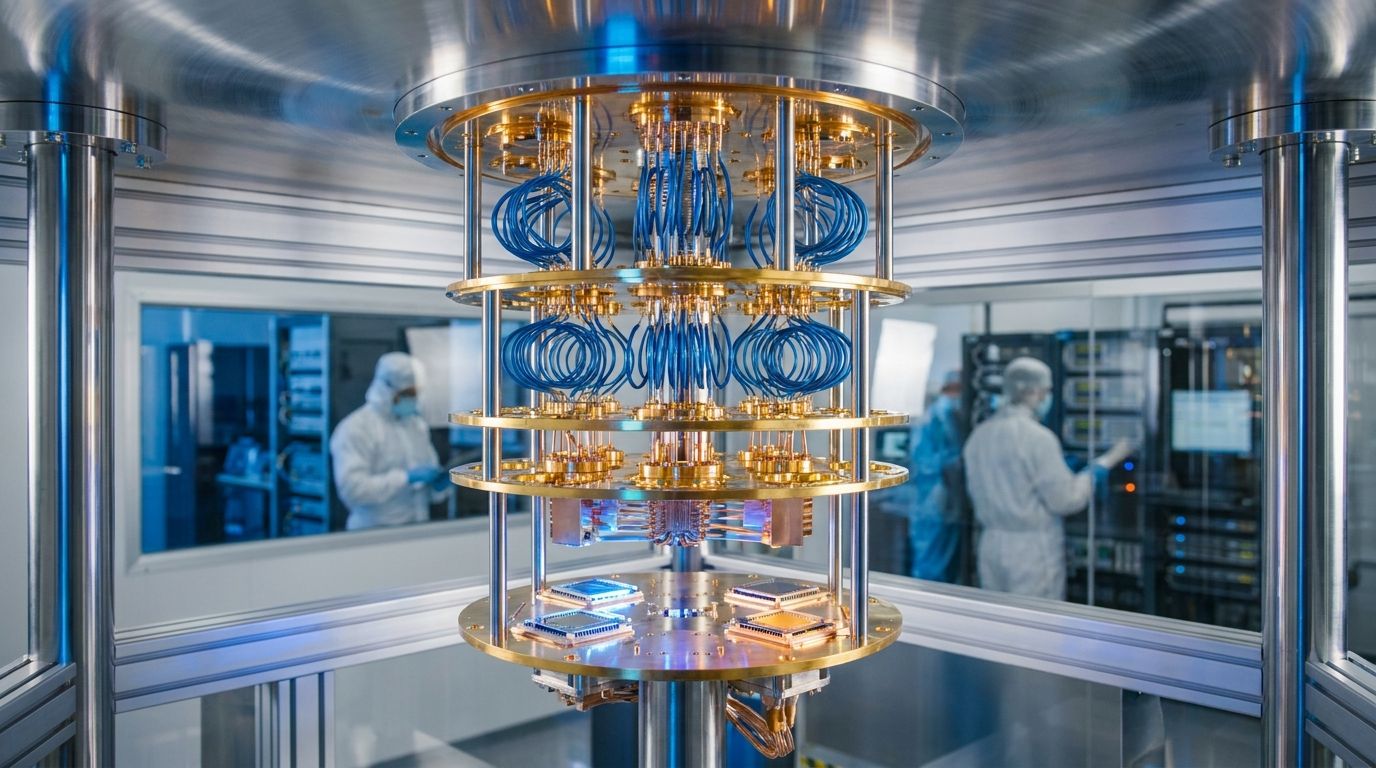
The history of quantum computing is littered with milestones that turned out to be premature. For years, each announcement of a new qubit count record or a claimed quantum advantage was met with reasonable scepticism: the systems were too error-prone to run useful algorithms, too difficult to scale, and too far from the conditions required to outperform well-optimised classical software on problems that actually matter.
The events of 2025 and early 2026 feel different in a specific, quantifiable way. The reason is error correction — and the gap between the theoretical promise and the experimental reality of quantum error correction has, for the first time, measurably narrowed.
Why error correction is the whole game
A quantum computer's fundamental operating unit is the qubit. Unlike a classical bit that is deterministically 0 or 1, a qubit can exist in a superposition of both states, and multiple qubits can be entangled in ways that allow quantum algorithms to explore exponentially many computational paths simultaneously. This is the source of quantum computing's theoretical power.
The problem is that qubits are extraordinarily sensitive to environmental disturbances — vibration, heat, electromagnetic noise, even cosmic rays. Any interaction with the environment causes decoherence: the qubit loses its quantum state and produces an error. The physical error rates of the best superconducting qubits today are around 0.1% to 1% per operation. Run a thousand operations — as a useful algorithm might require — and your computation is almost certainly corrupted.
Quantum error correction addresses this by encoding one logical qubit across many physical qubits. The collective system is designed so that errors on individual physical qubits can be detected and corrected without measuring (and collapsing) the logical qubit's quantum state. The theoretical framework for this has existed since the 1990s; the engineering challenge is building physical qubits good enough, and in sufficient numbers, to make the logical qubit more reliable than its components.
The critical threshold — called the fault-tolerance threshold — is the physical error rate below which adding more error-correction qubits actually improves logical qubit fidelity. Above the threshold, more qubits just adds more noise. Below it, scaling the error-correction code exponentially suppresses errors.
Google's Willow chip and what it demonstrated
In December 2024, Google published results from its Willow quantum processor that represented the clearest demonstration yet of below-threshold error correction in a superconducting system. The key result: as Google increased the size of their surface code error-correction scheme from a 3×3 grid to a 7×7 grid of physical qubits, the logical error rate dropped exponentially — exactly the behaviour the theory predicts for below-threshold operation.
Willow achieved a logical qubit error rate of approximately 0.143% per round of error correction using a 7×7 surface code (49 physical qubits per logical qubit). That number needs context: it is still not low enough to run most practically useful quantum algorithms without further improvement. But the exponential scaling behaviour was confirmed experimentally for the first time at meaningful scale, establishing that the path to arbitrarily low logical error rates is open.
Google also demonstrated a random circuit sampling benchmark in which Willow performed a computation in under five minutes that they estimate would take the world's fastest classical supercomputers 10 septillion (10²⁵) years. Critics correctly note that this specific benchmark was designed for quantum computers and has no practical application — but the result establishes a performance ceiling for classical simulation of the system.
Microsoft's topological qubit announcement
In February 2025, Microsoft announced a fundamentally different approach: topological qubits, based on exotic quasiparticles called Majorana fermions that are theoretically far more resistant to decoherence than conventional approaches. The company published peer-reviewed results in Nature demonstrating the creation of a topological superconducting phase in a semiconductor-superconductor device — the key physical ingredient for Majorana-based qubits.
Microsoft's claim is that topological qubits, once fully realised, will require orders of magnitude fewer physical qubits per logical qubit than surface codes on conventional architectures — potentially making the overhead of error correction tractable at much smaller scale. Independent researchers verified the core physics result while noting that demonstrated Majorana qubits remain in early stages of development and that the path from the observed physical phase to functioning topological qubits involves many additional engineering challenges.
IBM's path to 2033
IBM has been running the most consistent public roadmap in quantum computing, shipping increasingly capable systems on a near-annual cadence. Their current Heron processors, with error rates of around 0.1% for two-qubit gates, represent the best publicly available superconducting qubit performance. IBM's published roadmap targets fault-tolerant quantum computing — systems capable of running algorithms with thousands of logical qubits — by 2033.
More immediately, IBM's quantum network gives cloud access to 100+ qubit systems that researchers use for quantum chemistry, optimisation, and machine learning experiments. The value of this infrastructure is less in the raw qubit count than in the accumulated tooling, error mitigation techniques, and software ecosystem (Qiskit) that has developed around reliable access.
What useful quantum computing actually requires
The applications most frequently cited for quantum computing — breaking RSA encryption, simulating molecular dynamics for drug discovery, optimising supply chains, accelerating machine learning — each require different qubit counts and error rates.
Breaking 2048-bit RSA encryption using Shor's algorithm would require approximately 4,000 logical qubits running with very low error rates, which translates to millions of physical qubits using current error correction overhead. This is likely 15–20 years away at current scaling trajectories — which is why NIST finalised post-quantum cryptography standards in 2024 as a precaution.
Quantum chemistry simulations for drug discovery — modelling the electronic structure of molecules that are too complex for classical computers — requires hundreds to low thousands of logical qubits for practically useful cases. This is the application where near-term progress is most likely to produce genuine commercial value.
The consensus among researchers is that 2025 and 2026 have moved the field from "can we achieve below-threshold error correction at all?" to "how quickly can we scale the logical qubit count?" That shift in the central question is not a minor reframing. It suggests that the engineering trajectory, while still long and expensive, is now clearly pointed in the right direction.