QUIC is changing how the web works — here's why your browser switched protocols without telling you
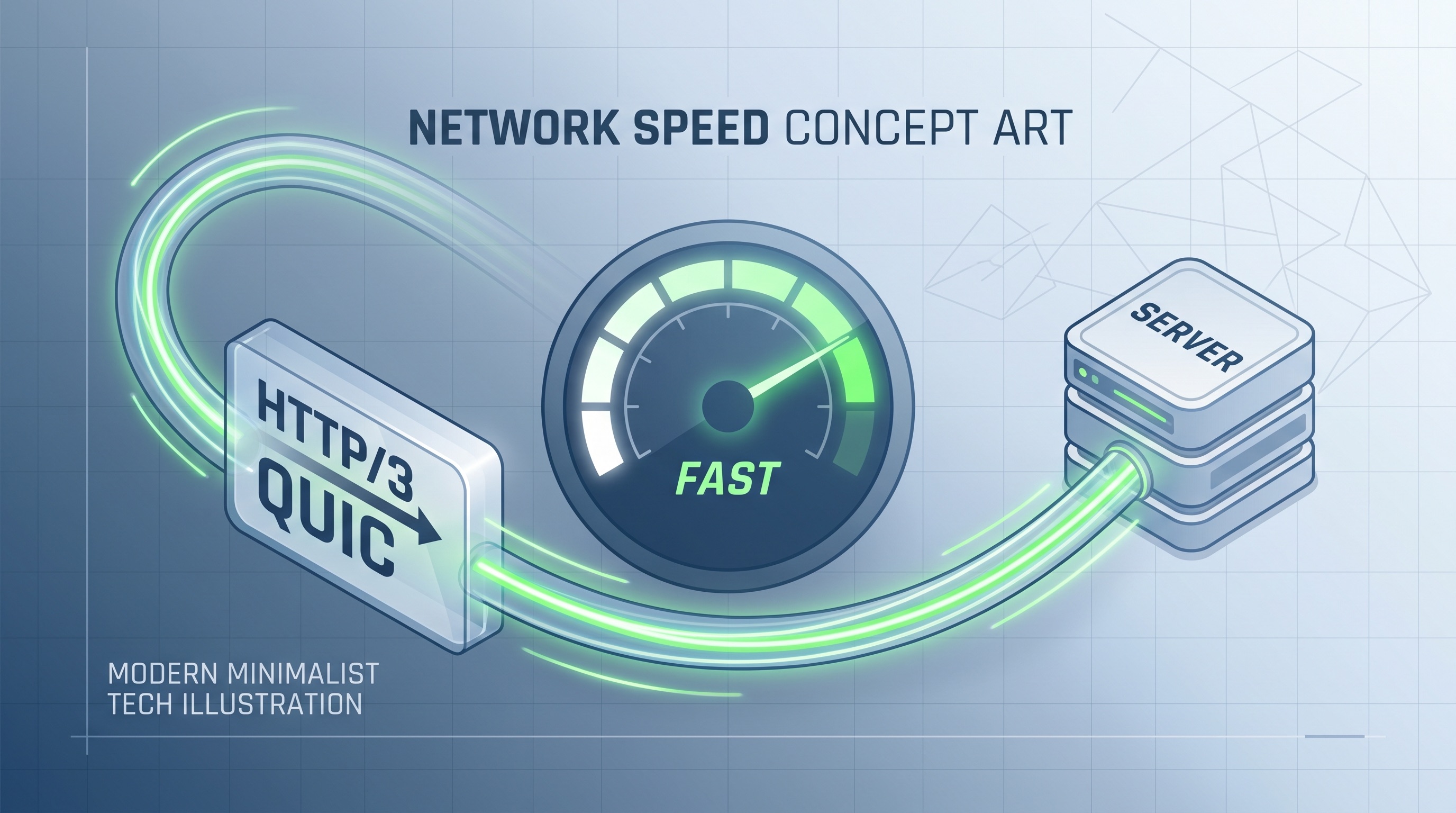
Sometime in the past few years, without any announcement or software update notification, your browser stopped using the same transport protocol that has powered the internet since the 1980s. It didn't ask your permission. There was no changelog entry. Yet something fundamental shifted in how your data travels across the network — and it's one of the most significant changes to web infrastructure in a generation.
The protocol you never thought about
For most of the web's history, HTTP ran on top of TCP — the Transmission Control Protocol. TCP is reliable by design: it guarantees that every packet arrives in order, retransmits anything that gets lost, and ensures data integrity end to end. This made it the obvious choice for the web when HTTP was first designed in the early 1990s.
But reliability has a cost. TCP requires a handshake before any data flows — typically 1 to 3 round trips just to establish a connection. On a fast fiber connection in a quiet datacenter, this overhead is invisible. On a mobile network, where packets can arrive out of order, get dropped, or experience wildly varying latency, TCP's guarantees become a source of friction rather than comfort.
The head-of-line blocking problem
HTTP/2, released in 2015, tried to solve web performance by multiplexing multiple requests over a single TCP connection. Instead of opening six separate connections to a server (as HTTP/1.1 browsers did), HTTP/2 could send dozens of requests simultaneously through one pipe. It was a genuine improvement — faster page loads, lower server overhead, better use of bandwidth.
But HTTP/2 had a hidden flaw it inherited from TCP: head-of-line blocking. When a single TCP packet gets lost in transit, the entire connection stalls. Every stream — every image, stylesheet, and script being transferred simultaneously — freezes and waits while TCP retransmits the missing piece. On a lossy mobile network where 2–3% packet loss is common, this can make HTTP/2's multiplexing counterproductive. You're sharing a connection, and one dropped packet stops everything.
This is the problem QUIC was designed to solve.
What QUIC actually is
QUIC — which started as an experiment at Google around 2012 — takes a different approach at the transport layer. Instead of building on TCP, it runs directly over UDP, the User Datagram Protocol. UDP is the simpler, connectionless sibling of TCP: it sends packets without guarantees, without handshakes, without ordering. This sounds like a step backward. But QUIC builds its own reliability mechanisms on top of UDP — ones that are stream-aware.
In QUIC, each stream is independently reliable. If a packet carrying data for your page's hero image gets lost, only the hero image stream stalls while retransmission happens. Your CSS, JavaScript, and API calls keep moving. Head-of-line blocking is eliminated at the transport layer.
QUIC also builds TLS 1.3 encryption directly into the protocol. There's no separate TLS handshake negotiation on top of the connection handshake — they happen together. This reduces the startup cost from 2–3 round trips (TCP + TLS) to just 1 round trip for a new connection, and with 0-RTT connection resumption, returning visitors can send their first request before the connection is even fully established. For a web where users expect sub-second page loads, these savings matter.
Connection migration: your phone's superpower
One of QUIC's most practically useful features is connection migration. A TCP connection is tied to an IP address and port number. When you walk from your office's WiFi to the hallway where your phone switches to cellular data, your IP address changes — and every TCP connection you had breaks. Your downloads restart. Your video calls stutter. Your streaming session hiccups.
QUIC connections are identified by a connection ID rather than an IP/port tuple. When your phone switches networks, the connection ID persists. Your QUIC connections migrate seamlessly to the new network path without interruption. In practice, this means video calls stay smooth when you move between networks, file transfers don't restart, and web sessions don't drop — even if the underlying network changes beneath you.
HTTP/3: QUIC in the browser
HTTP/3 is simply HTTP semantics running over QUIC instead of TCP. The request-response model, headers, methods — all the same. But the transport layer underneath is fundamentally different. HTTP/3 became an IETF standard (RFC 9114) in June 2022, and by that point all major browsers had already shipped support: Chrome since 2020, Firefox since 2021, Safari since 2022, Edge following Chrome's lead.
On the server side, adoption moved fast. Cloudflare enabled HTTP/3 by default across its entire network in 2020. Google's servers have served HTTP/3 since the protocol was still called "QUIC" internally. Meta — which manages one of the world's largest web infrastructures — reported significant performance gains from QUIC adoption on mobile, particularly in markets where network reliability is inconsistent. Akamai, one of the largest CDN providers, brought HTTP/3 support to its entire edge network.
Today, when your browser visits a major website, the exchange likely goes like this: the first connection uses HTTP/2 or HTTP/1.1, and the server advertises HTTP/3 availability via the Alt-Svc header. On subsequent visits, your browser upgrades automatically to HTTP/3 — no user action required, no visible change except pages potentially loading faster.
Where adoption stands now
As of 2024, HTTP/3 is not a niche experiment. According to Cloudflare's radar data, roughly 30% of global web traffic now uses HTTP/3. The number is higher on mobile and in regions with more challenging network conditions — exactly the use cases where QUIC's advantages are most pronounced.
The infrastructure challenge, however, is real. QUIC runs over UDP, and for decades network equipment — firewalls, load balancers, deep packet inspection boxes — was optimized around TCP. Many enterprise networks and corporate firewalls block or throttle UDP on port 443, which is where QUIC lives. This means browsers and servers need fallback logic: if QUIC can't get through, they fall back to HTTP/2 over TCP. The transition is designed to be invisible.
For developers and operators, HTTP/3 support typically comes for free if you're behind a major CDN. If you run your own infrastructure, nginx's QUIC branch, Caddy, and LiteSpeed all support HTTP/3. The configuration overhead is low once you have a valid TLS certificate — which in the QUIC era is non-negotiable, since encryption is built into the protocol itself.
The hidden infrastructure shift
What makes the QUIC transition remarkable is that it happened largely without end users noticing. No one uninstalled their browser. No one clicked "upgrade to HTTP/3." The change happened at the protocol negotiation layer, invisible in the browser chrome but fundamental at the network level.
This is how the web's infrastructure tends to evolve: not through sudden revolutions but through backward-compatible negotiations that slowly shift the baseline. HTTP/2 took years to reach majority adoption after its 2015 standardization. HTTP/3 is on a faster trajectory, driven by the scale of the deployments — when Cloudflare and Google switch, a large fraction of the web's traffic shifts with them.
For users on mobile networks — which today means most of the world's internet users — the improvements are meaningful: faster page loads, more resilient connections, seamless network handoffs. The internet didn't change overnight. But under the hood, the pipes your data travels through got significantly better. QUIC is the reason why.