Satellite Messaging Has Arrived on Mainstream Phones — But It's Not the Star Trek Communicator You're Imagining
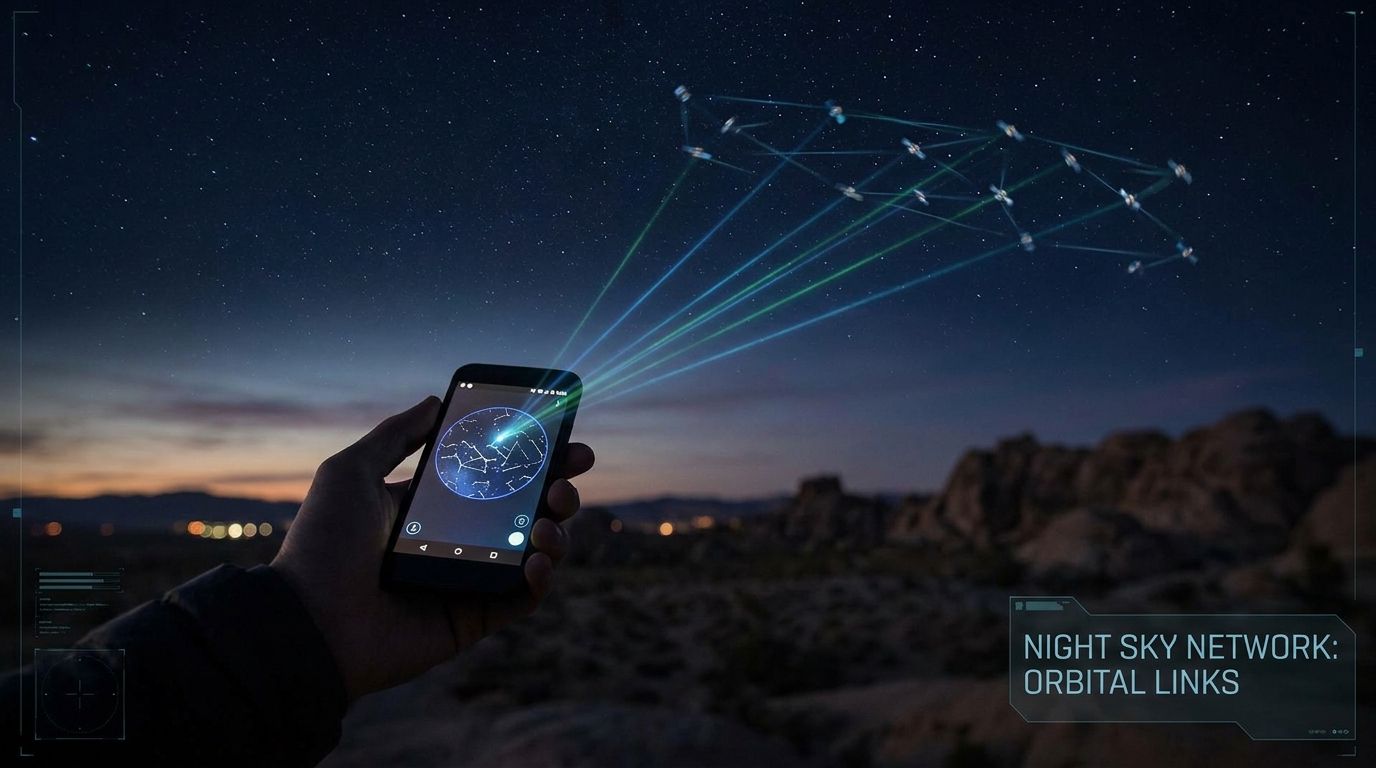
When Apple launched Emergency SOS via satellite on the iPhone 14 in late 2022, the reaction was predictable: half the tech press declared the future had arrived, and the other half pointed out you could only send a pre-scripted distress message while standing in a field. Both were right. That feature was a proof of concept — the first time a mass-market consumer phone used satellite connectivity as part of its core value proposition. By 2026, the technology has matured considerably, and the landscape looks very different. But the gap between marketing and reality remains wide enough to matter.
How Direct-to-Device Satellite Actually Works
There are two fundamentally different approaches to getting a satellite signal into a standard smartphone, and conflating them is the source of most confusion.
Bent-Pipe via Low Earth Orbit (LEO)
Starlink's partnership with T-Mobile, and AST SpaceMobile's BlueBird constellation working with AT&T and Verizon, both use a "bent-pipe" architecture. The satellite doesn't process your call or message — it acts as a relay, essentially a cell tower orbiting at 340–500 km altitude. Crucially, these satellites reuse standard 4G LTE and 5G NR frequencies already licensed to terrestrial carriers. Your phone's cellular modem sees what looks like a very distant cell tower. No special hardware is required beyond a modem that can handle the additional path loss and Doppler shift from a moving satellite.
This approach is elegant because it works with existing devices. The tradeoff is capacity: a single Starlink satellite covering a cell-sized footprint on the ground has to share bandwidth across potentially thousands of users. Typical throughput in a Starlink direct-to-cell zone runs 2–7 Mbps aggregate for the entire cell, not per user. Latency sits around 40–80 ms round-trip — better than geostationary (500–700 ms), but noticeably higher than terrestrial 5G. AST SpaceMobile's BlueBird satellites are physically much larger (each with a 64 square meter phased array antenna), which improves link budget significantly.
Purpose-Built NTN: 3GPP Release 17/18
The second approach is the 3GPP standardized Non-Terrestrial Network (NTN) path. 3GPP Release 17, finalized in 2022, and Release 18 define how 5G NR and NB-IoT can operate via satellite using dedicated L-band and S-band frequencies. Qualcomm's Snapdragon Satellite, built into the X70 modem and later, implements this standard. These aren't reused cellular bands — they're spectrum specifically allocated for satellite use.
The performance ceiling here is much lower: NTN NB-IoT tops out around 1,400 bps in current deployments. That's enough for an emergency text message or a GPS coordinates ping. It is not enough for browsing, voice, or media. The advantage is that NTN L-band/S-band links are more robust in weak-signal conditions — the physics favor lower frequencies for punching through atmospheric noise — and the standard is carrier-agnostic by design.
What's Actually Shipping in 2026
- Apple iPhone 14, 15, 16 series: Emergency SOS and Roadside Assist via Satellite use Apple's partnership with Globalstar. Available in the US, Canada, UK, EU, Australia, and Japan. Text-only; message delivery takes 5–15 seconds. Not usable indoors.
- Android via Starlink (T-Mobile): Devices with Snapdragon X-series modems (X55 and later with NTN support) can fall back to Starlink direct-to-cell when T-Mobile terrestrial coverage is absent. SMS and basic data. US-only as of mid-2026.
- Google Pixel 9 series: Google announced Starlink satellite connectivity for the Pixel 9 family in 2025. Messaging and emergency services in areas without terrestrial coverage.
- AST SpaceMobile (AT&T, Verizon): Commercial service launched in parts of the US in late 2025. The BlueBird constellation supports voice and data for compatible devices.
The Real Performance Numbers
- Starlink direct-to-cell: 2–7 Mbps aggregate cell throughput; latency 40–80 ms; service available during satellite passes, not continuously
- Apple Emergency SOS via Globalstar: 9.6 kbps data channel; messages queue and transmit in 5–15 seconds
- NTN NB-IoT (Qualcomm Snapdragon Satellite): ~1–2 kbps; emergency and IoT messaging only; no voice, no streaming
- AST SpaceMobile BlueBird: Theoretically capable of 10+ Mbps per user under optimal conditions
LEO satellite "coverage" doesn't mean a satellite is always overhead. A given location might have a usable Starlink pass for 10–15 minutes every 30–90 minutes. The gaps are shrinking as Gen 2 and Gen 3 satellites increase constellation density, but continuous service like a terrestrial tower is not the current state.
What It Cannot Do Yet
Voice calls over satellite direct-to-device remain experimental. Streaming video or any latency-sensitive application is not practical on current NTN bands. Indoor use doesn't work — the link budget for L-band and S-band NTN assumes a clear sky view. Cost models are still evolving. In dense urban areas, terrestrial 5G always wins.
Why the Modem Matters
Older Qualcomm modems — anything pre-Snapdragon X55 — don't implement 3GPP NTN. Snapdragon X55 added partial NTN support; X65 and X70 added full NTN and Snapdragon Satellite capability. On the MediaTek side, the Dimensity 9300 introduced NTN support. Apple's C1 modem (iPhone 17) and the Globalstar hardware path in iPhone 14–16 are chip-level implementations with specific Globalstar protocol support — not standard 3GPP NTN. This is hardware, not a software update. A phone with a Snapdragon 888 or a Dimensity 9000 will never have satellite messaging.
What's Coming in 2027–2028
3GPP Release 19 specifically targets voice over NTN — actual phone calls via satellite on standard 5G devices — with commercial deployment expected 2027–2028. AST SpaceMobile targets 168 BlueBird satellites for full commercial coverage; approximately 45–60 are operational as of mid-2026. Starlink's Gen 3 satellites include a direct-to-cell antenna array with roughly 4x the capacity of Gen 2. Basic data browsing over satellite on mainstream phones is plausible by 2028 for devices with capable modems.
The Bottom Line
Satellite direct-to-device messaging is a genuine technology achievement and a genuine safety net. If your car breaks down in a dead zone or you're hiking in a wilderness area, having an iPhone 15 or a Pixel 9 with T-Mobile might save your life in a way that simply wasn't possible three years ago. That's not marketing — it's real. But it is not the Star Trek communicator. It's not a replacement for terrestrial mobile coverage. The phones that have it are meaningfully better in emergencies; don't cancel your carrier plan.