Silicon-Carbon Batteries Are Ending Smartphone Battery Anxiety
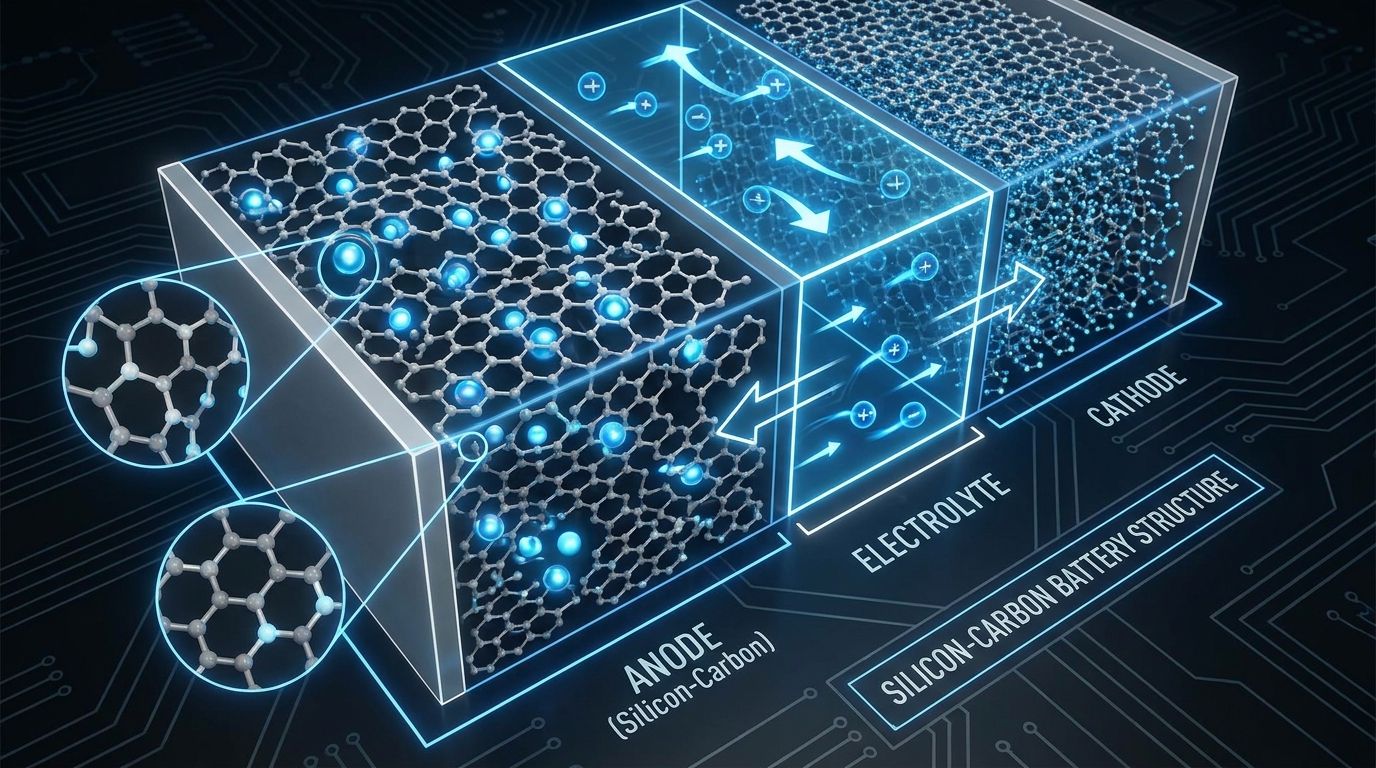
Flagship smartphones shipping in late 2024 and into 2025 are quietly doing something remarkable: fitting 6,000–7,000 mAh batteries into chassis that previously held 4,500 mAh cells — with no increase in thickness. The OnePlus 13 squeezes 6,000 mAh into a phone thinner than its predecessor. The Vivo X200 Ultra matches that figure. Xiaomi's 15 series tops 5,400 mAh. This is not a coincidence and it is not a marketing trick. It is the result of a genuine shift in battery chemistry: silicon-carbon anodes replacing graphite as the dominant anode material in high-end smartphone cells.
Why This Matters: The First Real Chemistry Change in a Decade
Smartphone batteries have used the same fundamental architecture since the mid-2000s: a graphite anode, a lithium cobalt oxide (or variant) cathode, and a liquid electrolyte sandwiched between them. Manufacturers wrung out efficiency gains through better manufacturing tolerances, higher-density cathode formulations, and refined charging algorithms — but the anode material stayed graphite. Silicon-carbon anodes change that equation at the most basic level.
Graphite's theoretical capacity is 372 mAh per gram. Silicon's theoretical capacity is 4,200 mAh per gram — more than eleven times higher. That difference is the entire story. More lithium ions can bind to silicon during charging, which means more energy stored in the same physical volume.
The Physics: Why Silicon Was Avoided for So Long
The problem with pure silicon anodes has been known since the 1990s: silicon expands by approximately 300% in volume when it absorbs lithium ions during charging and contracts again on discharge. Repeat this expansion-contraction cycle a few hundred times and the anode physically cracks, loses electrical contact with the current collector, and the cell's capacity collapses. Early silicon anode experiments produced batteries that failed after fewer than 100 cycles — completely impractical for a device people charge daily.
The solution that made commercial silicon-carbon batteries viable is structural rather than chemical. Instead of bulk silicon, manufacturers use silicon nanoparticles embedded in a carbon nanotube matrix. The nanoparticle scale matters: at sub-150nm diameters, silicon particles can swell without fracturing because the stress is distributed across the particle's surface before it can propagate as a crack. The carbon nanotube scaffold surrounding each nanoparticle acts as a flexible cage — it accommodates the expansion, maintains electrical conductivity throughout the volume change, and holds the anode's structural integrity across thousands of cycles.
Current commercial implementations blend silicon with graphite rather than replacing it entirely. The silicon-carbon composite typically comprises 10–25% silicon by weight, with the rest remaining graphite. This hybrid approach sacrifices some of silicon's theoretical maximum capacity in exchange for dramatically improved cycle life and thermal stability — a necessary engineering trade-off for a consumer device expected to last 3–5 years.
Which Phones Have It Right Now
Silicon-carbon anode technology has moved from prototype to mainstream flagship within roughly 18 months:
- OnePlus 13 — 6,000 mAh silicon-carbon cell, launched January 2025. The benchmark that proved large-format silicon-carbon was production-ready.
- Vivo X200 Ultra — 6,000 mAh, with Vivo's BlueImage charging tuning specifically optimized for the silicon-carbon anode's different charge acceptance curve.
- Xiaomi 15 series — 5,400–5,500 mAh depending on variant, paired with 90W+ fast charging.
- Honor Magic7 Pro — 5,600 mAh silicon-carbon cell with Honor's Silicon-Carbon Gen 2 designation, indicating iterative improvements to the composite formula.
- iQOO 13 — 6,150 mAh, currently one of the highest-capacity silicon-carbon cells in a non-Ultra-thick form factor.
Samsung and Apple have not yet made the full transition. Samsung's Galaxy S25 series uses an evolved graphite formulation with minor silicon doping rather than a true silicon-carbon composite. Apple's supply chain constraints and stringent cycle-life certification requirements have kept the iPhone on graphite anodes through 2024, though supply chain signals point to a shift in the iPhone 17 generation.
Real-World Performance Numbers
Moving from a 4,500 mAh graphite cell to a 6,000 mAh silicon-carbon cell in similar chassis dimensions translates directly to screen-on time gains in the range of 20–35% under comparable workloads. In practice, OnePlus 13 users consistently report 8–10 hours of screen-on time under mixed usage — a figure that was the exclusive territory of mid-range phones with physically larger batteries just two years ago.
Fast charging compatibility is unchanged by the anode material shift. The OnePlus 13 supports 100W wired charging and reaches full capacity in approximately 36 minutes despite the larger cell. The silicon-carbon anode's higher charge acceptance rate at lower states of charge actually enables faster early-stage charging compared to graphite equivalents.
Cycle life in current first-generation commercial silicon-carbon cells is rated at 800–1,000 full charge cycles before reaching 80% of original capacity. That figure compares to roughly 800–1,200 cycles for premium graphite cells. The gap is narrowing with each generation — Honor's Gen 2 designation reflects measurable improvements in cycle durability — but it exists.
What Manufacturers Aren't Highlighting
The marketing around silicon-carbon batteries focuses entirely on capacity and fast charging. The fine print is less prominent:
- Degradation rate is not identical to graphite. First-generation silicon-carbon composites show slightly steeper capacity fade in the 0–200 cycle range as the carbon nanotube matrix settles. A phone with a silicon-carbon battery may show more noticeable capacity loss at the 18-month mark compared to a premium graphite cell from 2022.
- Thermal management matters more. Silicon-carbon anodes generate more heat during fast charging than graphite equivalents. Manufacturers compensate with more aggressive thermal throttling during charge cycles, which can make fast charging slower in hot ambient conditions than spec sheets suggest.
- The "silicon-carbon" label is not standardized. A phone marketed as using silicon-carbon anodes might contain anywhere from 5% to 25% silicon by anode weight. Higher silicon content means more capacity gain but also more expansion stress. Without access to the cell spec sheet, consumers cannot determine where on that spectrum a given phone sits.
- Replacement cost is higher. Silicon-carbon cells currently cost more to manufacture and the repair supply chain has not caught up. Third-party battery replacements at the two-year mark may be limited to graphite equivalents that do not match original capacity.
How Silicon-Carbon Compares to the Alternatives
Solid-State Batteries
Solid-state batteries replace the liquid electrolyte with a solid ionic conductor, theoretically enabling even higher energy density and eliminating flammability risks. They are commercially available in small formats (hearing aids, IoT sensors) but remain years away from smartphone-scale production at competitive cost. Toyota's solid-state EV roadmap targets 2027–2028; smartphone-scale cells face even higher manufacturing precision requirements. Solid-state is not a 2025 or 2026 consumer smartphone technology.
Graphene Batteries
Graphene battery marketing has circulated since 2016. The reality: graphene as a pure anode material faces the same fundamental challenge as silicon — it degrades under repeated lithiation cycles. What manufacturers label as "graphene batteries" are typically graphite anodes with graphene additives that improve thermal conductivity and reduce internal resistance. These are real but incremental improvements, not a new battery technology. No production smartphone uses a true graphene anode.
What to Look for When Buying
Identifying silicon-carbon phones requires cutting through marketing language. Specific signals to look for:
- Explicit "silicon-carbon anode" or "Si/C" specification in the phone's official spec sheet — not just "advanced battery technology."
- Capacity above 5,400 mAh in a standard-thickness flagship (under 9mm). Achieving this with pure graphite requires either a physically larger cell volume or compromises elsewhere.
- Honor's "Silicon-Carbon Gen" designation is among the most transparent labeling in the industry. Xiaomi and Vivo also publish anode material in Chinese-market spec sheets that may not appear in global marketing.
- Check third-party teardowns (iFixit, JerryRigEverything) — they typically identify anode chemistry when inspecting cell labels.
If you are buying a flagship phone in 2025 and battery longevity is a priority, prioritize devices with confirmed silicon-carbon cells over those with large graphite batteries. A 6,000 mAh silicon-carbon cell in a slim chassis is a fundamentally different proposition from a 6,000 mAh graphite cell in a thicker mid-range device.
The Bottom Line
Silicon-carbon batteries are not vaporware and they are not a minor spec bump. They represent the first change to anode chemistry in mainstream smartphones in over a decade, and the early results are substantive: 30%+ capacity gains in equivalent form factors, without sacrificing charging speed. The technology is still maturing — first-generation cycle life is marginally behind best-in-class graphite, thermal behavior during fast charging requires attention, and the "silicon-carbon" label lacks standardization across the industry.
But the trajectory is clear. The phones shipping with these cells in 2025 are demonstrating that all-day battery life on a slim flagship is no longer a compromise. For consumers who have lived with battery anxiety as the default smartphone experience, that shift is overdue.