Smart Rings Are the Wearable Nobody Expected to Matter — Now They Track Everything
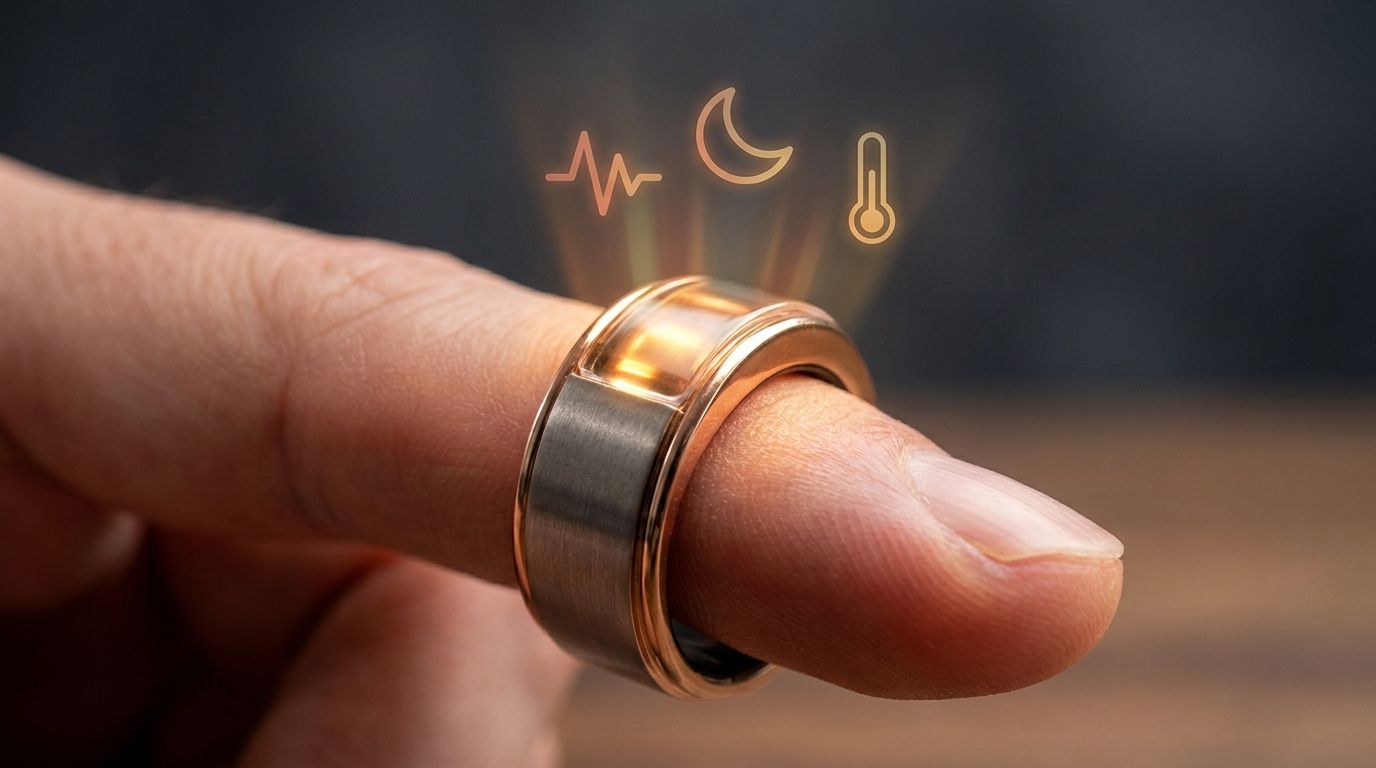
A few years ago, smart rings were a curiosity — a small category of expensive wellness gadgets for quantified-self enthusiasts willing to spend $300 on a piece of titanium that could detect their resting heart rate. Today, Oura counts millions of active subscribers, Samsung has entered the category with its Galaxy Ring, and nearly every major consumer electronics company is either shipping a ring or has one on its roadmap.
The wearable form factor that almost nobody took seriously has become one of the fastest-growing segments in consumer health technology. Here's why.
What Smart Rings Do That Smartwatches Can't
The most important thing about a ring is where it sits. The finger has exceptionally rich blood flow close to the skin surface, making it one of the best locations on the body for optical biosensors. Rings detect heart rate, heart rate variability (HRV), blood oxygen (SpO2), skin temperature, and respiration rate with accuracy that matches or exceeds wrist-worn devices — in some cases significantly better.
Sleep tracking is where the gap is most pronounced. A smartwatch, worn on the wrist, captures arm movement and heart rate during sleep. A ring on the finger captures more consistent optical sensor data, less affected by movement artifacts, with a sensor closer to arterial blood flow. Oura's sleep staging — classifying time in light, deep, and REM sleep — has been validated in multiple peer-reviewed studies as approaching clinical accuracy for healthy adults.
The form factor also means all-day wear is actually practical. A ring doesn't feel like wearing a device. There's no screen to glance at, no app notifications interrupting your day, no charging cable to remember every night. Oura's Gen 4 ring claims up to 8 days of battery life. Samsung's Galaxy Ring offers 6-7 days. Compare that to 18-24 hours for most smartwatches.
Oura: The Company That Built the Category
Oura has been making smart rings since 2015, and its third and fourth generation rings are what proved the category could scale. The Finnish startup counts professional sports teams, hospitals, and military units among its clients, and it has published more than 40 peer-reviewed studies using Oura data.
The Gen 4 ring, released in late 2024, added a new sensor array that enabled menstrual cycle tracking with period prediction — a feature that has driven significant growth among female users. The ring's Readiness Score — a composite metric combining sleep quality, HRV, body temperature, and activity — has become a cultural touchstone in wellness communities, shorthand for how recovered your body is before training.
Oura operates on a subscription model: the ring costs $299-$349, plus $6/month for the full app. The subscription layer has been controversial among users who feel the hardware cost should include the software, but it has given Oura a recurring revenue base and a financial incentive to keep improving the platform.
Samsung Enters, Changes the Economics
Samsung launched the Galaxy Ring in July 2024, and the move had immediate market implications. Unlike Oura, Samsung doesn't charge a subscription fee — ring functionality is included with the hardware. For Galaxy smartphone owners, it integrates with Samsung Health and syncs data across the ecosystem. The Galaxy Ring costs $399-$449 depending on size.
Samsung's entry signals that smart rings are no longer a niche play. When the world's largest smartphone manufacturer enters a hardware category, it typically accelerates both consumer adoption and competitive pressure. Apple, which has dominated the smartwatch market with Apple Watch, has multiple smart ring patents filed and faces obvious questions about whether it needs to respond.
Google acquired Fitbit in 2021 and has since integrated it deeply into its health platform. A Google ring — potentially leveraging Fitbit's sensor expertise and Google's AI health models — has been widely speculated but not confirmed. The category is crowded enough that even mid-tier players like Ultrahuman and RingConn have found audiences.
Health Data and Who Owns It
The growth of smart rings raises pointed questions about health data ownership and privacy. Oura's data represents a continuous stream of biometric information — heart rate 24 hours a day, body temperature every minute, sleep patterns every night. That data lives on Oura's servers, under Oura's terms of service, which have evolved over time.
When Oura partnered with the NBA, PGA Tour, and UFC to provide ring data to performance staff, it sparked debate about who actually controls athlete health information and how it might eventually be used for contract decisions. Similar concerns apply to employer wellness programs that offer Oura subscriptions as a benefit.
The regulatory environment is also unclear. Oura's ring is classified as a general wellness device, not a medical device — a distinction that matters for the accuracy claims the company can make and the regulatory oversight it faces. As rings add more clinical-adjacent features (atrial fibrillation detection, continuous glucose monitoring integrations), the regulatory line will eventually be crossed.
Where the Category Is Going
The next frontier for smart rings is continuous biomarker monitoring that goes beyond the current optical sensor suite. Non-invasive blood glucose estimation — the holy grail of wearable health tech that has eluded every major player for a decade — is actively being pursued by multiple ring manufacturers. Galvanic skin response (stress measurement), blood pressure estimation, and early illness detection from subtle biometric changes are all areas of active development.
Battery life improvements from more efficient processors and better energy harvesting could eventually push rings past two weeks between charges, removing one of the last practical barriers to truly continuous wear.
The wearable wars used to be about smartwatch features. They're increasingly about passive, continuous, frictionless health monitoring — and the ring, not the watch, is where that competition is most intense.