Solid-State Batteries Are Three Years Away — and Have Been for a Decade
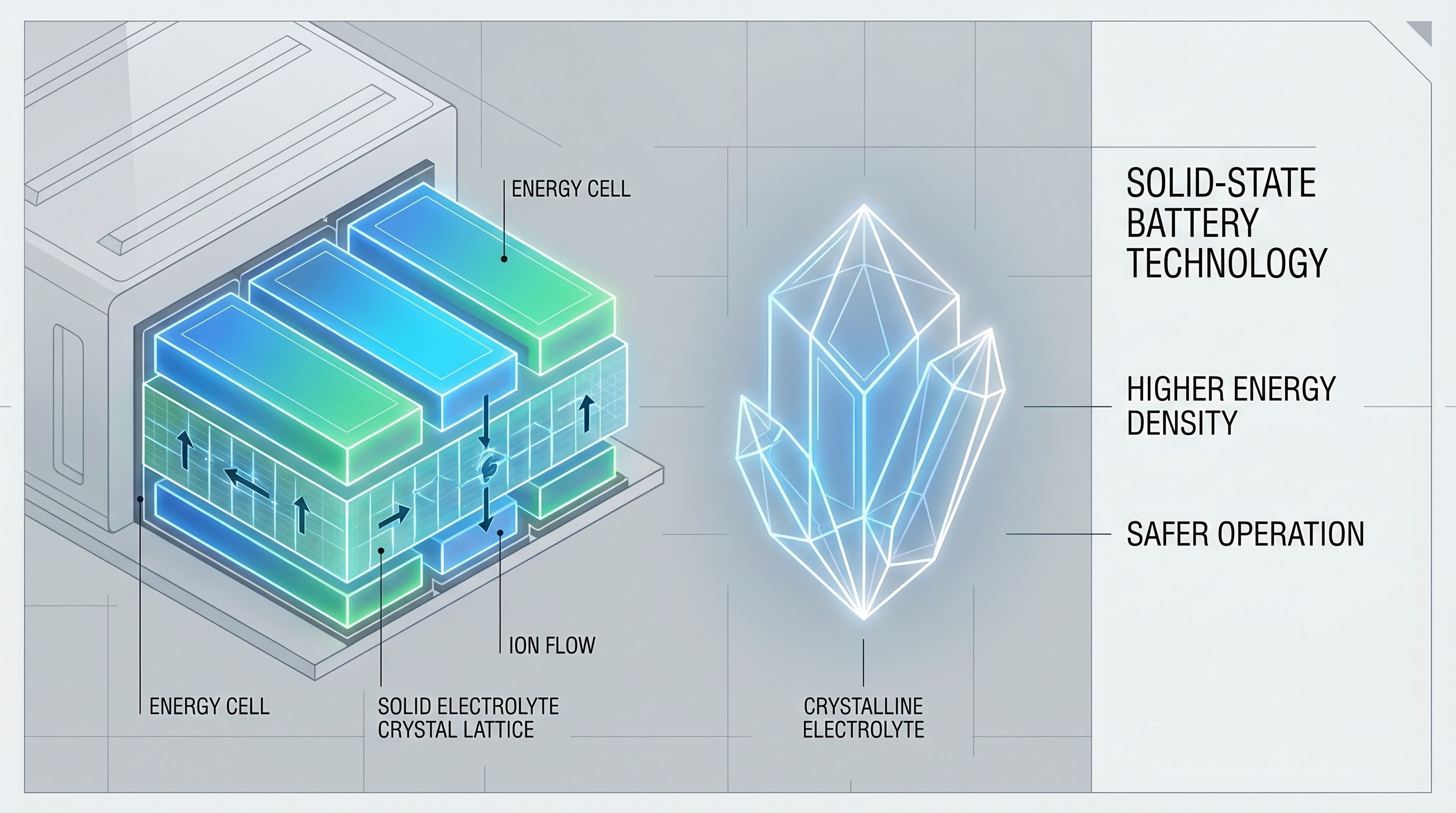
The joke in battery research circles is that solid-state EV batteries are always three years away. Toyota announced solid-state batteries for 2022, then 2025, then 2027-2028. QuantumScape went public via SPAC in 2020 with Bill Gates backing and a 2024-2025 production target. Solid Power has a partnership with BMW and Ford and has pushed its timelines multiple times. The gap between "we demonstrated this in a lab" and "we're building a million of these" is where the technology keeps stalling.
That said, the 2027-2028 window that Toyota, Samsung SDI, and QuantumScape are now targeting is the most credible version of these promises yet — because the technical problems have narrowed significantly.
What Solid-State Actually Means
Conventional lithium-ion batteries use a liquid electrolyte to carry ions between the anode and cathode. That liquid is flammable — it's why lithium-ion batteries catch fire when punctured or overcharged — and it degrades over time, limiting cycle life. It also limits how fast you can charge, because pushing ions through liquid too quickly causes lithium dendrites to form on the anode, which can eventually short-circuit the cell.
A solid-state battery replaces the liquid electrolyte with a solid material — typically a ceramic, glass, or polymer. The theoretical benefits are substantial: no flammable liquid means a safer cell; denser packing without liquid means higher energy density (potentially 400-500 Wh/kg vs. 250-300 Wh/kg for current lithium-ion); faster ion transport in some solid materials means faster charging; and slower degradation means longer cycle life.
Why Mass Production Keeps Slipping
The problem is manufacturing, not chemistry. The solid electrolyte layer needs to be extremely thin — typically 10-20 micrometers — and in perfect contact with both electrodes across the entire cell area. Any voids, cracks, or contamination in that interface creates resistance or shorts. Manufacturing at laboratory scale on small cells is achievable; manufacturing at automotive scale with consistent quality across billions of cell layers is a fundamentally different engineering problem.
Toyota's approach uses a sulfide-based solid electrolyte, which has good ionic conductivity but is moisture-sensitive — it reacts with water vapor and releases hydrogen sulfide gas, which means manufacturing must happen in dry room environments with humidity below 1% relative humidity. That's more extreme than current lithium-ion production environments and requires significant capital investment in manufacturing facilities.
QuantumScape uses a lithium-metal anode (replacing graphite), which offers higher energy density but requires extremely precise anode formation during charging. Its cells have demonstrated over 1,000 charge cycles in testing — a threshold that satisfies automotive longevity requirements — but the manufacturing process for the ceramic separator is still being scaled from its pilot line to automotive volumes.
Who's Closest and What They've Shown
Toyota has shown solid-state cells in test vehicles and claims 1,200 km range and 10-minute charging. It has signed agreements with Panasonic (via Prime Planet and Energy Solutions) to produce solid-state cells starting in 2027, with initial volumes going into a premium vehicle line before broader rollout. Samsung SDI has disclosed a solid-state cell with 900 Wh/L energy density — a number that would represent roughly a 40% improvement over its current best cells — with production targets of 2027 for EV applications. Solid Power is delivering cells to BMW's testing program and targeting commercial production in 2026-2027, initially for hybrid applications before full EV deployment.
What Happens If It Works This Time
A credible solid-state battery arriving in volume by 2028 would change the EV market's competitive dynamics significantly. Range anxiety — the factor that still causes consumers to choose ICE vehicles — largely disappears with 600-800 km real-world range. Charging time dropping below 15 minutes at high power removes the last major convenience objection. Battery pack size could shrink, reducing vehicle weight and opening new vehicle form factors.
The China dimension matters here: CATL and BYD are also developing solid-state batteries, with CATL targeting 2027 for limited production. If Chinese manufacturers reach mass production first and at lower cost — which they've done with liquid lithium-ion — the competitive implications for Western EV makers are significant.