Solid-state batteries keep arriving soon — here's where the technology actually stands in 2026
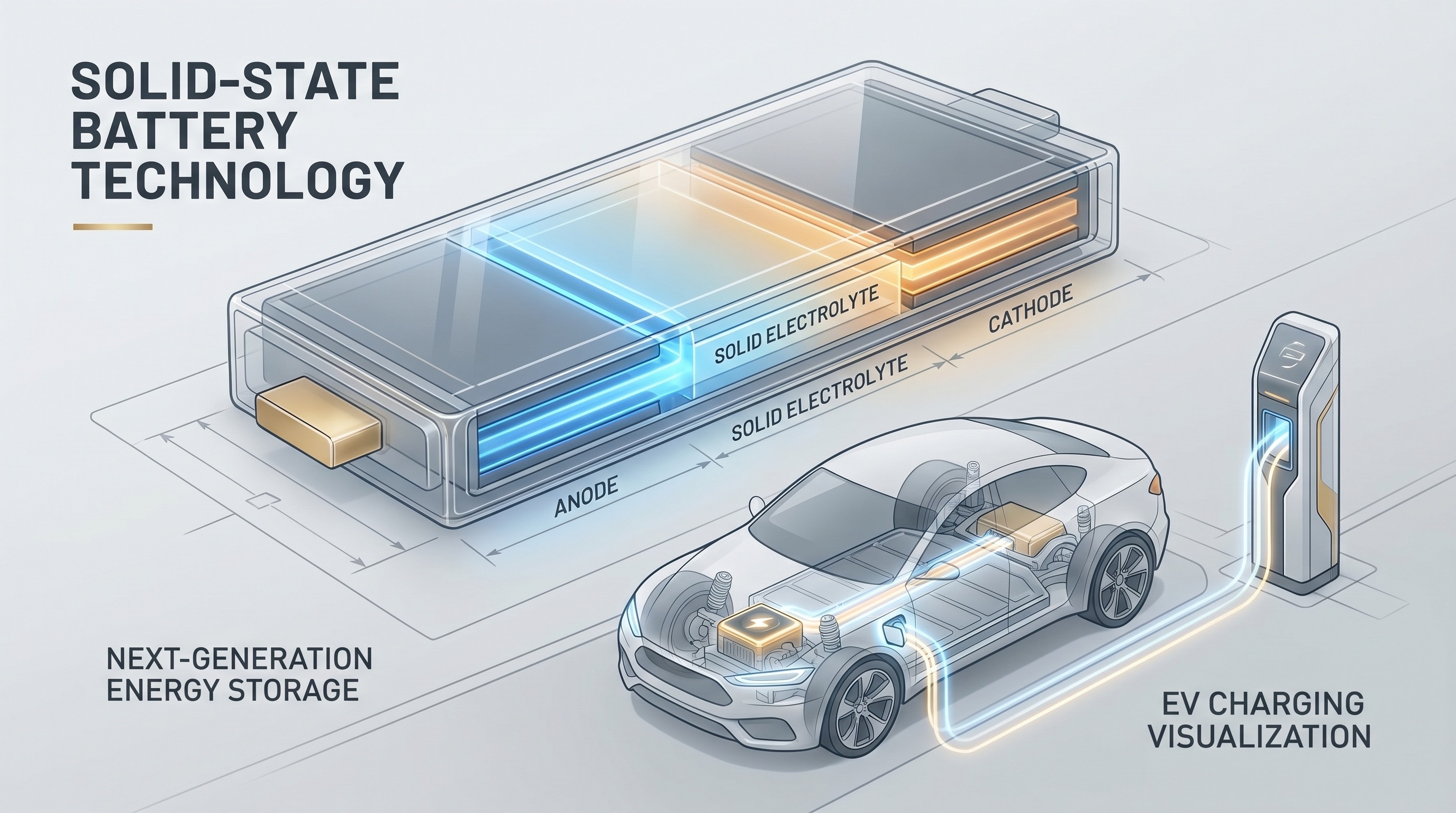
Solid-state batteries have been "three to five years away" for approximately fifteen years. The promise is compelling: replacing the liquid electrolyte in conventional lithium-ion batteries with a solid material eliminates the flammability risk, enables higher energy density, and potentially allows faster charging. For electric vehicles, this translates to longer range, shorter charge times, and better safety — the three dimensions where EVs still face consumer skepticism.
The persistent "coming soon" status reflects genuine engineering difficulty rather than vaporware. The fundamental physics of solid-state batteries work. Laboratory cells have demonstrated the promised advantages. The challenge is manufacturing them at automotive scale, with consistent quality, at a cost that makes vehicles competitive. In 2026, those challenges are closer to solved than at any previous point — but "closer to solved" and "solved" remain meaningfully different.
What makes solid-state different
In a conventional lithium-ion cell, lithium ions travel between the anode and cathode through a liquid electrolyte — a solution of lithium salt in an organic solvent. The liquid electrolyte is flammable, which is why EV battery packs require elaborate thermal management systems and why fires, though rare, are catastrophic when they occur. The liquid also reacts with lithium metal anodes, which limits how much energy you can store per unit of anode material.
A solid electrolyte — typically a ceramic, glass, or polymer material — addresses both problems. It's not flammable. And because it doesn't react with lithium metal the same way, it enables the use of lithium metal anodes instead of graphite, dramatically increasing energy density. A solid-state cell with a lithium metal anode can store 2-3 times more energy per kilogram than a conventional lithium-ion cell.
The tradeoff is at the interface. Where liquid electrolytes conform to electrode surfaces and maintain ionic contact through volume changes during charge/discharge cycles, solid electrolytes don't flex. Over thousands of cycles, the mechanical stress at the solid-solid interface creates microcracks, delamination, and degraded ionic contact. Managing this "interface problem" is the central engineering challenge of solid-state battery development.
Where the leading players stand
Toyota has been the most public about aggressive timelines, announcing plans for solid-state EVs in production vehicles by 2027-2028. The company has a significant patent portfolio in solid-state technology and has been developing what it describes as a "bipolar" solid-state cell design. Toyota's approach uses a sulfide-based solid electrolyte, which has good ionic conductivity but is sensitive to moisture — a manufacturing challenge. The company has acknowledged that achieving its timeline requires resolving manufacturing yield issues that are still ongoing.
QuantumScape, backed by Volkswagen, uses a ceramic (garnet-based) solid electrolyte and a lithium metal anode deposited directly during charging rather than pre-manufactured. The company has published data showing cells that maintain high capacity after thousands of cycles at automotive conditions — a genuine technical milestone. However, QuantumScape's cells are still single-layer laboratory cells; scaling to multi-layer cells suitable for automotive use while maintaining yield and cost targets remains the outstanding challenge. Commercial production is now targeted for late 2026 to 2027.
Solid Power, partnered with BMW and Ford, uses a sulfide electrolyte with a conventional manufacturing approach designed to be compatible with existing lithium-ion production equipment — reducing the capital investment required for automakers to adopt the technology. The company began producing automotive-format cells for pilot line testing in 2024, with vehicle integration testing underway with both BMW and Ford.
Samsung SDI and CATL, the world's largest battery manufacturers, are both developing solid-state cells internally, with announced timelines of 2027-2030 for commercial production. CATL has described its approach as "condensed battery" technology — a semi-solid cell that sits between conventional lithium-ion and full solid-state, potentially reaching production faster by accepting partial rather than complete electrolyte replacement.
The manufacturing problem
The interface problem that causes capacity fade in solid-state cells is manageable under laboratory conditions but harder to control at scale. Manufacturing uniformity — ensuring every cell in a large pack has the same interface characteristics — is critical because a few degraded cells limit the entire pack's performance. Achieving that uniformity at the rates required for automotive production (thousands of cells per day) requires manufacturing equipment and processes that don't yet exist at scale.
Sulfide electrolytes, which have the best ionic conductivity of the solid electrolyte options, react with moisture to produce toxic hydrogen sulfide gas — requiring dry room manufacturing environments more controlled than those used for current lithium-ion production. This adds capital cost and limits how quickly existing battery factories can be converted.
What this means for EV buyers
Solid-state batteries will not transform the EV market overnight. The first commercial applications will be in premium vehicles where the cost premium is more acceptable — Toyota has indicated its initial solid-state models will be performance-oriented. Mass-market adoption will follow as manufacturing costs decline through scale.
The more immediate impact for EV buyers in the 2026-2028 timeframe is likely to come from improvements to conventional lithium-ion technology — silicon anodes (already appearing in vehicles from Tesla, Panasonic, and others), higher-nickel cathodes, and improved thermal management — rather than full solid-state transition. These incremental improvements are delivering real gains in energy density and charging speed without the manufacturing complexity of solid-state.
Solid-state batteries will matter enormously when they arrive at scale. The honest assessment is that "at scale" is more likely 2028-2032 than 2026-2027 for most manufacturers — but the engineering progress is real, and the gap between "promising laboratory technology" and "manufacturable automotive product" is smaller than it has ever been.