Solid-state EV batteries are closer than ever — but 2026 still isn't the year they ship at scale
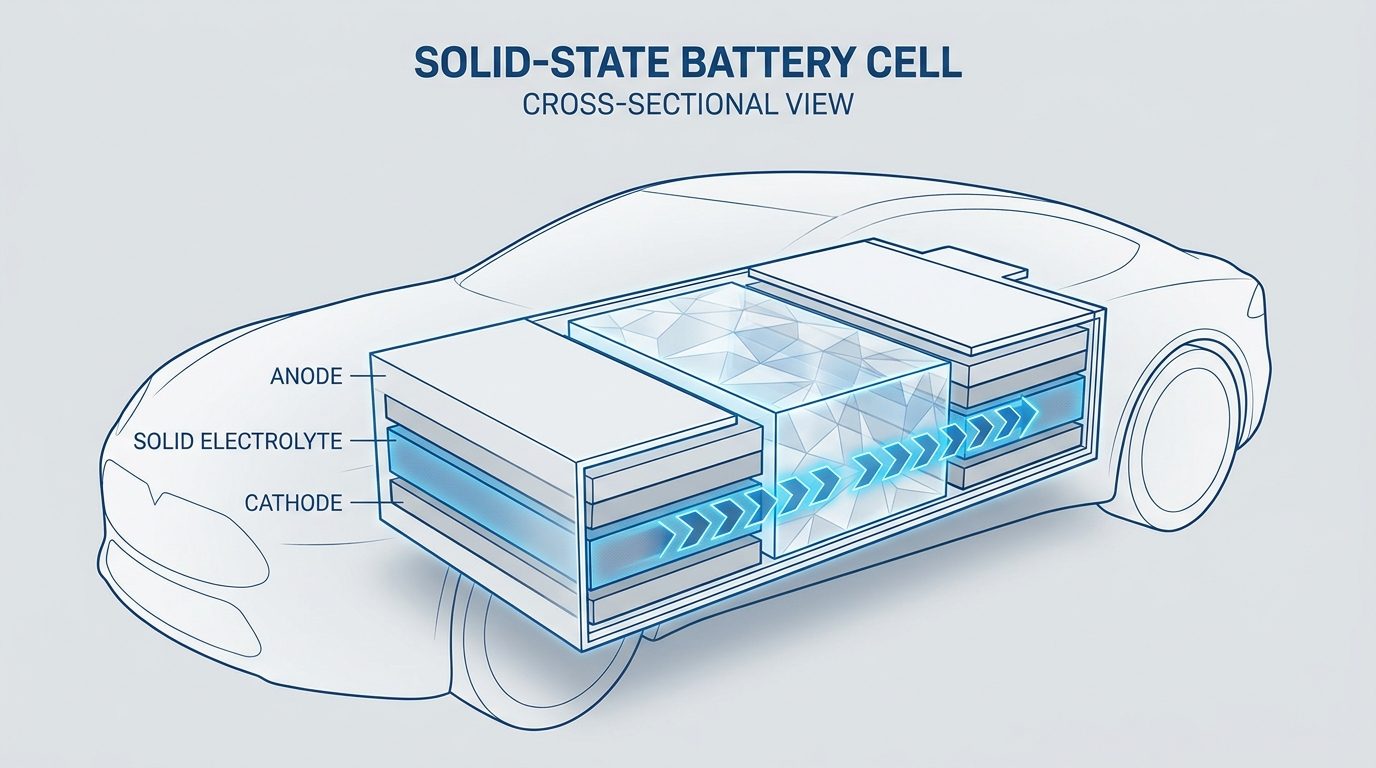
Solid-state batteries have been five years away for roughly fifteen years. The technology's core promise — double the energy density of lithium-ion, no flammable liquid electrolyte, faster charging, wider operating temperature range — has been repeated at auto shows and investor presentations so many times that skepticism is the appropriate default. That skepticism is now being slowly, unevenly earned back. In 2025 and into 2026, several companies moved from laboratory demonstrations to hardware that can be tested in real conditions. None have shipped at volume. The problems that remain are specific, tractable, and expensive — which is a different situation than the vague hand-waving that dominated the previous decade.
Why solid-state, and why it's hard
Today's lithium-ion cells — whether NMC or LFP chemistry — use a liquid electrolyte: a lithium salt dissolved in an organic solvent. That liquid is what allows lithium ions to move between anode and cathode during charge and discharge. It is also what burns. Organic solvents are flammable, and thermal runaway — the chain reaction where one cell's heat triggers adjacent cells — is the mechanism behind EV fire incidents. Battery management systems, separators, and pack design have made thermal runaway rare, but the underlying flammability risk is structural to the liquid electrolyte design.
Replacing the liquid with a solid electrolyte removes the flammability risk almost entirely. It also changes the energy density ceiling: solid electrolytes are more stable at high voltages, which enables cathode chemistries that can't be used with liquid electrolytes. More significantly, solid electrolytes can pair with a lithium metal anode — pure lithium rather than graphite — which stores roughly ten times more lithium per unit volume. The theoretical energy density of a lithium metal / solid electrolyte cell is around 500 Wh/kg, compared to 250–300 Wh/kg for current best-in-class lithium-ion. In practice, demonstrated cells in 2025–2026 are achieving 400–450 Wh/kg at the cell level, which is still a meaningful improvement.
The problem is that solid electrolytes, unlike liquids, cannot flow into gaps. Ionic conductivity across a solid-solid interface is orders of magnitude lower than across a liquid-solid interface. As the battery charges and discharges, the anode and cathode expand and contract — around 10% volume change for common cathode materials, and far more for lithium metal anodes. That mechanical stress cracks solid electrolyte layers, creating dead zones where ions can no longer cross. It also creates pathways where lithium dendrites — thin metallic filaments — grow through the electrolyte and cause short circuits.
The three unsolved problems
Solid-solid interface resistance. Ions move through liquid electrolytes with low resistance because the liquid conforms to electrode surfaces at the molecular level. In solid-state cells, the electrolyte and electrode are two rigid solids in contact. Surface roughness, grain boundaries, and chemical incompatibilities at the interface create resistance that reduces the effective C-rate — how fast the cell can charge or discharge. Current solid-state prototypes demonstrate respectable performance at 0.3–0.5C rates, but the 3C fast-charging that consumers expect from top-tier lithium-ion cells is not yet demonstrated at scale. Coating electrode particles with thin ionic conductor layers improves contact, but adds cost and manufacturing complexity.
Mechanical stress and cracking. During the charge/discharge cycle, electrode volume changes create stress that solid electrolytes cannot accommodate by flowing. Sulfide electrolytes — used by Toyota and Samsung SDI — are relatively soft and deformable under stack pressure, which helps. Oxide electrolytes — used by QuantumScape and others — are ceramic and brittle; they crack under cyclic stress unless the cell architecture specifically manages mechanical load. QuantumScape's thin-film approach is designed to address this: extremely thin electrolyte layers flex more than thick ceramic sheets. Results from BMW's testing partnership indicate that QuantumScape's cells are surviving meaningful cycle counts, but the company has been guarded about specific numbers at production-relevant electrode loading.
Manufacturing cost and dry room requirements. Sulfide electrolytes — the most ionically conductive class of solid electrolytes, with conductivities approaching or matching liquid electrolytes — react with atmospheric moisture to produce hydrogen sulfide gas. Manufacturing with sulfide electrolytes requires dry rooms with dew points below −40°C, more stringent than the −30°C dry rooms used for lithium-ion. Oxide electrolytes avoid the moisture sensitivity but require sintering at 1000–1400°C to achieve dense, conductive ceramics — energy-intensive and incompatible with organic binder materials used in conventional electrode coating. Neither path is cheap, and neither has been proven at gigawatt-hour scale.
Who's closest and what they've actually shown
Toyota is the most credible near-term contender, and also the most aggressive in its claims. The company has been developing sulfide-based solid-state cells for over a decade and announced in 2023 a target of small production runs for vehicles by 2027–2028, revised to 2026–2027 by some internal communications. Toyota's claimed specifications — 1,200 km range on a single charge, 10-minute charging — would require roughly 450 Wh/kg at the pack level, which is plausible for a lithium metal cell. What Toyota has demonstrated publicly is cells that perform well in limited cycle testing; what they have not demonstrated is a production process that can make these cells at volume with acceptable yield rates. The 2026–2027 timeline refers to a small production run of premium vehicles — think hundreds or low thousands of units — not mainstream production.
QuantumScape uses a thin-film oxide electrolyte approach and has a multi-year partnership with BMW. The company went public via SPAC in 2020, and its stock has had a turbulent few years as production timelines slipped. In 2024 and 2025, QuantumScape demonstrated cells surviving over 1,000 cycles with less than 20% capacity loss — meaningful progress on cycle life, which was an early criticism. The remaining challenge is manufacturing: QuantumScape's process for depositing their proprietary ceramic electrolyte layer is not yet transferable to high-volume production equipment. The company's "QS-0" pilot production line is operating, but throughput remains far below what would be needed for automotive volumes. QuantumScape's cells use a lithium metal anode that is deposited in-situ during first charge rather than pre-fabricated — an elegant solution to the lithium metal handling problem that may or may not translate cleanly to mass manufacturing.
Samsung SDI has published credible research on sulfide solid-state cells and announced a 2027 pilot production target. Their demonstrated cells have shown strong performance at low C-rates and reasonable cycle life in controlled conditions. Samsung SDI's advantage is manufacturing experience: the company already operates large-scale lithium-ion production and understands the process engineering challenges. Their disadvantage is that being second or third to market in a capital-intensive industry is genuinely difficult.
CATL, the world's largest lithium-ion manufacturer, is taking a different near-term approach with its "condensed battery" — a semi-solid electrolyte that is not fully solid-state but uses a high-viscosity gel rather than liquid. CATL announced 500 Wh/kg condensed batteries in 2023 and has suggested production for aviation applications. This is a real product, not a laboratory demonstration, but it is not solid-state in the strict sense and does not fully eliminate flammability concerns. CATL is also developing true solid-state cells but has been more measured than Toyota in its public timelines.
The near-term alternative: silicon-carbon anodes
While solid-state cells are still in the pilot phase, a simpler improvement is already shipping. Silicon-carbon composite anodes can replace graphite in conventional lithium-ion cells, increasing anode energy density by 20–30% because silicon stores roughly ten times more lithium than graphite by weight. The challenge is that silicon expands 300% during lithiation and cracks over cycles; the carbon composite matrix and nanostructuring techniques manage this degradation.
Silicon-carbon anodes are already in high-end smartphones — the iPhone 15 and Samsung Galaxy S24 series use cells with silicon content. Automotive-grade silicon-carbon cells are now shipping in premium EVs and will be more widespread by 2027. A silicon-carbon anode upgrade to NMC chemistry is not as dramatic as solid-state, but it is manufacturable today at scale, improves energy density meaningfully, and requires no change to the liquid electrolyte or manufacturing infrastructure. For most consumers, this improvement will arrive years before solid-state.
Realistic consumer timeline
2026–2027: Small production runs of premium vehicles with solid-state packs — likely Toyota and possibly a BMW / QuantumScape collaboration. These will be expensive, low-volume, and treated as technology demonstrators as much as consumer products. Range and charging claims should be treated as laboratory results until independent testing confirms real-world performance.
2028–2030: Volume production is possible if manufacturing challenges are solved. "Volume" here means tens of thousands of vehicles, not millions. Pricing will remain a significant premium over lithium-ion for several years after production starts, because the manufacturing cost penalty is structural, not merely a learning-curve issue.
Mass-market pricing parity: Unknown. The structural manufacturing costs — dry rooms, high-temperature sintering, low-yield deposition processes — are not the kind of problems that disappear with scale alone. They require fundamental process innovations. Some of those innovations may happen on a 5–10 year horizon; some may require completely different electrolyte materials than are currently being developed.
What buyers should actually do today
Do not wait for solid-state batteries to buy an EV. Current lithium-ion packs — especially LFP chemistry for its cycle life and thermal stability, or NMC for energy density — are mature, well-understood technology. Real-world range from modern EVs covers the needs of the overwhelming majority of drivers. Charging infrastructure, while still uneven, is substantially better than it was three years ago.
If you buy an EV in 2026, the pack will likely last the useful life of the vehicle. The silicon-carbon anode improvements arriving in 2027–2028 model years will offer meaningfully better range within the existing lithium-ion paradigm. Solid-state will eventually arrive and will make EVs better — faster charging, longer range, more durable packs. But "eventually" is doing real work in that sentence, and the consumers who waited for solid-state in 2019, 2021, and 2023 are still waiting.
The technology is genuinely progressing. The timeline is genuinely uncertain. Both of those things are true simultaneously, and anyone telling you otherwise — in either direction — is selling something.