Stablecoins Are Growing Up: USDC, Tether, and the Push for Real Regulatory Clarity
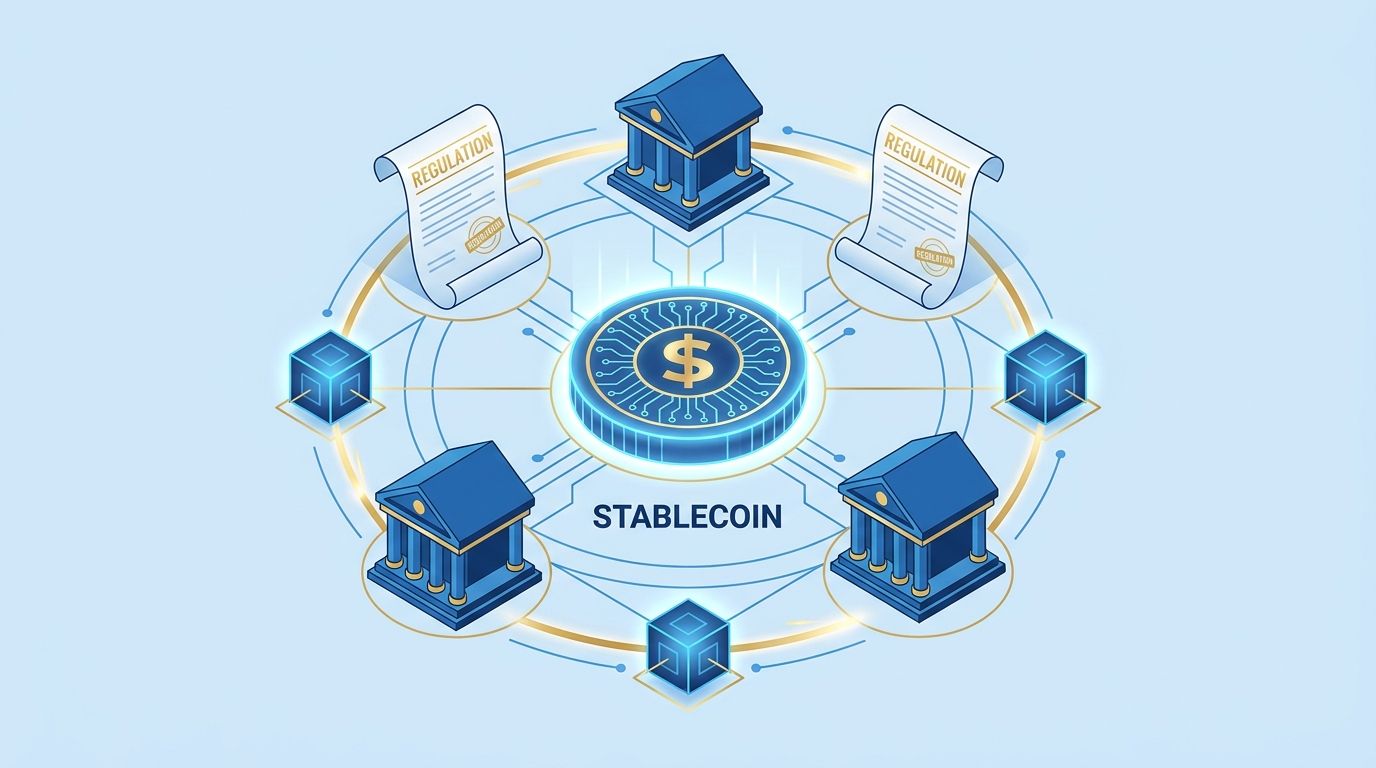
Stablecoins have processed over $27 trillion in transaction volume in the past 12 months — more than Visa. They are the settlement layer for most crypto trading, the primary vehicle for cross-border remittances in dollarized emerging markets, and increasingly the payment mechanism of choice for DeFi protocols moving tens of billions in liquidity daily. Yet until 2025, the legal status of a stablecoin issuer in the United States was genuinely unclear.
That is changing. The GENIUS Act (Guiding and Establishing National Innovation for US Stablecoins), signed into law in early 2026, created the first federal framework specifically for payment stablecoins. Europe's Markets in Crypto-Assets regulation (MiCA) came into full effect at the end of 2024. Between them, the two largest Western financial markets now have actual rules — not guidance, not enforcement actions, not congressional letters, but law.
What the GENIUS Act Actually Does
The GENIUS Act establishes two paths for stablecoin issuers: federal licensure under the Office of the Comptroller of the Currency (OCC), or state-level licensure under a framework that meets federal minimum standards. It requires 1:1 backing by high-quality liquid assets — US dollar deposits, short-term Treasury bills, or central bank reserves — and bans the use of customer stablecoin backing for lending, investments, or anything other than the reserves themselves.
This last provision directly targets the model that Terra/LUNA used before its $40 billion collapse in 2022: algorithmic stablecoins that maintained their peg through protocol mechanics rather than real asset backing. Under the GENIUS Act, those are simply illegal for licensed payment stablecoins.
Monthly attestation by a registered public accounting firm is required for issuers above $50 billion in circulation. Circle, the issuer of USDC, has already been publishing monthly attestations voluntarily since 2021 — the law essentially codifies the practice Circle had already adopted as competitive differentiation from Tether.
Tether's Complicated Position
Tether (USDT) remains the largest stablecoin by circulation at roughly $145 billion as of mid-2026, approximately double USDC's $72 billion. But Tether's position is legally precarious in the post-GENIUS Act environment. Tether is incorporated in the British Virgin Islands, issues from an entity headquartered in El Salvador, and has historically provided only quarterly attestations (not audits) from a small BVI-based accounting firm.
The GENIUS Act requires that foreign-issued stablecoins must comply with comparable regulations in their home jurisdictions to be distributed to US residents or used in US financial markets. Whether El Salvador's regulatory framework qualifies as "comparable" is a question the OCC will answer with rulemaking. The most likely outcome: Tether creates a separately capitalized US-licensed subsidiary — Tether USD (US), essentially — backed with full audits and Treasury-only reserves, operating alongside the offshore USDT for international markets.
This bifurcation model is already emerging. Several large exchanges have quietly begun distinguishing between "compliant" and "non-compliant" stablecoins in their onboarding flows, routing new US retail accounts toward USDC by default. The market share shift has been gradual but consistent.
Europe's MiCA and the Euro Stablecoin Gap
MiCA created two categories of stablecoins: Asset-Referenced Tokens (ARTs), which are pegged to a basket of assets, and Electronic Money Tokens (EMTs), which are pegged to a single fiat currency. EMTs are regulated as electronic money institutions — issuers need a license from a national EU financial regulator, must hold reserves in segregated accounts at EU credit institutions, and face transaction volume limits if they exceed certain systemically significant thresholds.
The significant-token threshold — 10 million users or €5 billion in outstanding value — triggers direct European Banking Authority oversight instead of national regulators. USDC's EU volume cleared the threshold in mid-2025, making Circle one of the first non-bank financial entities subject to EBA prudential oversight.
What MiCA has revealed is a structural gap: there are almost no euro-denominated stablecoins with meaningful liquidity. The EU market has been running on dollar-denominated stablecoins because the euro equivalent — Circle's EURC, Societe Generale's EUR CoinVertible (EURCV) — have never achieved the network effects of USDC or USDT. Regulatory clarity has not yet fixed the euro liquidity problem, but it has at least made the market for euro stablecoins predictable enough for serious issuers to commit capital.
What Banks Are Actually Doing
The most significant structural shift underway is bank-issued stablecoins. JPMorgan's JPM Coin processed over $1 billion in institutional transactions daily as of Q1 2026 — though it operates as a private permissioned network for JPMorgan clients, not a public blockchain token. The GENIUS Act's framework is clear enough that at least three major US banks — JPMorgan, Bank of America, and Wells Fargo — are evaluating publicly available stablecoin products for retail distribution.
The competitive calculus is uncomfortable for traditional card networks. A bank-issued stablecoin that settles in real time, costs 0.1% to transact, and requires no interchange fee is a direct competitive threat to Visa and Mastercard's 1.5–3.5% merchant discount rates. Both card networks have responded by building stablecoin settlement infrastructure — Visa settling USDC on Solana since 2023, Mastercard running a multi-token network that accepts various stablecoin types — essentially trying to be the on/off ramp rather than be disintermediated entirely.
The Yield Question
One provision of the GENIUS Act drew less attention but may have significant long-term consequences: licensed payment stablecoins cannot pay yield to holders. The backing assets earn interest (Treasury bills currently yield around 4.5%), but that interest stays with the issuer, not the stablecoin holder.
This creates an uncomfortable competitive dynamic with money market funds, which do pass yield through to investors. Circle earns approximately $3.2 billion annually from its USDC reserve portfolio. Tether earned approximately $6.2 billion in 2025 from its reserve assets. The "yield for issuer, no yield for holder" model is profitable for issuers and arguably fair given the infrastructure they provide — but it means stablecoins remain economically inferior to money market funds for pure savings, and superior only for transactional use cases.
The workaround being explored: yield-bearing stablecoins structured as securities rather than payment stablecoins, which would fall outside the GENIUS Act's scope. Mountain Protocol's USDM and Ondo Finance's USDY are already doing this at smaller scale. The line between a yield-bearing stablecoin and a tokenized money market fund is thin and will be tested in regulatory proceedings over the next two years.
The broader picture is that stablecoins in 2026 are no longer a fringe crypto experiment. They're a payment infrastructure layer with real regulatory oversight, institutional backing, and enough volume to be taken seriously by the same regulators who spent years trying to shut them down. The rules are imperfect and incomplete — but they exist, and that alone changes the competitive and operational calculus for every participant in the space.