How Starlink's Direct-to-Cell Service Is Quietly Rewriting the Rules of Rural Connectivity
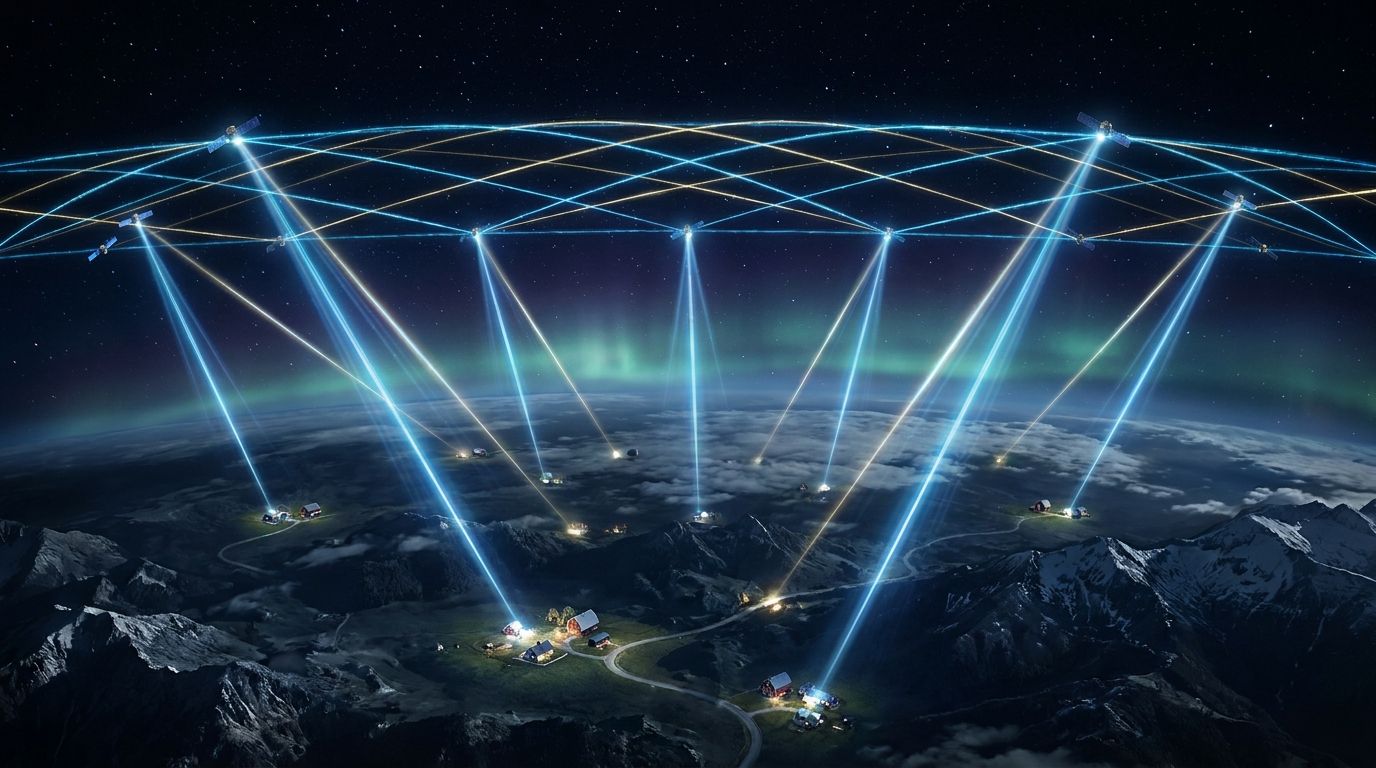
On July 23, 2025, T-Mobile flipped the switch on T-Satellite, the commercial face of SpaceX's Starlink Direct-to-Cell service. No press spectacle, no product launch event — just a firmware update, and suddenly your phone could connect to a network of satellites 550 kilometres above your head when the nearest cell tower was nowhere in sight.
Eighteen months of industry hype had made it easy to be sceptical. Satellite internet had always meant either a bulky dish, expensive hardware, or the cramped low-speed emergency features Apple introduced with iPhone 14's Emergency SOS. What Starlink Direct-to-Cell actually delivered was something different: a service that worked on the phone already in your pocket, on LTE-compatible handsets from the last four years, with no special configuration.
What it can do now, and what it cannot
The current service handles SMS messaging, image messaging, location sharing, and a curated set of apps: WhatsApp (including voice and video calls), Google Maps, AllTrails, AccuWeather, and X. Emergency 911 texting is available to anyone with a compatible handset, even without a T-Mobile subscription. Activation is automatic — when your phone drops terrestrial coverage, it connects to the satellite network and displays a small satellite icon in the status bar.
Data speeds in the current generation run around 2–4 Mbps per user. Sufficient for messaging, maps, and email, but not for streaming. Native voice calls outside WhatsApp are still in beta, with a broader rollout expected later in 2026. The next hardware generation — SpaceX's V3 satellites, planned for launch on Starship in mid-2027 — targets 150 Mbps peak download and full 5G compatibility.
Pricing is $10 per month added to most T-Mobile plans, or included in the premium "Experience Beyond" tier. Non-T-Mobile customers can subscribe independently at the same price through T-Mobile stores. An exclusivity window means other US carriers must wait until July 2026 before Starlink can partner with them directly — though by then, they may have their own satellite answer in the form of AST SpaceMobile.
The competition is real
AST SpaceMobile is the most technically interesting rival. Where Starlink's Direct-to-Cell satellites are relatively small, AST's BlueBird satellites carry phased-array antennas spanning roughly 2,400 square feet — enormous by satellite standards — capable of peak speeds up to 120 Mbps to unmodified 4G and 5G phones. AT&T and Verizon are both invested, both contracted, and both watching AST's constellation build-out closely.
The build-out has had setbacks. BlueBird 7 was lost in April 2026, setting back the timeline for continuous US coverage. A replacement launch of three Block 2 BlueBirds is scheduled for mid-June. The target is intermittent US coverage in early 2026 transitioning to continuous coverage across the US, Europe, and Japan by late 2026. If it lands on schedule, T-Mobile's early mover advantage will face a serious test.
Amazon, following its acquisition of Globalstar in April 2026, is also manoeuvring into direct-to-device territory, though no launch date has been announced. Apple's Emergency SOS via Satellite (Globalstar-backed, iPhone 14 and later) remains positioned as a safety feature rather than a connectivity service, though it has quietly expanded to include offline maps and photo messaging.
The coverage reality
As of January 2026, Starlink had more than 650 Direct-to-Cell satellites in orbit — making its network the largest 4G coverage footprint on Earth by area, if not by user density. The FCC has approved an expansion to 15,000 Gen2 satellites. Coverage is effectively global anywhere with an unobstructed view of the sky.
That coverage, however, is being used differently than T-Mobile initially projected. Demand has concentrated around specific outdoor activities — hiking, mountaineering, backcountry travel — rather than continuous daily use. The safety use case appears to dominate over the convenience use case for now. The free 911 texting available to all compatible phones, regardless of carrier subscription, may turn out to be the most impactful single feature the service offers.
What changes for rural communities
The long-term implications extend well beyond hikers. Rural telehealth, which has spent two decades constrained by connectivity gaps, now has a safety net that requires no infrastructure investment at the local level. Remote workers who could not viably leave urban centres over connectivity concerns have a floor beneath them that did not exist two years ago. Rural students with spotty or no home internet access have something to work with when they need it most.
None of this replaces terrestrial broadband, and the 2–4 Mbps current ceiling makes that clear. But the gap between "no signal" and "basic connectivity" is where the most meaningful quality-of-life improvements live. By that measure, the quiet arrival of Direct-to-Cell has already moved the needle in ways that a decade of rural broadband policy debate has not.
The next leap — full 5G at meaningful speeds via the V3 constellation — is still a couple of years away. The race between Starlink and AST SpaceMobile for who gets there first, and which carriers carry whose service, is the connectivity infrastructure story of the decade.