Submarine Cables Carry 99% of the World's Internet Traffic — and They Keep Getting Cut
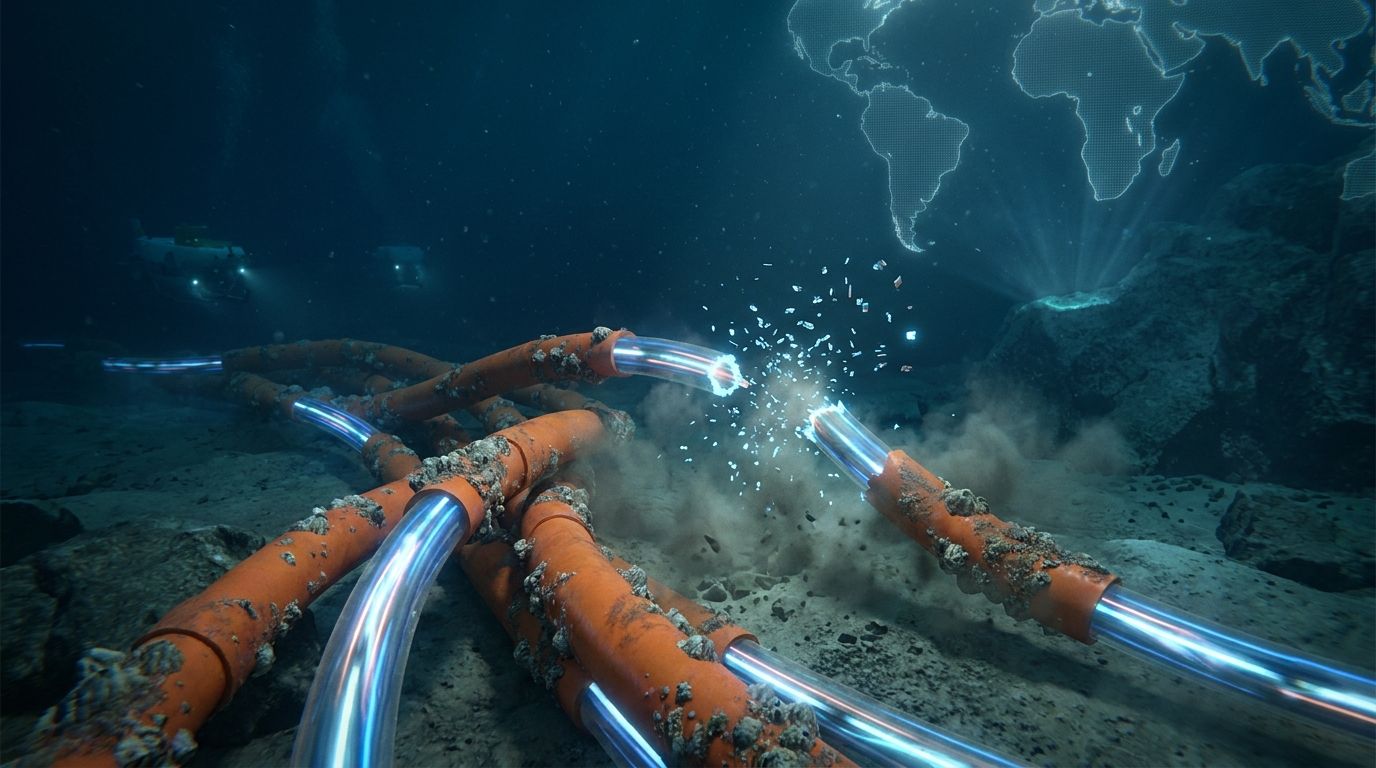
When you send an email from London to New York, it almost certainly travels as pulses of light through a glass fiber thinner than a human hair, inside a cable resting on the Atlantic seabed, at depths of up to 7,000 meters. The satellites we imagine routing international internet traffic handle perhaps 1% of it. The rest — streaming video, financial transactions, intelligence communications, social media, cloud backups — travels through submarine cables that most people have never thought about.
There are currently around 550 active or under-construction submarine cable systems worldwide, totaling over 1.4 million kilometers of fiber. The total capacity of this network has grown dramatically — modern cables like the 2Africa system (which encircles the African continent and connects Europe, Asia, and East Africa) can carry up to 180 terabits per second. The technology has advanced from single-fiber coaxial cables in the 1950s to wavelength-division multiplexing systems that carry hundreds of independent light channels simultaneously on a single fiber strand.
How Modern Submarine Cables Work
A submarine cable system is more complex than the familiar image of a cable on the seafloor. The cable itself has multiple layers: the fiber strands at the center, surrounded by protective layers of steel wire and polyethylene, with waterproofing throughout. In shallow coastal areas (where most damage occurs), cables are buried under the seabed using remotely operated plow vehicles. In deep water, they rest on the ocean floor with only gravity anchoring them.
The signal degrades over distance because light scatters and absorbs in glass fiber. Repeaters — small electronic amplifiers spaced every 60–100 kilometers along the cable route — regenerate the signal to compensate. A transoceanic cable will have dozens to hundreds of repeaters, each requiring power delivered through the cable itself via a continuous DC current running alongside the fiber. Branching units allow a single cable to connect to multiple landing stations, avoiding the need for separate cables to every destination point.
Cable landing stations on shore receive the fiber and convert between submarine and terrestrial transmission formats. These stations are critical infrastructure choke points — the physical points where submarine capacity connects to national internet backbones. They are typically fenced facilities with significant physical security, backup power, and in some cases military protection.
The Red Sea Incidents
In February 2024, three major submarine cables in the Red Sea — AAE-1, EIG, and Seacom — were damaged within a short period. The cables, which carry significant traffic between Europe, the Middle East, and Asia via the Suez Canal route, suffered cuts that disrupted internet connectivity across multiple countries. Yemen-based Houthi forces were accused of deliberately targeting the cables, though this was not conclusively proven.
The damage took weeks to fully repair. Submarine cable repair vessels — there are approximately 60 in service globally, operated by a handful of specialized companies — must locate the fault precisely using time-domain reflectometry, navigate to the site, recover the cable from the seabed using grappling hooks, splice in a replacement section, and lower it back. Each repair can take 1–3 weeks depending on depth, sea conditions, and the complexity of the damage. In conflict zones or politically sensitive waters, ships may be unable to reach the site at all.
The Red Sea incidents were particularly significant because the route carries an estimated 17% of global internet traffic. The damage forced operators to reroute traffic through alternative paths — the Cape of Good Hope route around Africa, the northern terrestrial routes through Russia and Central Asia — at the cost of increased latency and congestion. Redundant routing absorbed much of the capacity, but peak-hour performance degraded noticeably for users across Africa and South Asia for weeks.
The Baltic Sea Pattern
A different pattern has emerged in the Baltic Sea. Between late 2023 and 2025, multiple submarine cables in the Baltic were damaged under suspicious circumstances. The cables connecting Finland, Estonia, Germany, and Sweden were severed on multiple occasions, with investigations pointing to ships dragging anchors — deliberately or otherwise — across cable routes.
The pattern was unusual enough that NATO established an enhanced submarine infrastructure protection mission in the Baltic in early 2024, involving surface ships and undersea detection systems. Several cargo vessels, including Chinese-owned ships transiting Baltic waters, came under suspicion in connection with specific cable incidents. The European Union has described the incidents as part of a pattern of deliberate hybrid warfare against critical infrastructure.
Determining intent in cable damage incidents is genuinely difficult. Anchor dragging is the most common cause of submarine cable damage globally — fishing vessels and commercial ships accidentally drag anchors across cable routes thousands of times per year. The Baltic incidents were concentrated in a way that the random-accident model doesn't fully explain, but proving deliberate intent to a legal standard requires forensic evidence that is hard to obtain for events on the ocean floor.
The Concentration Problem
The resilience of the submarine cable network depends on geographic and routing diversity. Most cables follow a small number of routes — the North Atlantic corridor, the Mediterranean-Red Sea route to Asia, the Pacific cable corridors — because those routes follow population centers and minimize landing station costs. This creates concentration risks: damage to cables in a high-traffic corridor affects more traffic than damage in a lower-traffic area.
The situation is improving. The 2Africa cable, Amazon's Project Kuiper cable investments, and Meta and Google's private cable programs (both companies now own significant cable capacity outright rather than purchasing bandwidth from cable consortia) are adding new routes and new capacity that increases diversity. Google's Firmina cable from the US to Argentina, Brazil, and Uruguay is one example; Microsoft's investment in the Marea cable across the Atlantic is another. Hyperscaler-owned cables now represent a significant and growing fraction of transoceanic capacity.
Satellites as Partial Backup
Low-earth orbit satellite constellations — primarily Starlink, but also OneWeb, Amazon Kuiper, and others — are sometimes cited as alternatives to submarine cables that would provide resilience against cable cuts. The reality is more limited. The total capacity of even a full LEO constellation is significantly smaller than a single modern submarine cable, and the cost per bit is currently higher.
Satellites are valuable as diversity — adding a path that doesn't share physical infrastructure with submarine cables. For remote regions without cable access and for continuity in crisis scenarios, LEO connectivity has proven its value. But satellite systems aren't a substitute for submarine cable capacity at the scale the modern internet requires. The data demands of streaming 4K video, cloud synchronization, and enterprise connectivity to billions of users require capacity measured in terabits per second, and no satellite system in service or planned comes close to that.
The submarine cable network is the world's internet infrastructure — not a backup system, not an alternative to something else, but the actual foundation. Its vulnerability to physical damage, whether accidental or deliberate, is a genuine concern that military planners, infrastructure operators, and policymakers are taking increasingly seriously. The relevant question is not whether the internet can survive a single cable cut — it almost always can, through rerouting — but how much stress the system can absorb simultaneously before redundancy runs out.