TCP Was Too Broken to Fix, So the Internet Built a New Protocol on Top of UDP
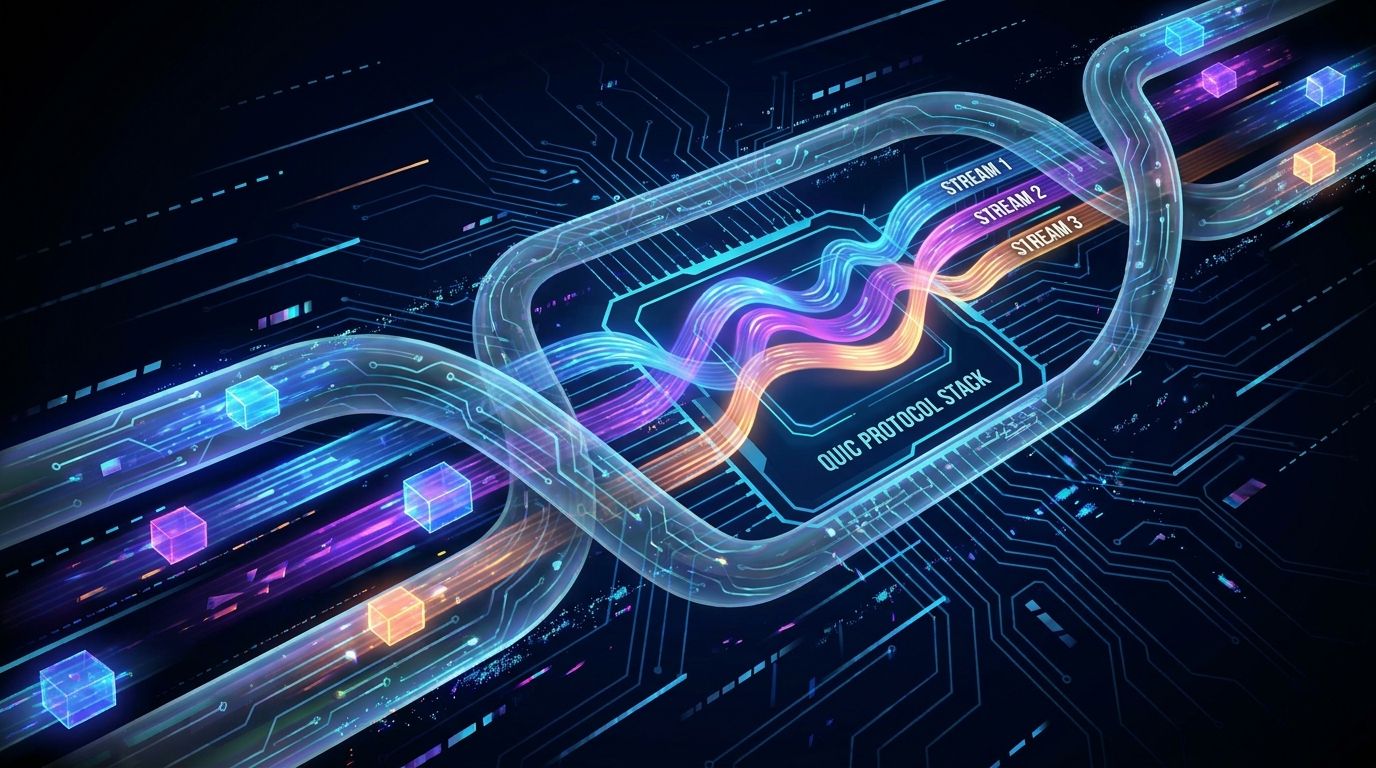
TCP has been the transport layer of the internet since 1974. Every web page you load, every API request your app makes, every email you send — for fifty years, almost all of it has traveled over TCP. The protocol is reliable, battle-tested, and deployed on every networked device on earth. It's also increasingly a bottleneck for the way the modern web actually works, and fixing it turned out to be politically impossible. So the industry built something new on top of UDP instead.
That something new is QUIC, standardized by the IETF in 2021 as RFC 9000. HTTP/3, the latest version of the protocol that powers the web, runs on QUIC. Cloudflare has served HTTP/3 to over 40% of its traffic. Google has deployed QUIC across its own services since 2013. The protocol that was supposed to be an experiment is now carrying a substantial slice of the internet.
What Was Wrong With TCP
TCP's fundamental design was built for a world of fixed, reliable wired connections. The protocol assumes that if a packet is lost, the network is congested, and it should slow down. This was reasonable in 1974. In 2026, with mobile users constantly switching between Wi-Fi and cellular, packets get dropped for reasons that have nothing to do with congestion — signal interference, handoffs between towers, brief coverage gaps. TCP can't distinguish between "the network is congested" and "the user just walked into an elevator," and it slows down in both cases.
The bigger structural problem is head-of-line blocking. A single TCP connection is an ordered stream of data. If packet 7 is lost, packets 8 through 100 all sit waiting even if they arrived fine. HTTP/2 addressed one version of this problem by multiplexing multiple requests over a single TCP connection — but this actually made head-of-line blocking worse at the TCP layer, not better. A single lost packet can now stall all of the multiplexed streams on the connection simultaneously.
There was also the connection establishment overhead. TCP requires a three-way handshake before data can flow. TLS adds another 1-2 round trips for cryptographic negotiation. Loading a resource from a new server requires 2-3 full round trips before the first byte of content arrives. For a user in Tokyo connecting to a server in Virginia, each round trip takes roughly 170 milliseconds. Multiply that by the number of distinct servers a modern web page talks to, and the latency overhead is significant.
Why They Built It on UDP
The logical question is: why not fix TCP? The answer is that TCP is implemented in every operating system kernel, every router, every firewall, every load balancer, and every middlebox on the internet. Changing the TCP behavior would require updates to billions of devices. Some of those devices are decades old and will never be updated. Network middleboxes — the appliances that inspect, route, and filter traffic — assume TCP behavior and break in unpredictable ways when TCP is modified. The IETF tried several TCP extensions over the years and found that they were simply blocked or stripped by middleboxes in the field.
UDP, by contrast, is essentially a blank canvas. It's a fire-and-forget protocol with no inherent connection state, ordering, or reliability. Middleboxes don't fiddle with UDP the way they do TCP because there's nothing to fiddle with. Building QUIC on UDP means QUIC can implement its own connection management, reliability, ordering, and congestion control in user space — where it can be updated without kernel changes — while still passing through the existing internet infrastructure unchanged.
What QUIC Actually Changes
The most immediately noticeable improvement is connection establishment time. QUIC combines the transport handshake and the TLS 1.3 cryptographic handshake in a single round trip. For a first connection to a server, QUIC requires one round trip before data can flow, versus two or three for TCP+TLS. For a returning user who has connected to the server before, QUIC supports 0-RTT resumption — the client can send application data in the very first packet, with zero round trips. The performance improvement is most pronounced on mobile networks where latency is high.
Connection migration solves the mobile handoff problem directly. A QUIC connection is identified by a connection ID chosen by the endpoint, not by the 4-tuple (source IP, source port, destination IP, destination port) that identifies a TCP connection. When a phone moves from Wi-Fi to cellular and gets a new IP address, its TCP connections all break and need to be re-established. QUIC connections survive the IP change — the client announces its new address and the connection continues without interruption.
Multiplexed streams without head-of-line blocking is the structural fix HTTP/2 needed but couldn't achieve over TCP. QUIC implements multiple independent streams within a connection; a lost packet for stream A doesn't block streams B, C, and D. Each stream has its own ordering guarantee, so loss on one stream only stalls that stream.
The Deployment Reality
Adoption has been faster than most protocol transitions in internet history, which is still "measured in years." Google deployed QUIC in Chrome in 2015, initially just for Google's own services. The IETF standardized QUIC and HTTP/3 in 2021. By 2023, W3Techs data showed HTTP/3 supported on roughly 30% of websites. Cloudflare reports that QUIC carries roughly 35-40% of its traffic, and that fraction has grown steadily year over year.
Server-side adoption is strong among major CDNs (Cloudflare, Fastly, Akamai) and cloud providers (AWS CloudFront, Google Cloud). Most modern web frameworks and load balancers support HTTP/3. The client side is covered: Chrome, Firefox, Safari, and Edge all support HTTP/3 by default, as do mobile browsers.
Not every QUIC connection performs better than TCP. On high-quality fixed broadband connections, the difference is minimal. QUIC's user-space implementation means it doesn't benefit from the CPU optimizations that TCP has accumulated over decades in the kernel — the per-packet processing overhead is higher, which matters on high-throughput connections. For bulk file transfers on fast, reliable links, TCP is still competitive.
The gains are most pronounced in three scenarios: high-latency mobile networks, connections that survive IP address changes, and page loads that involve many small requests to many servers. The web in 2026 is heavily weighted toward all three scenarios, which is why the migration has sustained momentum that previous HTTP versions didn't achieve.
QUIC doesn't fix every problem with internet transport — congestion control, bufferbloat, and last-mile capacity remain genuine constraints. But it solves the problems that were fixable without replacing the physical network infrastructure. That's a meaningful improvement, delivered via one of the fastest protocol deployments in the IETF's history.