Tesla's 4680 Cell Reached 350 Wh/kg. Here Is Why That Number Took Three Years to Get There.
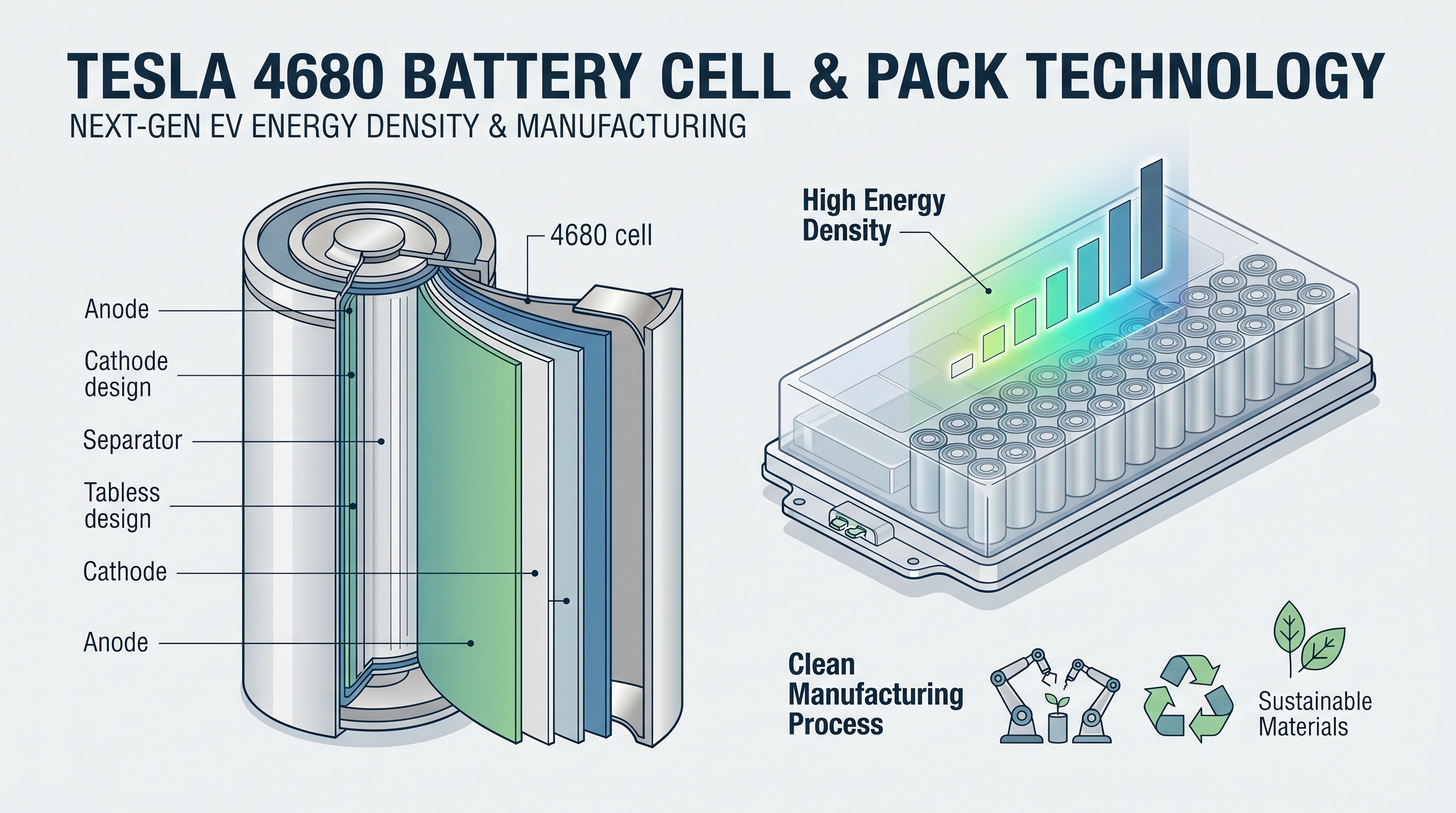
In September 2020, Tesla's Battery Day announced the 4680 cell — a new 46mm x 80mm cylindrical format with tabless design and dry electrode manufacturing — with a target of 300+ Wh/kg and 5x energy improvement versus the 2170 cells used in Model 3 and Model Y. In early 2025, production cells from Tesla's Gigafactory Texas reached approximately 350 Wh/kg, according to data published by Munro & Associates from cell teardowns of 2025 Cybertruck production units. The gap between the 2020 announcement and the 2025 reality reveals the manufacturing difficulty behind battery chemistry claims — and why the 4680 program matters beyond Tesla.
The Three Technical Innovations and Why Each Was Hard
The 4680 cell's architecture combines three distinct innovations: larger cell format, tabless electrode design, and dry electrode coating. Each was presented at Battery Day as delivering multiplicative improvements. In practice, each required years of manufacturing process development to produce consistently at scale.
Larger format (46mm vs 21mm diameter): Bigger cells hold more energy per unit, but heat management becomes exponentially harder. A larger cell generates more heat internally and has less surface area per unit of volume for dissipation. Tesla's solution was a combination of faster charge termination algorithms and a redesigned thermal management system that uses glycol channels running between cells rather than a blanket approach. Getting this thermal system to work reliably in production took until late 2023.
Tabless design: Traditional cylindrical cells have a tab — a metal strip connecting the wound electrodes to the cell terminals. The tab is a single-point connection that limits current flow and creates a hotspot. The 4680's tabless design connects the full width of the electrode directly to the terminal via laser-cut "shingled" connections. The manufacturing challenge: cutting these connections requires laser patterning at micron-scale precision across a cell wound at 60 RPM on a production line. Yield rates on tabless winding were below 70% in early 2022 production; by 2024 they reached above 90%.
Dry electrode coating: Standard battery electrode manufacturing uses a solvent (NMP) to coat active material as a slurry onto metal foil, then evaporates the solvent — an energy-intensive process requiring large drying ovens. Tesla's dry electrode process, inherited from Maxwell Technologies (acquired in 2019), mixes active material with a PTFE binder and directly rolls it into a thin film. This eliminates the solvent process, reduces energy costs by 20-30%, and allows thicker electrodes (more energy density). The problem: PTFE binding creates a film with different mechanical properties than solvent-cast electrodes, and controlling electrode porosity (critical for lithium ion movement) in a dry process required entirely new manufacturing science. Tesla is still using dry coating for cathodes but has used wet coating for anodes in some production runs while continuing dry anode development.
The Numbers in Production Context
Tesla's 350 Wh/kg production figure compares favorably against the competition. CATL's current flagship cylindrical cell (the 46-series used in the BMW iX M60) reaches approximately 300 Wh/kg. Panasonic's 2170 cells in the Tesla Model 3 Long Range are rated at 260-270 Wh/kg. The 4680 at 350 Wh/kg is a meaningful step change.
However, gravimetric energy density (Wh/kg) is one number. Volumetric energy density (Wh/L), cycle life, and cost per kWh are equally important for automotive applications. The 4680's volumetric density reached approximately 890 Wh/L — competitive but not class-leading (CATL's LFP prismatic cells reach 450 Wh/L but at lower gravimetric density). Cycle life data on production 4680 cells is still emerging from long-term field studies; early third-party teardown analysis from Cybertruck cells suggests 1,500-2,000 cycles to 80% capacity, consistent with Tesla's specifications.
Why the Cell Size Change Matters to the Whole Industry
Before Tesla's Battery Day, the industry had settled on the 2170 (21mm x 70mm) as the premium cylindrical format, with prismatic and pouch cells used by most other manufacturers. The 4680 forced a re-evaluation. In 2023-2024, virtually every major battery manufacturer announced 46-series cell development programs: CATL's 46-series, Samsung SDI's 46-series, Panasonic's 4680 (in development for North American markets), and LG Energy Solution's 46-series.
This industry convergence matters because it enables supply chain standardization. A larger ecosystem of 46mm-format cell producers means more competition, faster cost reduction, and wider vehicle manufacturer access. BMW, Rivian, and Lucid have all announced 46-series cell programs for 2026-2028 vehicle generations. The 4680 format may become the standard cylindrical cell format for performance EVs the way the 18650 defined consumer electronics batteries.
Structural Battery Pack: The Other Half of the Story
The 4680 cell is only half of Tesla's battery innovation. The cells are assembled into a structural battery pack — where the battery pack is a load-bearing element of the vehicle's chassis rather than a box bolted underneath it. The Cybertruck's structural pack replaces portions of the floor structure, reducing overall vehicle weight by approximately 10% compared to a conventional pack approach and improving torsional rigidity by 20%.
The structural pack creates a manufacturing trade-off: repairability. When a cell in a conventional pack fails, that module can be replaced. In a structural pack, cell replacement requires disassembling a significant portion of the vehicle. Tesla has addressed this partly through improved battery management system algorithms that better balance cells and prevent cascade failures, but it remains a genuine limitation that insurers and repair shops are grappling with.
The BYD and CATL Counter-Response
BYD's Blade Battery, using LFP (lithium iron phosphate) chemistry in a long prismatic format, represents a different optimization strategy: lower energy density (130-150 Wh/kg) but dramatically lower cost, better cycle life (3,000+ cycles), and no thermal runaway risk. BYD's approach dominates the Chinese market and is expanding globally. The BYD Seagull electric city car delivers a 38 kWh Blade pack at under $10,000 total vehicle price — economics the 4680 cannot match for price-sensitive segments.
CATL's Shenxing Plus battery (2024) achieves 10-minute fast charging to 80% using a sodium-ion + lithium-ion hybrid approach. This addresses the charging speed gap that 4680-based packs still exhibit — the Cybertruck charges at a maximum of 250 kW (roughly 15 minutes to 80%), while the Shenxing Plus targets 500 kW charging capability.
Actionable Context for EV Buyers and Investors
- The Cybertruck uses 4680 cells; the Model Y does not (yet): the refreshed Model Y launched in early 2025 still uses 2170 cells in most configurations. Tesla's production allocation of 4680 cells is limited by Gigafactory Texas capacity. Full 4680 Model Y production is expected in the 2026-2027 timeframe.
- Range anxiety with 4680 packs is less relevant than charging infrastructure: the real-world constraint for most EV owners is not energy density but charging network availability and reliability. A 350 Wh/kg cell that can't find a working 250 kW charger is less useful than a 270 Wh/kg cell near a dense Supercharger network.
- For investors watching battery technology: the 46-series cell format convergence is a more durable structural trend than any single manufacturer's density claims. Track CATL, Panasonic, Samsung SDI, and LG Energy Solution's 46-series production timelines as the indicator of where the industry is actually going.
- The dry electrode cost advantage is real but delayed: Tesla's dry cathode process is in production; dry anode is still being qualified. The full cost reduction thesis requires both. Expect the complete dry electrode manufacturing cost benefits to materialize in the 2026-2027 cell generation.