The AI Wrapper Problem: Why Most of Today's AI Startups Won't Exist in 2028
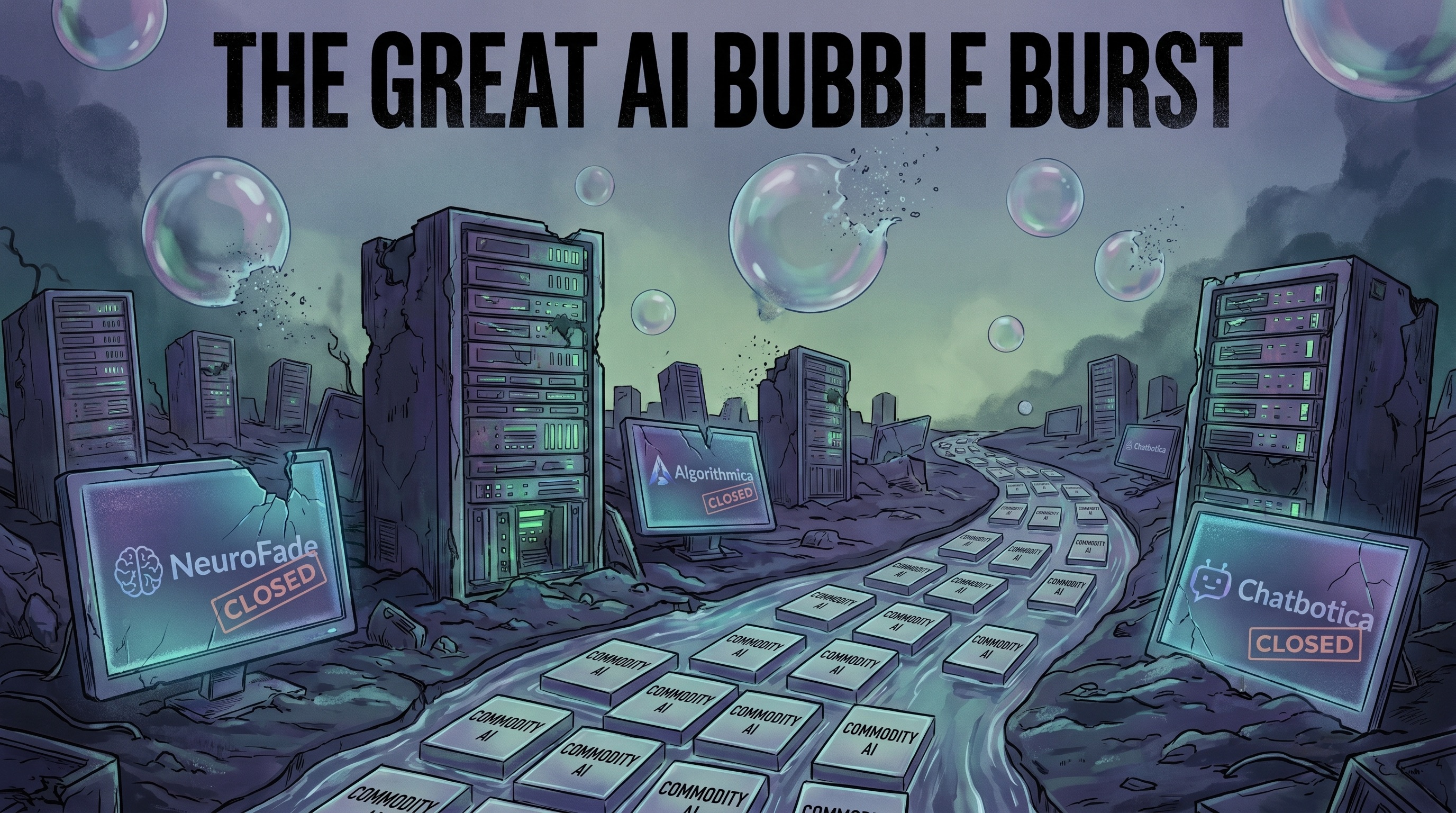
A pattern is emerging in the AI startup market that investors are beginning to discuss honestly and founders are still mostly avoiding: a large portion of the companies funded between 2022 and 2025 on the strength of AI-first positioning are building on borrowed time. The problem isn't that they're building bad products. The problem is that their products are features — and the platforms they depend on are shipping those features faster than the startups can grow.
What a "Wrapper" Actually Is
An AI wrapper, in the unflattering sense the term has acquired, is a startup whose primary value proposition is presenting an LLM API (OpenAI, Anthropic, Google) through a cleaner interface, for a specific use case, at a markup. The user gets a GPT-4o or Claude-based product without the complexity of the raw API. The startup gets a subscription fee. The foundation model provider gets inference revenue plus the customer relationship when they ship the same capability natively.
The timeline for that last step has been remarkably consistent: ChatGPT Custom GPTs, memory features, file handling, image generation, canvas-based document creation, and tone-adjustment tools each took 12 to 18 months from when a category of startups was funded around the capability to when OpenAI or Anthropic shipped it natively. The startups that built defensibility in that window survived. The ones that hadn't don't have a path forward at comparable scale.
The Unit Economics Problem
The structural problem compounds the competitive one. A startup built on a commercial LLM API typically faces inference costs that consume 70 to 80 percent of revenue at modest scale. Traditional SaaS businesses run at 70 to 80 percent gross margins. The difference isn't a minor handicap — it's a different business model entirely.
High inference costs mean AI wrapper startups can't invest in sales, marketing, and product development at the same rate as comparable SaaS businesses. They can't acquire customers as aggressively because each customer costs more to serve. And as usage scales, the margin problem gets worse rather than better, because inference costs scale linearly with usage while software infrastructure costs at SaaS companies are largely fixed.
The companies with sustainable unit economics in AI are those that either train their own models (requiring hundreds of millions in capital) or find use cases where the value delivered per inference is high enough to support the margin structure. Legal contract review at $500 per document can sustain the economics. AI-powered email subject line generation at $20 per month probably can't.
Where the Venture Capital Went
Q1 2026 global venture funding reached approximately $300 billion, with roughly 80 percent going to AI companies. Of that, the overwhelming majority concentrated in a small number of large rounds: OpenAI, Anthropic, xAI, and Waymo collectively absorbed the lion's share of AI venture investment in the quarter. Foundation model infrastructure, AI data center buildout, and a handful of vertical AI companies with genuine proprietary data moats attracted the rest.
The seed and Series A market for AI startups remains active, with AI-positioned startups commanding 42 percent valuation premiums over non-AI peers. But the ability to raise does not equal the ability to build a sustainable business. Many of the companies raising seed rounds in 2025 and 2026 will face their Series A moment in 2027 with growth that has plateaued, a competitive landscape that has compressed around them, and investors who have grown skeptical of AI-first as a sufficient differentiation claim.
What Actually Works
The startups demonstrating durable value have several characteristics in common. First, proprietary data: companies that have accumulated training data, feedback loops, or domain-specific datasets that can't be replicated from publicly available data have a genuine moat. Healthcare AI startups with EHR partnerships, legal AI startups with document libraries, and fintech startups with transaction data can fine-tune models in ways that generic LLMs don't replicate well.
Second, outcome-based pricing: the companies aligning their revenue model with the business outcomes they deliver — cost reduction, revenue generation, risk avoidance — can command pricing that supports their unit economics. A startup charging a percentage of the legal cost savings it achieves is in a fundamentally different market than one charging a flat monthly subscription for access to AI-assisted document generation.
Third, workflow automation depth: startups that have gone beyond the UI layer to integrate with enterprise systems, handle the messy edge cases in real business processes, and build the institutional trust required for autonomous action on behalf of users have built switching costs that a foundation model feature drop can't instantly eliminate. These companies have invested in the unsexy parts of enterprise software — security reviews, compliance documentation, change management support — that pure AI capability doesn't replace.
The Difficult Message for Founders
The venture ecosystem has incentives to fund optimistic narratives. A seed investor who passes on a company that succeeds has made a mistake they can observe. A seed investor who funds a company that fails gracefully has made a mistake that's easy to rationalize. That asymmetry means founders building thin-wrapped AI products will continue to find funding even as the structural pressures on their category intensify.
The honest question for any AI startup founder is: what does my company have in two years that OpenAI, Anthropic, or Google can't ship as a feature? If the answer isn't proprietary data, deep vertical integration, or a customer relationship built on switching costs that take years to develop, the clock is running. The AI market is real, large, and growing. But most of the value accrues to the infrastructure layer and the narrow set of applications that can sustain defensible business models above it.