The EV Charging Network Is Finally Growing Up — But the Reliability Problem Hasn't Been Solved
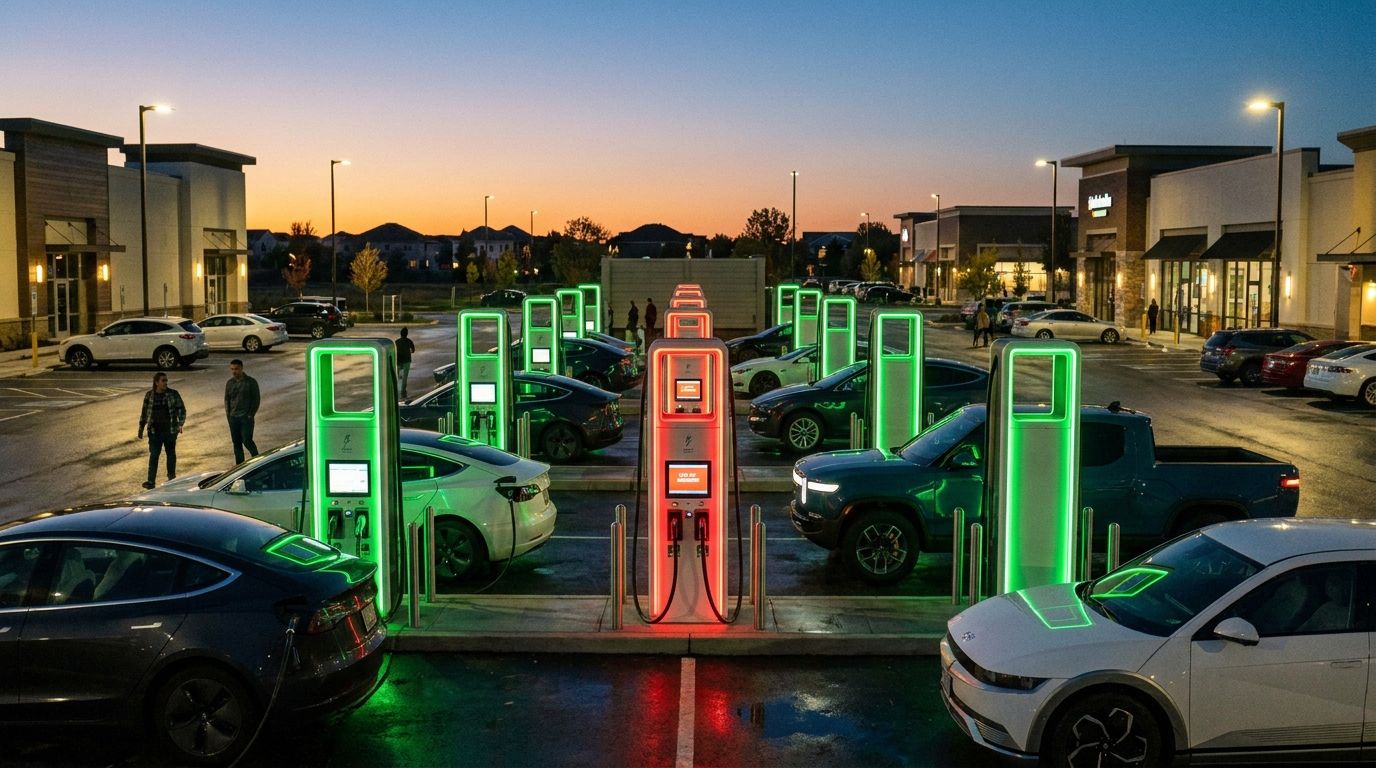
Range anxiety was supposed to be solved by infrastructure. Build enough chargers, make them fast enough, and the last psychological barrier to EV adoption disappears. The logic was correct; the execution has been slower and messier than the projections suggested. In 2026, the US has significantly more public charging infrastructure than it did in 2022 — but a substantial portion of drivers have stories about chargers that didn't work when they needed them.
The infrastructure buildout is real. The US charging network grew from approximately 113,000 public charging ports in 2022 to over 220,000 in early 2026, with fast DC charging ports growing even faster proportionally. The Bipartisan Infrastructure Law's $7.5 billion allocation for EV charging infrastructure has funded stations along interstate highways in states that previously had critical gaps. The number of charging locations in rural areas and along major travel corridors has meaningfully improved.
But raw port count is not the same as reliable charging. A 2023 study by J.D. Power found that 21% of public fast-charging sessions in the US resulted in failure — the driver connected but didn't get a charge. A 2024 study by the Department of Energy found that uptime rates at public DC fast chargers averaged around 72–78% across major networks. Tesla Superchargers, by contrast, consistently report uptime above 99%. The gap between Tesla's network and the rest of the industry is not a minor operational variance — it represents a fundamentally different approach to network operation.
Why Public Chargers Fail
The failure modes of public charging are varied and mostly fixable, but fixing them requires operational investment that many charging operators have been slow to make. Payment system failures — broken card readers, authentication errors, network connectivity problems — are the most common cause of session failures, accounting for an estimated 30–40% of failed charging attempts. Software glitches in charging station management systems cause sessions to fail to initiate, terminate prematurely, or charge at reduced rates. Connector hardware damage — broken latches, damaged cables, bent pins — is the most visible failure and grows over time without regular maintenance. Electrical infrastructure problems, including tripped breakers and faulted grid connections, account for a smaller but meaningful fraction of outages.
Most of these failures are addressable with adequate maintenance staffing and monitoring. Tesla's Supercharger uptime reflects a combination of design choices (Tesla controls both the vehicle and the charger software, simplifying the authentication and communication handshake) and operational investment (proactive maintenance, remote monitoring, fast replacement of failed components). Non-Tesla networks have historically underinvested in operations relative to installation, driven by a business model that prioritized network growth metrics over reliability metrics.
The NACS Consolidation
The most consequential structural change in US charging has been the adoption of Tesla's connector design as the North American Charging Standard (NACS). What began as a Tesla-proprietary connector — longer, lighter, and more reliable than the CCS1 connector used by other EVs — became an industry standard when Ford, GM, and then virtually every other major automaker announced they would adopt it for their 2025 and 2026 model year vehicles.
The SAE International standardized NACS as SAE J3400 in June 2023, completing the transition from proprietary to open standard. By 2026, all new EV models from US, Japanese, Korean, and European automakers shipping to North America include NACS ports. CCS1 adapters allow older vehicles to use NACS-capable chargers, and the combined effect is a de facto unification of the US charging connector landscape.
This matters for reliability in ways beyond connector compatibility. Tesla's Supercharger network — approximately 25,000 stalls in the US as of 2026 — is now accessible to all NACS-capable vehicles, effectively doubling or tripling the accessible fast-charging footprint for most non-Tesla EV owners overnight. Tesla has been expanding Supercharger capacity to accommodate the expanded user base, and its operational infrastructure is now serving as the reliability benchmark the industry is forced to match.
The V2G Dimension
Vehicle-to-grid (V2G) charging — where EVs can discharge back into the home or grid — is becoming commercially available, but it requires bidirectional charging hardware that most existing public chargers don't have. Ford's F-150 Lightning and several other models support V2G; the DC Fast Chargers needed to enable grid-to-vehicle-to-grid round trips are beginning to be deployed by utilities offering demand response programs.
The charging infrastructure investment case changes when chargers can participate in grid services: charging during low-demand periods, discharging during peak demand, providing frequency regulation. Several utilities in California and the Northeast are piloting programs that pay EV owners for managed charging. The economic case for charging network operators improves if their stations can generate revenue outside of active EV sessions.
The Reliability Floor
The federal infrastructure funding, NACS consolidation, and competitive pressure from Tesla's open network have created momentum that wasn't present in 2022. State-level reliability requirements — California, Colorado, and New York have all implemented or proposed minimum uptime requirements for publicly funded charging stations — are adding regulatory pressure to operational improvement.
The US charging network in 2026 is substantially better than it was in 2022. The gaps are real but shrinking: coverage along major corridors is approaching adequate; connector compatibility is effectively resolved; the uptime trajectory is improving as operators face competitive and regulatory pressure. What hasn't happened yet is the kind of systemic reliability investment that would make charging-while-traveling as reliable as gas stations — which run at something above 99% uptime by virtue of decades of infrastructure refinement and standardization.
The industry is five to ten years away from that standard. The EV transition will succeed or struggle in part based on whether the charging infrastructure gets there fast enough to build the confidence of the next wave of buyers — the ones who need public charging to be reliable, not just present.