The New Biology of Aging: Senolytics, Epigenetic Clocks, and the Science Trying to Add Healthy Years
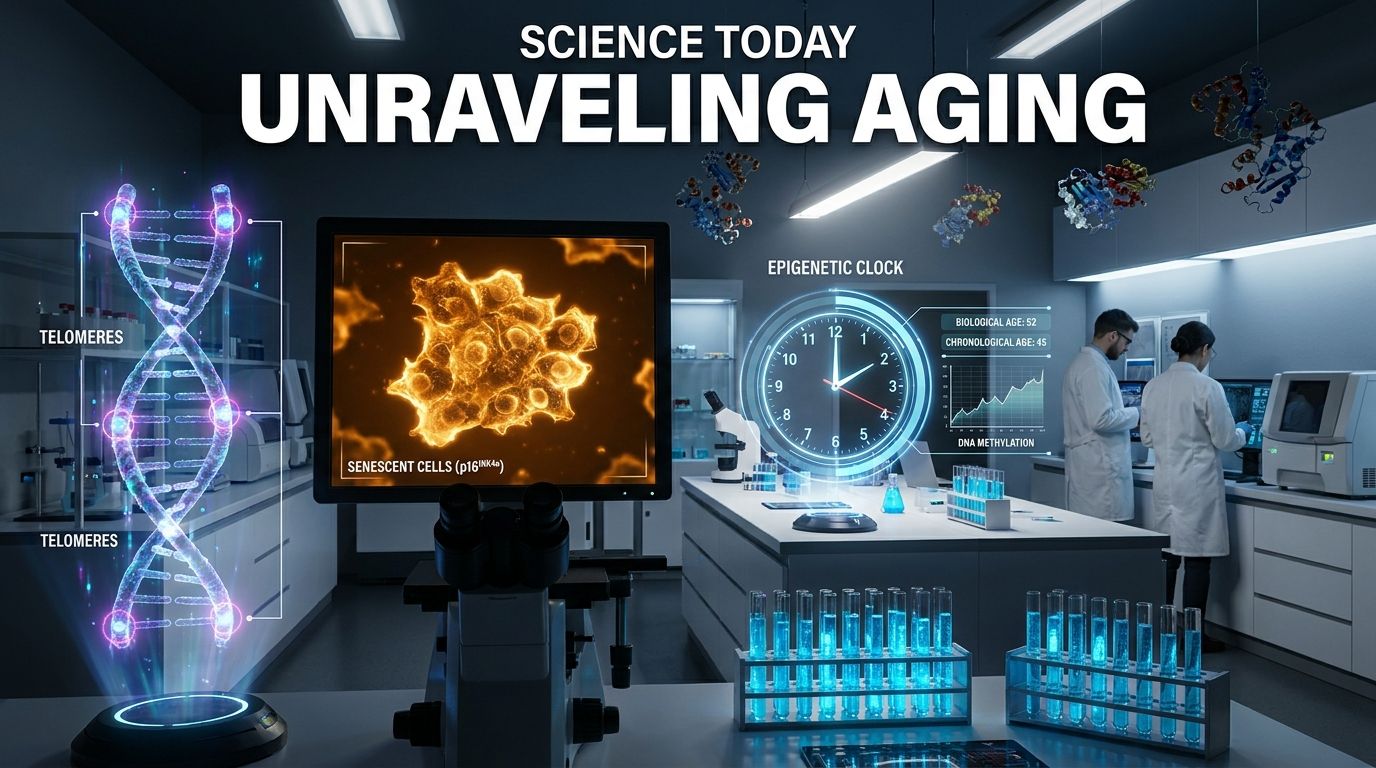
For most of human history, aging was understood as an inevitable decline — a background process that simply happened, like entropy, with no more internal logic than the weathering of stone. That understanding is changing. Over the past decade, biologists have developed a coherent molecular framework for what aging actually is, and a growing number of companies are building drugs and diagnostics on top of it. The results so far are partial, genuinely exciting in specific cases, and considerably more complicated than the popular press tends to convey.
The Hallmarks Framework
The dominant intellectual framework in aging biology is the "hallmarks of aging," first systematized by Carlos López-Otín and colleagues in a 2013 Cell paper and updated with new entries in 2023. The hallmarks describe the molecular features that accumulate in aging cells and organisms: genomic instability, telomere attrition, epigenetic alterations, loss of proteostasis, disabled macroautophagy, deregulated nutrient sensing, mitochondrial dysfunction, cellular senescence, stem cell exhaustion, altered intercellular communication, chronic inflammation, and dysbiosis.
The value of this framework isn't just descriptive — it provides intervention targets. If cellular senescence is a hallmark of aging, then drugs that selectively eliminate senescent cells (senolytics) might slow or reverse aspects of aging. If epigenetic alterations are a hallmark, then drugs that restore youthful epigenetic states might have therapeutic potential. This is the logic driving the field.
Senolytics: The Most Advanced Clinical Programme
Senescent cells are cells that have stopped dividing but haven't died. They accumulate with age and secrete a cocktail of inflammatory signals — the senescence-associated secretory phenotype (SASP) — that damages surrounding tissue. Senolytics are drugs designed to kill senescent cells selectively.
The most clinically advanced senolytic combination is dasatinib (a leukemia drug) plus quercetin (a plant flavonoid). The combination works because senescent cells upregulate survival pathways that these two drugs inhibit — quercetin targeting the PI3K/Akt/p21 pathway and dasatinib targeting tyrosine kinases. A 2023 Phase 1 trial in five Alzheimer's patients showed favorable tolerability and central nervous system penetration, followed by a 2024 Phase 2 trial in sixty postmenopausal individuals examining whether the combination reduced markers of inflammation and senescent cell burden.
Unity Biotechnology has taken a different approach — targeting senolytics locally rather than systemically to sidestep the toxicity concerns that have plagued systemic administration. Their drug UBX1325 targets BCL-xL, a survival protein that senescent cells in the eye depend on. The 2025 Phase 2b ASPIRE trial in diabetic macular edema showed visual acuity gains of five or more letters, achieving non-inferiority to aflibercept — the current standard of care — at nine of ten measurement time points through 36 weeks, with no intraocular inflammation or serious adverse events. It's a narrow result, but it's the clearest evidence to date that removing senescent cells in a human target tissue produces meaningful clinical benefit.
Navitoclax (ABT-263) is a more potent BCL-2/BCL-xL inhibitor with strong senolytic activity in preclinical models, but it causes dose-limiting thrombocytopenia because platelets also depend on BCL-xL for survival. New formulations targeting delivery to specific tissues — avoiding systemic platelet exposure — are in early development.
Partial Reprogramming: The Altos Labs Bet
Cellular reprogramming is a more ambitious approach. The Yamanaka factors (Oct4, Sox2, Klf4, c-Myc) can reset cells to a pluripotent state — erasing their developmental history. Partial reprogramming — expressing these factors briefly, not long enough to induce full pluripotency — appears to restore youthful epigenetic and functional states without causing cancer or losing cellular identity.
Altos Labs, founded in 2022 with $3 billion in initial funding from Bezos Expeditions and others, is the largest bet on this approach. The company has published results in animal models showing improved vision in aged mice and muscle regeneration, consistent with other labs' findings. As of August 2025, Altos entered early human safety testing based on its most advanced programme — a milestone that had previously been projected for mid-2026. The company's scientific founders include Shinya Yamanaka himself.
Calico Life Sciences (an Alphabet company) has been running longevity research since 2013 with significantly less public output than its funding would suggest. The company has published work on the naked mole rat (which ages differently from most mammals) and is developing proprietary reprogramming-based approaches, but remains primarily in preclinical stages.
Measuring Biological Age: Epigenetic Clocks
One of the most practically important developments in aging science is the epigenetic clock — a computational model that predicts biological age from patterns of DNA methylation. These clocks have become the primary outcome measure for longevity interventions: if a drug reduces epigenetic age, that's evidence it's doing something to the underlying aging process.
Different clocks measure different things. The Horvath clock estimates chronological age from methylation patterns. GrimAge, developed at UCLA, correlates with mortality risk and is better at predicting who will die sooner. DunedinPACE, developed at Duke, measures the pace of aging — how fast an individual is aging right now, rather than estimating their current biological age. A 2025 study in Nature Communications comparing 14 clocks against 174 disease outcomes found that DunedinPACE and GrimAge measure largely distinct aspects of aging, with weak correlation between them (r = 0.13 for DunedinPACE vs. Horvath), underscoring that "biological age" isn't a single number.
The commercial market for epigenetic age testing has grown rapidly. TruDiagnostic, the market leader in direct-to-consumer epigenetic testing, had processed over 250,000 cumulative samples by 2025. In April 2026, its parent company Infinite Epigenetics acquired Tally Health to integrate testing with personalised intervention recommendations. The biological age testing market was valued at $1.8 billion in 2025 and is projected to reach $4.3 billion by 2034.
What's Missing
The honest gap in the field is that most interventions showing remarkable results in model organisms (mice, C. elegans, flies) have failed to translate cleanly to humans. Rapamycin extends lifespan in mice; its use in humans shows promise in some aging-related contexts but evidence for lifespan extension in healthy people is absent. Senolytics show striking results in old mice; the human evidence is limited to narrow organ targets and surrogate endpoints.
The field also lacks a confirmed biomarker of aging that is accepted as a regulatory endpoint — meaning clinical trials of aging interventions must still measure disease outcomes rather than "aging" directly, making trials expensive and long. TAME (Targeting Aging with Metformin), a large NIH-funded trial of metformin in aging, is designed partly to establish whether an aging intervention can be approved based on composite disease endpoints rather than a single disease.
The biology has moved faster than most people realise. The gap between understanding and intervention is still large. But the first approvals for drugs that explicitly target biological aging mechanisms are no longer an absurd prospect — they're a plausible five-to-ten-year horizon.