The Physical SIM Card Is Dying. The Carriers Aren't Happy About It.
The SIM card was invented in 1991. Its job is simple: store a unique identifier that tells a cellular network which account you are. For 30 years, this identifier lived on a small removable chip — a physical SIM — that you inserted into your phone. When you switched carriers, you got a new chip. When you traveled internationally, you swapped chips. The hardware was simple, the model was straightforward, and it served the industry well.
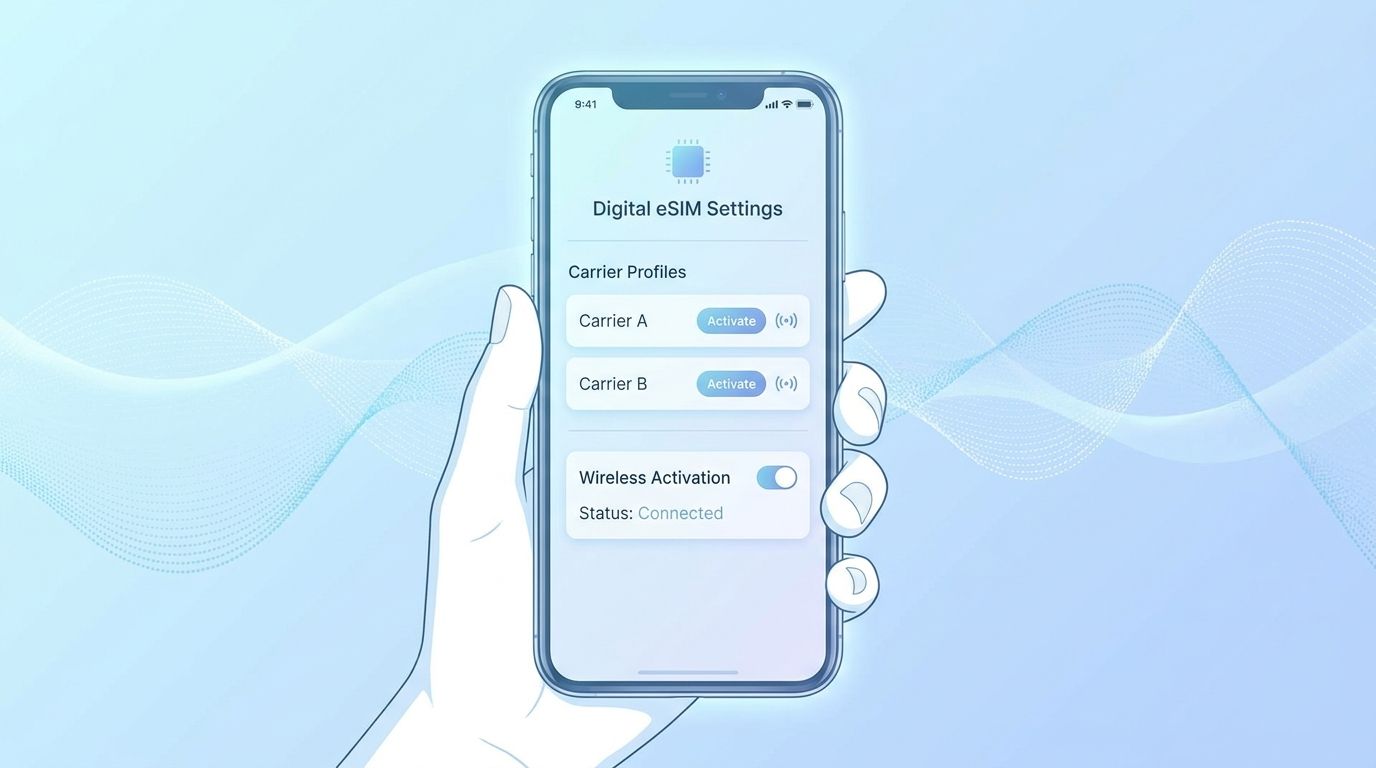
The eSIM does the same job without the chip. An eSIM (embedded SIM, formally eUICC — embedded Universal Integrated Circuit Card) is a small chip soldered permanently into the device, programmed remotely by carriers over the air. Instead of swapping physical cards, you scan a QR code or tap a button, the carrier sends a profile to your device, and your new number is active in minutes. Apple went eSIM-only for US models of the iPhone 14 in 2022. Google followed with the Pixel 7 in the US. The direction is clear. What's less clear is how fast the rest of the world follows.
Why eSIM Is Technically Better in Almost Every Way
The practical benefits for users start with the obvious: no SIM tray means more room inside the phone for battery or other components, and one fewer physical opening means better water resistance. Devices without SIM slots are genuinely simpler to seal to IP68 or higher.
Switching carriers becomes a software operation. The current process — visiting a store, waiting for a new SIM, potentially experiencing downtime during the transfer — compresses to a few minutes on your phone. Price competition benefits from this: a user who can switch carriers in five minutes responds differently to an overpriced renewal offer than one who needs to take a half-day for the process.
International travel is where eSIM delivers the most immediately obvious value. Instead of landing in a new country and hunting for a local SIM vendor in an unfamiliar airport, travelers can provision a local data profile before their flight lands. Services like Airalo, Holafly, and Google Fi have built businesses specifically around this: they sell eSIM profiles for 190+ countries through apps, and activation takes under two minutes. The markup over local SIM prices is real, but the convenience commands it reliably.
Dual-SIM is also cleaner with eSIM. Many flagship phones support one physical SIM and one eSIM simultaneously, or two eSIMs simultaneously. This enables a common business use case — work number on one carrier, personal on another, in a single device — without carrying two phones or a dual-tray monstrosity.
Why Carrier Adoption Is Uneven
eSIM adoption in the US, UK, Germany, Australia, and Japan is strong. eSIM works reliably on major carriers, switching is straightforward, and consumer awareness is high. In most of the world, including large parts of Southeast Asia, Latin America, Africa, and Eastern Europe, the situation is more complicated.
The fundamental issue is that carriers' business models depend partly on the friction of switching. A physical SIM that requires a store visit to replace is, from a carrier's perspective, a natural lock-in mechanism. eSIM removes that friction deliberately. Carriers in markets where number portability is poorly enforced, where prepaid SIM markets are fragmented, or where physical distribution networks represent significant sunk-cost investments have strong incentives to delay eSIM adoption.
Technical infrastructure requirements also matter. Supporting eSIM requires carriers to deploy SM-DP+ (Subscription Manager Data Preparation) servers for remote provisioning, update their BSS/OSS systems to handle profile management, and train customer service to troubleshoot eSIM activations. For a small regional carrier without the engineering staff to handle this, eSIM rollout is a real project, not a checkbox.
Regulatory environments complicate things further. Some countries require identity verification at point of SIM sale for law enforcement and counter-terrorism reasons — a requirement designed around physical SIM distribution that doesn't map cleanly to remote eSIM provisioning. India, one of the world's largest mobile markets, launched eSIM support but with a verification process that partially reintroduces the friction it's supposed to eliminate.
The GSMA Standards Question
GSMA, the industry body that sets global mobile standards, published the eSIM specification for consumer devices (SGP.22) in 2016. The Consumer eSIM architecture it defines has worked well for phones. The M2M (machine-to-machine) eSIM specification for IoT devices has been deployed at scale in connected cars, smart meters, and industrial equipment.
The newer SGP.32 specification for IoT eSIM, published in 2023, simplifies provisioning for resource-constrained devices — important for the long tail of connected sensors and embedded devices where the full SGP.22 flow is too heavy. This is a bigger deal for the IoT ecosystem than for consumer phones, but it affects the total installed base of eSIM-capable hardware.
One gap in the current architecture is interoperability between eSIM profile providers. A travel eSIM from Airalo and a domestic eSIM from Verizon coexist fine on your device, but the profile management experience is fragmented — each provider has its own app, its own activation flow, its own troubleshooting path. An industry-wide eSIM discovery and management standard doesn't yet exist at the consumer level, which creates friction that physical SIM switching never had.
What Happens to the Physical SIM
Physical SIM cards aren't going to disappear from global markets for at least another decade. The installed base of devices that only support physical SIM is enormous — hundreds of millions of devices, concentrated in markets where eSIM infrastructure is weakest. Budget smartphones from Chinese manufacturers, which dominate large swaths of the developing world, are often physical-SIM-only because the hardware cost of adding an eUICC matters at sub-$100 price points.
The Apple-led push toward eSIM-only in premium smartphones accelerated the timeline, but the diffusion from flagship to mid-range to budget takes years. The US is probably 3-5 years away from meaningful market penetration above eSIM-capable devices; global markets are likely a decade or more out.
For consumers who can use eSIM today, the pragmatic advice is simple: use it. The flexibility, especially for travel and carrier switching, is genuinely better than physical SIM in almost every measurable way. The carriers' reluctance to promote it is a reliable signal that it benefits users at their expense. That's usually a good heuristic for which technology wins in the long run.