Two Years In, Electric Trucks Are Splitting the Market They Were Supposed to Conquer
The Promise: More Truck, Not Less
The pitch for electric trucks was never "sacrifice range for sustainability." It was the opposite. Truck buyers were told they'd get instant torque that makes 0–60 irrelevant, towing that pulls without the diesel rumble, and a bed full of power outlets that contractors and campers would actually use. The argument wasn't environmental — it was capability. Truck for truck people.
Two years into meaningful volume sales, that promise is half-delivered. Where EV trucks shine, they genuinely shine. Where they don't, the shortcomings hit exactly the buyers they most need to win over.
The Four Players in 2026
The segment now has real contenders, each targeting a different kind of truck buyer.
- Rivian R1T (~$70K): The one actual truck enthusiasts tend to love. With up to 410 miles of range on the large pack and a purpose-built adventure platform, the R1T has found a loyal following in the overlanding and camping community. Rivian shipped roughly 60,000 units in 2025 — real production, real buyers. It still loses money per vehicle, but margins are improving. The gear tunnel, the camp kitchen, the quad-motor setup: these aren't marketing features. They're things owners actually use.
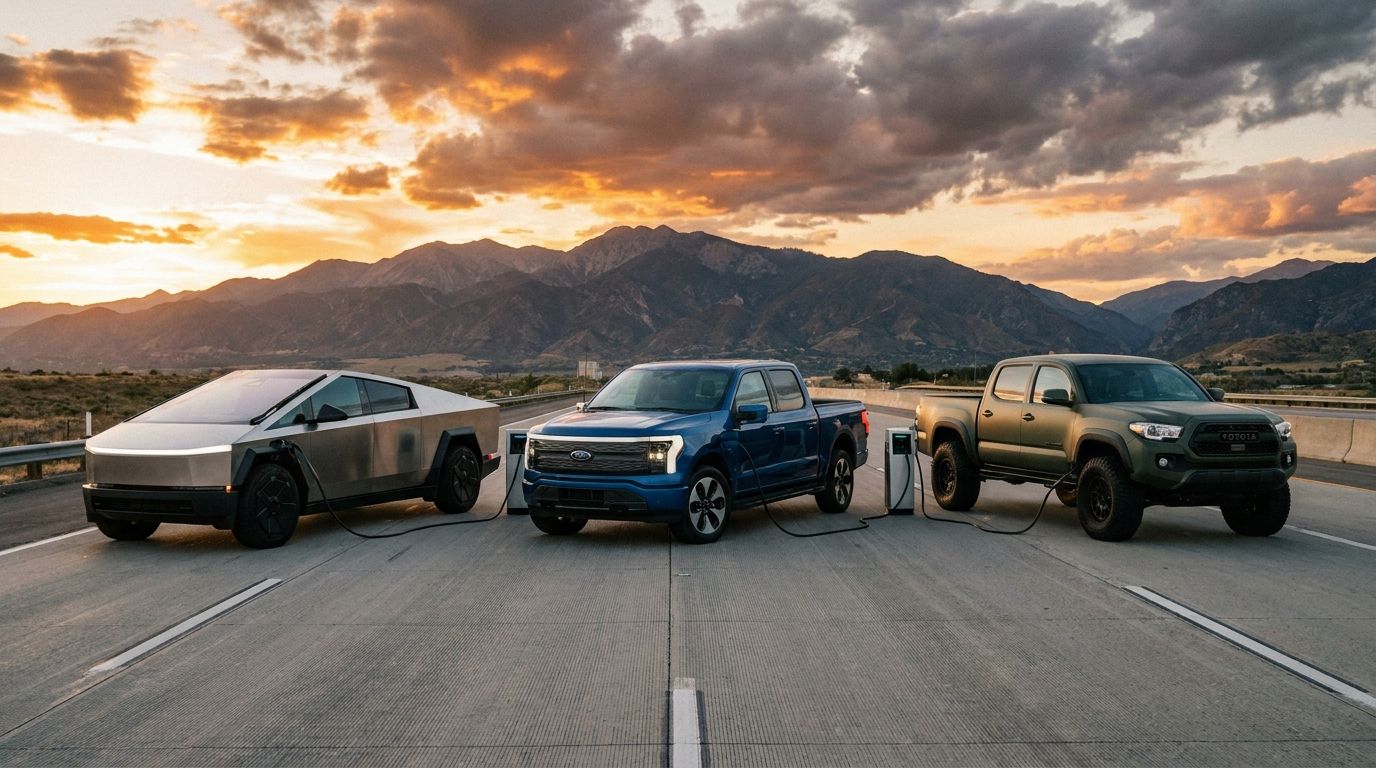
- Ford F-150 Lightning (~$55K–$90K): The most important EV truck in terms of mainstream credibility, and the most complicated story. The Lightning is a real truck — it tows, it hauls, it fits into a work site. But the rated range collapses under load: expect 230 miles or less when towing near capacity at highway speeds. Ford cut production targets twice in 2024–2025 as consumer demand plateaued. The Lightning has quietly pivoted toward fleet and commercial buyers — utilities, municipalities, construction fleets — where predictable routes and depot charging make the math work.
- Tesla Cybertruck ($80K+): It divides rooms and parking lots equally. The stainless exoskeleton is either visionary or absurd depending on your priors, and that design alone caps the addressable market. The specs are legitimate: 340-mile range, 11,000 lbs towing capacity. But delivery timelines stretched, quality complaints surfaced in early production runs, and the $80K+ entry point after options leaves it competing with fully-loaded gas trucks on price — without gas truck ubiquity on the road or at service centers.
- RAM 1500 REV (launched late 2025): Stellantis played the long game and came in with the biggest battery in the segment: 229 kWh, with a claimed 500-mile range. Towing and payload numbers are competitive. The problem is the buyer base. RAM's traditional customers skew conservative on technology adoption, and the dealer network that sells RAMs has spent years moving Hemi-powered trucks. Convincing that sales force — and that customer — to go electric is a slower turn than the specs suggest.
The Towing Range Problem Nobody Solved
Here's the number that matters most for actual truck buyers: EV pickups lose 40–60% of their rated range when towing at highway speeds. That's not a firmware issue. It's physics. Trailer aerodynamics create enormous drag; battery chemistry doesn't recover energy the way a coasting ICE vehicle can coast on compression. A truck rated at 350 miles becomes a 160–200 mile truck with a loaded trailer behind it.
For the commuter or the weekend warrior driving light, this is manageable. For the buyer towing a horse trailer from Texas to Colorado, or hauling a fifth-wheel to a campground three states away, it's a fundamental problem. Every charging stop adds 30–45 minutes to a trip that gas drivers complete without thinking about it. The math isn't close yet.
The Infrastructure Gap at the Edges
Urban and suburban charging infrastructure has improved dramatically. Tesla's NACS network is now accessible to Ford, Rivian, and increasingly other manufacturers. But truck buyers disproportionately live in and drive to places where charging density remains low. Rural Montana. The Texas Panhandle. Northern Minnesota in February. The buyers who most need a capable truck are often the buyers who face the most charging uncertainty on their actual routes.
The transition to NACS as a common standard is genuine progress. But the density of 150kW+ fast chargers in areas where heavy-duty towing happens is still a fraction of what would normalize EV truck adoption for primary-vehicle users.
Who Is Actually Buying These Trucks?
The data and anecdotal reports tell a consistent story. The current EV truck buyer is largely:
- A dual-vehicle household where the EV truck is the weekend or lifestyle vehicle, not the daily primary driver
- A fleet operator running predictable routes — construction firms, utilities, municipalities — where depot charging works and fuel cost savings are concrete
- An early adopter in a specific community (overlanding, camping, off-road) who has structured their use case around the truck's strengths
The mass-market primary-vehicle truck buyer — the one who tows regularly, uses the truck for work, and needs it to handle whatever comes up — hasn't made the switch in meaningful numbers. That's not opinion; it's what Ford's production cut signals, and what the sales data confirms.
What Would Actually Move the Market
Three things would materially shift EV truck adoption among mainstream buyers. First, real-world towing range above 400 miles — not rated range, but towing range. Ford and GM have both explored integrated tow-vehicle charging systems that recover energy from the trailer during deceleration; this technology, if it reaches production, changes the calculus. Second, a sub-$50K entry price for a truck with competitive specs. The Lightning has gotten close, but payload and range concessions at that price point are significant. Third, fast charging along towing corridors: highway chargers near RV parks, near boat launches, near trailheads. Not just near Starbucks.
The Competitive Reality
ICE trucks aren't waiting. The Toyota Tundra, Chevy Silverado, and their siblings are still outselling all EV trucks combined by roughly 20 to 1. More telling: hybrid trucks — the Ford F-150 PowerBoost, the Tundra Hybrid — are outselling pure EV trucks in the segment. Buyers who want to reduce fuel costs and emissions but can't live with the range constraints are voting for the hybrid compromise. That's not a detour to EVs; for many buyers, it may be the destination.
The Honest Verdict
Electric trucks are not a failed experiment. The Rivian R1T is, by almost every measure, a remarkable vehicle. The Lightning works for fleets. The Cybertruck has its committed owners. The REV's battery capacity hints at where the technology is heading.
But "works well for specific use cases" is not the same as "won over the American truck buyer." The buyers who needed to be convinced — the ones who tow every weekend, run the truck as a work vehicle, and live 40 miles from the nearest charger — have not switched. The physics and the infrastructure explain why. The manufacturers who are honest about that gap, and are engineering toward it rather than marketing around it, are the ones most likely to close it.
If you're considering an EV truck in 2026: know your use case cold. If you tow regularly and heavily, run the range math on your actual routes before you buy. If you're a dual-vehicle household or a fleet operator with depot charging, the math already works. The trucks are good. The ecosystem around them, for heavy-duty towing buyers, is still catching up.