Bidirectional charging is giving EVs a second job on the grid
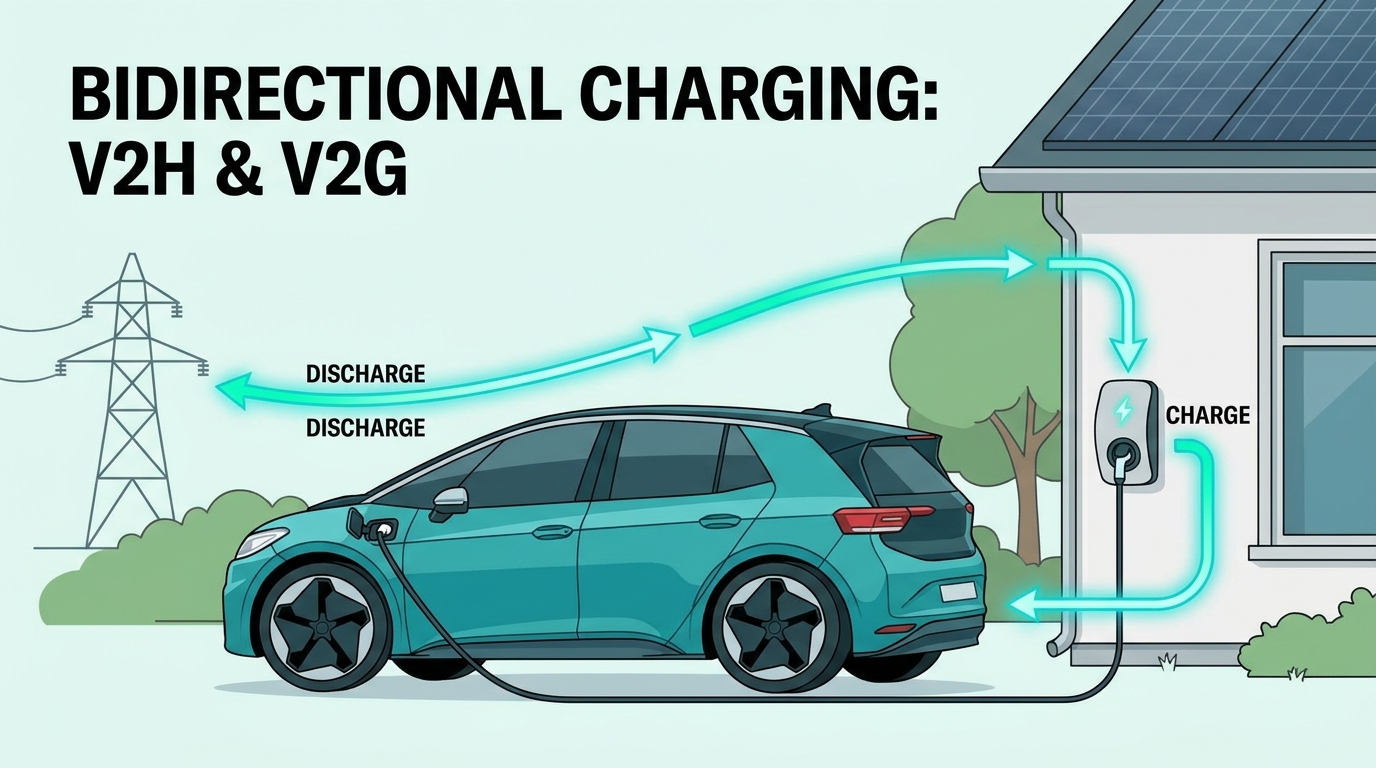
An electric vehicle connected to a bidirectional charger is not just consuming power — it's a battery pack on wheels that can push electricity back into a house, a building, or the grid itself. Vehicle-to-Grid (V2G) charging has been a theoretical grid-stabilization concept since the early 2000s. In 2026, it's a commercial product. Hyundai and Kia have live paid programs in Europe. The Ford F-150 Lightning built an entire owner subculture around its ability to run a household during a power outage. And grid operators are beginning to treat fleet EVs as a legitimate distributed energy resource.
The timing is not coincidental. The same AI data center build-out that's straining the US grid — data center demand projected at 41 GW in 2026 — is creating exactly the kind of peak-demand volatility that V2G is well-suited to address. Tens of millions of EVs, each carrying 50–100 kWh of battery capacity, represent an enormous distributed storage resource if they can be orchestrated to discharge during peak demand and recharge during off-peak periods.
The three levels of bidirectional charging
The terminology matters because the technical and commercial implications differ significantly:
Vehicle-to-Load (V2L) is the simplest form — an AC outlet on the vehicle that lets you power tools, camping equipment, or small appliances directly from the car's battery. Hyundai pioneered this in the IONIQ 5 in 2021 with a 3.6 kW output. Today it's common across many EV models and is essentially a standard feature rather than a premium one.
Vehicle-to-Home (V2H) connects the car's battery to a home's electrical panel through a bidirectional charger and transfer switch. During a grid outage, the car automatically backs up the house. Ford's Intelligent Backup Power system on the F-150 Lightning delivers up to 9.6 kW — enough to run a typical household for multiple days. V2H requires a dedicated bidirectional EVSE (electric vehicle supply equipment) and home panel integration, typically installed professionally. Kia launched V2H for EV9 owners in the US in early 2025; Hyundai extended V2H to the IONIQ 9 in 2026.
Vehicle-to-Grid (V2G) is the most complex and most commercially significant form. The car actively participates in grid services — providing frequency regulation, voltage support, or peak-demand response — under coordination with a utility or aggregator. The owner's car may discharge and recharge multiple times per day in response to grid signals. In return, the owner earns payment. V2G requires bidirectional charging hardware, a utility partnership, and software to manage the charging/discharging schedule without leaving owners with a depleted battery when they need to drive.
Hyundai and Kia's commercial programs
The most advanced commercial V2G programs operating in 2026 come from Hyundai Motor Group. In the Netherlands, Hyundai and Kia launched a paid V2G program — the first commercial V2G service from a major OEM in Europe — using the Kia EV9 and Hyundai IONIQ 9. The program runs in partnership with energy company Vattenfall and aggregator Jedlix. EV9 and IONIQ 9 owners can enroll, connect their vehicle to a bidirectional charger, and allow the system to optimize charge/discharge cycles in response to grid conditions and energy prices. Owners earn money when the grid is under stress and their car pushes power back.
In South Korea, a separate V2G pilot in Jeju province — where high renewable energy penetration creates significant grid variability — is using EV batteries to absorb excess solar and wind generation during peak production and release it during demand peaks. The Jeju grid has historically required curtailment (wasting renewable generation because the grid can't absorb it); EVs functioning as demand-response storage address this directly.
These programs are commercial but small. The Netherlands deployment covers thousands of vehicles, not hundreds of thousands. The revenue per vehicle is meaningful but not transformative — a well-managed V2G participant might earn €200–€500 per year in grid services payments. The economics improve as grid volatility increases and as the number of enrolled vehicles grows, allowing aggregators to offer larger, more reliable grid service blocks to utilities.
The F-150 Lightning's V2H legacy
Ford's F-150 Lightning made bidirectional charging mainstream in the US through the sheer visibility of its V2H capability. The 9.6 kW Pro Power Onboard system — which turns the truck into a mobile generator — became a major marketing angle, particularly after Hurricane Ian and other weather events demonstrated that EV owners could run their homes through multi-day outages while neighbors with gas generators dealt with fuel shortages.
Ford announced it would stop F-150 Lightning manufacturing in December 2025, a commercially disappointing end for a vehicle that proved the concept. But the Lightning's legacy in V2H is substantial: it established consumer expectation that electric trucks should have bidirectional capability, influenced other OEMs to develop their own V2H systems, and built a community of owners who understand what it means to have a battery on wheels as a household energy asset. Rivian, GM, and others have committed to bidirectional capability across their truck lineups as a direct response to what Lightning demonstrated.
Battery degradation: the concern that's mostly not the problem
The most common objection to V2G from EV owners is battery degradation — the worry that additional charge and discharge cycles will reduce battery capacity over time. This concern is largely overstated for two reasons. First, V2G and V2H cycles are typically shallow — discharging from 80% to 40% rather than 100% to 0% — and lithium battery degradation is significantly slower at shallow depths of discharge. Second, modern EV battery management systems are designed to manage thermal and electrochemical stress; the charge/discharge patterns used in grid services are generally less aggressive than performance driving.
Multiple studies show that optimized V2G cycling under controlled temperature conditions can actually extend battery life compared to irregular deep cycling, because shallow cycling avoids the electrochemical stress that full charge/discharge cycles cause. The practical concern for owners is making sure V2G enrollment includes guaranteed minimum state-of-charge rules — the car should always have enough battery to complete expected trips, which requires the V2G software to understand the owner's driving patterns.
What the grid needs and what EVs can provide
The V2G value proposition for grid operators is frequency regulation and peak demand response. Frequency regulation — keeping AC power at exactly 60 Hz (US) or 50 Hz (Europe) — requires resources that can respond in seconds. EV batteries can respond in milliseconds. A fleet of 10,000 enrolled V2G vehicles with an average available capacity of 20 kWh each represents 200 MWh of instantly-available storage with a combined power output in the hundreds of megawatts — competitive with utility-scale battery storage installations.
The V2G market is projected to exceed $15 billion by 2031. The path there runs through aggregators — companies that enroll individual EV owners, aggregate their capacity into grid-service blocks large enough to be commercially meaningful to utilities, and manage the individual vehicle schedules to deliver on grid commitments while respecting owner needs. The aggregator layer is where the business model matures: the hardware is the car and charger, the software is the aggregation and scheduling layer, and the revenue is grid services payments passed back to owners.
For EV owners, the calculation is straightforward: a car that sits in a driveway 22 hours a day represents an asset that's generating nothing. V2G turns it into a small power plant during the hours it's not needed. The grid is under increasing pressure. The battery is already paid for. The question is whether the software and utility integration infrastructure will scale fast enough to make that exchange routine.