WebAssembly left the browser — and it's becoming the universal runtime for the edge
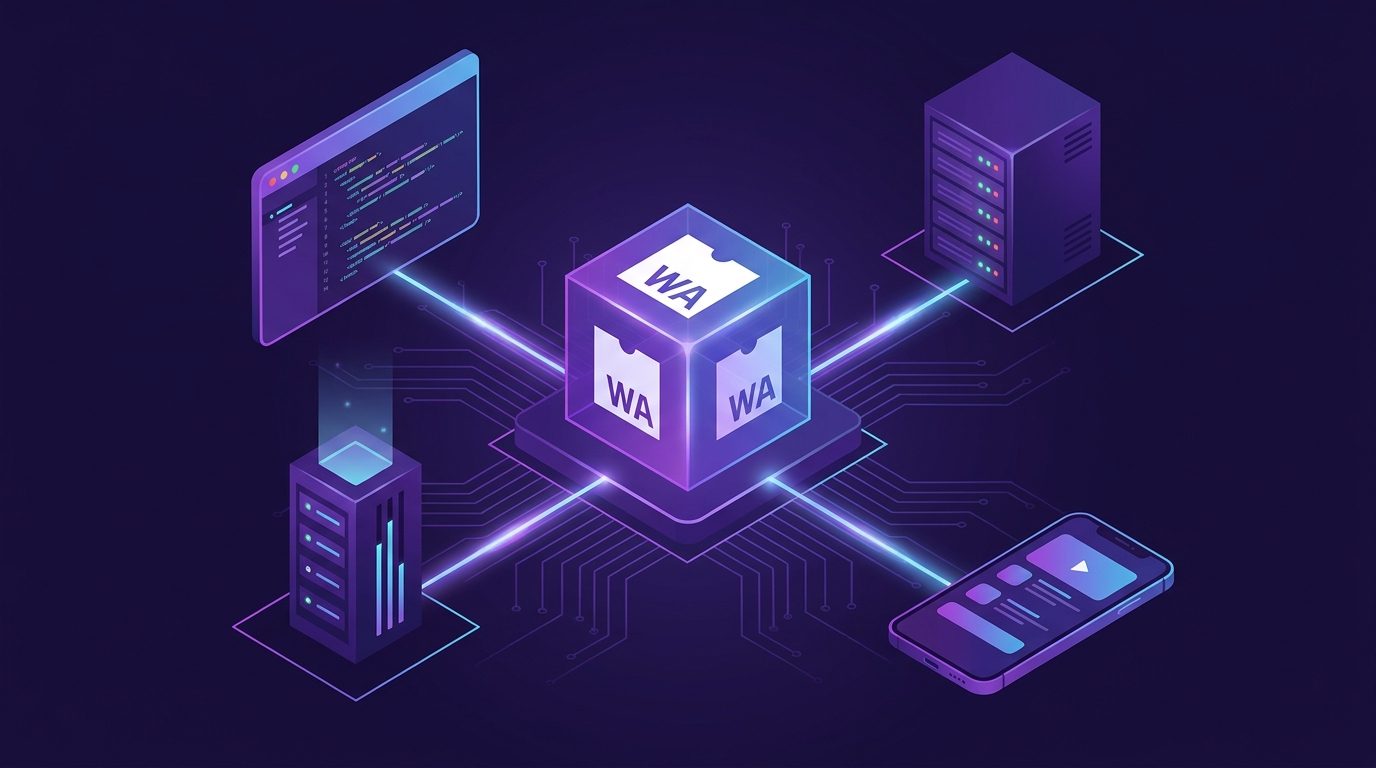
WebAssembly shipped in browsers in 2017 as a compilation target for performance-critical code — a way to run C, C++, or Rust at speeds that JavaScript cannot match for compute-heavy workloads. For the first few years, the conversation was almost entirely about browser use cases: game engines, image processing, video codecs. That framing has quietly become obsolete. In 2026, some of the most active WebAssembly deployments have nothing to do with browsers at all.
Cloudflare Workers runs more than 50 million requests per second across 300 edge locations, with Wasm as a first-class execution target alongside JavaScript. Fastly's Compute platform — built entirely around Wasm — is processing production traffic for customers who require sub-millisecond cold starts that container-based serverless cannot deliver. Databases like SQLite (via libsqlite-wasm), observability tools, and plugin systems in editors and game engines are deploying Wasm as a safe, portable plugin runtime. The technology has found product-market fit outside the context it was designed for.
What makes Wasm interesting as a runtime
Three properties set WebAssembly apart from alternatives like containers, native binaries, or JVM bytecode.
Binary portability. A .wasm file is a compact binary format with a well-specified instruction set. Compile once from Rust, C, Go, Swift, Python, or any language with a Wasm target, and the same binary runs on any host that has a compliant runtime — x86, ARM, RISC-V, regardless of OS. This is the promise the JVM made in the 1990s, but without the GC overhead or the platform-specific runtime installation requirement.
Near-native execution speed. Wasm's instruction set is designed to compile directly to machine code with minimal overhead. Modern runtimes use tiered compilation: a fast baseline compiler handles cold-start latency, a Cranelift- or LLVM-based optimizing compiler kicks in for hot functions. Benchmark results from the Bytecode Alliance show Wasm executing within 1.5–2x of equivalent native code for CPU-bound workloads — far better than interpreted languages and competitive with JIT-compiled environments.
Deterministic sandboxing. Every Wasm module runs in a memory-isolated sandbox. It cannot access host memory outside its own linear memory region. It cannot make system calls directly. It cannot spawn threads or open file descriptors without explicit permission from the host. This is not security theatre — it is enforced at the instruction level by the runtime. The same isolation model that prevented browser exploits makes Wasm a compelling plugin system: you can load untrusted third-party code, give it exactly the capabilities you want, and sandbox the rest.
WASI: the missing piece for running Wasm outside browsers
A Wasm module in the browser gets its system interface from JavaScript — the host exposes APIs for DOM access, networking, and storage. Outside the browser, there is no JavaScript host. This is the gap that WASI — the WebAssembly System Interface — was designed to fill.
WASI defines a capability-based API surface for filesystem access, clocks, random number generation, network sockets, and environment variables. A Wasm binary compiled against WASI can open files, read environment variables, and write to stdout using a standardised interface — and the host runtime decides at instantiation time which capabilities to actually grant. The same binary runs in Wasmtime on a Linux server and in a browser-side Wasm host without recompilation; only the capability grants differ.
WASI Preview 2, finalized in 2024 and seeing broad runtime adoption through 2025–2026, is the more significant advance. It introduces the component model — a way to compose multiple Wasm modules with typed interfaces using a new interface definition language called WIT (Wasm Interface Types). Instead of passing raw memory pointers between modules, components expose strongly typed APIs. A component that processes images can declare that it accepts image: png-image and returns thumbnail: jpeg-image, and the Wasm runtime can link it to any other component that speaks the same types, regardless of what language each was compiled from. This is the piece that makes "compile from Rust, call from Python" actually composable rather than just theoretically possible.
Runtimes and platforms
The runtime ecosystem has matured considerably since the early days of node-only experimentation.
Wasmtime, maintained by the Bytecode Alliance — a standards body whose members include Mozilla, Fastly, Intel, Microsoft, and Google — is the reference implementation for WASI. Written in Rust, it uses the Cranelift code generator for optimised compilation. Wasmtime is the runtime underlying Fastly Compute@Edge and is widely used for embedding Wasm in server applications. The CLI (wasmtime run module.wasm) makes it trivial to test Wasm binaries locally.
WasmEdge, a CNCF sandbox project, targets cloud-native and AI workloads. It has first-class support for ONNX model inference via a native wasi-nn implementation, making it the go-to runtime for edge AI use cases. WasmEdge integrates with containerd and can be used as a lightweight alternative to a full container runtime for Wasm workloads in Kubernetes clusters — a deployment pattern that avoids the overhead of a full Linux userland per workload.
Wasmer takes a different approach: it prioritizes language-native embedding, with SDKs for Rust, Python, Go, Java, PHP, and Ruby that let you instantiate and call Wasm modules from host-language code with minimal boilerplate. Wasmer also ships WASIX — an extension of WASI that adds POSIX-compatible threading, process forking, and pipe primitives, enabling more Unix-like programs to compile to Wasm without modification.
Spin, built by Fermyon, is an opinionated application framework for Wasm microservices. Where Wasmtime is a runtime you embed, Spin is a platform you build on — define your components in a spin.toml manifest, implement handlers in Rust, Go, or Python, and Spin manages HTTP routing, key-value storage, SQL access, and pub/sub via Wasm-native APIs. Fermyon Cloud runs Spin applications directly; the framework can also deploy to Kubernetes via the Spin Operator.
On the platform side, Cloudflare Workers pioneered Wasm-at-the-edge as a production service. Workers uses V8 isolates with Wasm support to achieve cold-start times under 5 milliseconds globally — a figure that container-based Lambda-style functions cannot approach. Fastly Compute@Edge goes further: every Compute instance is a Wasm module, with no JavaScript runtime at all, enabling sub-millisecond execution of request-handling logic at Fastly's edge nodes.
Real use cases in 2026
Plugin systems are arguably Wasm's most successful non-browser use case by deployment breadth. Extism (by Dylibso) is an open-source plugin system built on Wasm: embed a small Extism host in your application, and any third party can write plugins in Rust, Go, Python, or TypeScript that run in a sandboxed Wasm environment with declared capabilities. Projects like Zed editor, WasmCloud, and several database extensions use this pattern. The Wasm isolation model solves the plugin author trust problem that has plagued native plugin systems for decades.
Edge functions are the highest-volume deployment. Cloudflare Workers processes billions of requests daily using Wasm modules written by customers in Rust and C++ alongside JavaScript workers. Use cases range from request authentication and A/B routing to image transformation and HTML rewriting at the edge — logic that would otherwise require a round trip to an origin server.
AI inference at the edge is an emerging use case where Wasm's portability and WasmEdge's wasi-nn support intersect. Small ONNX models — image classifiers, embedding models, text categorisation — can be compiled into self-contained Wasm bundles and deployed to edge nodes without per-node dependency management. WasmEdge supports hardware acceleration via OpenVINO and TensorFlow Lite backends, keeping inference latency competitive with native deployments for models in the sub-100M parameter range.
Portable CLI tools built as Wasm binaries distribute as single files that run on any platform with a Wasm runtime — no architecture-specific builds, no dynamic linking issues. The wasi-vfs project allows bundling a virtual filesystem into the binary, enabling tools that behave like statically linked executables but compile once from a single source tree.
Where it still has rough edges
The threading story remains incomplete. The threads proposal — shared linear memory and atomics — is implemented in major browsers and in Wasmtime, but the interaction between threads and the WASI capability model is still being standardised. Most production Wasm deployments outside browsers are single-threaded, which is a real constraint for CPU-bound workloads that expect to parallelise across cores.
Toolchain maturity varies significantly by language. Rust has excellent Wasm support — cargo build --target wasm32-wasi works for most crates, and the ecosystem is well-tested. Go's Wasm output has improved in Go 1.21–1.24 but still produces large binaries and has limited WASI support outside the experimental GOOS=wasip1 target. Python via CPython-wasm or Pyodide works, but the interpreter binary alone is 20–30 MB. Languages with garbage collectors add runtime overhead — the GC itself must be compiled into the Wasm module, and without a host-managed heap, memory usage patterns differ from native deployments.
Debugging remains painful. DWARF debug info can be embedded in Wasm binaries, and tools like wasm-pack and browser DevTools support source maps for Rust and C++. But step-through debugging of Wasm modules in a server runtime — setting breakpoints, inspecting stack frames, watching memory — is not yet as smooth as debugging native code or JVM bytecode. The experience is improving but lags behind native toolchains by several years of polish.
The WASI API surface is still incomplete for general-purpose server applications. Asynchronous I/O (via wasi-io and wasi-http in WASI Preview 2) is available but the ecosystem of libraries targeting it is thin. Developers porting existing server code to Wasm often find that their dependencies assume POSIX interfaces that WASI either doesn't provide or wraps with enough friction to require significant porting work.
Where Wasm is heading
The component model's standardisation is the most consequential near-term development. As WASIp2 adoption spreads across runtimes — Wasmtime, WasmEdge, Wasmer, and the JS engine implementations in browsers — the ability to compose typed Wasm components from different language ecosystems without FFI friction becomes a genuine platform primitive. The tooling around WIT interface generation is maturing rapidly in the Bytecode Alliance's cargo-component and wit-bindgen projects.
The convergence of eBPF and Wasm is a longer-horizon development worth watching. Both technologies offer sandboxed code execution within a host environment — eBPF in the Linux kernel, Wasm in userspace runtimes. Projects like bpf-wasm explore using Wasm as a safer, more portable alternative to native eBPF programs for kernel-adjacent observability and networking. The instruction sets are different, but the architectural goals — capability-controlled, sandboxed, high-performance execution of untrusted code — are identical.
The browser was never going to be WebAssembly's largest deployment surface. A technology that provides deterministic sandboxing, near-native performance, and genuine binary portability across architectures is solving problems that exist everywhere in systems software — not just in the JavaScript runtime. The runtimes, the standards, and the real production deployments are now mature enough that "Wasm is a browser thing" is the same kind of category error as "Linux is a web server OS." True once, and now entirely beside the point.