WebAssembly has found its most compelling use case outside the browser
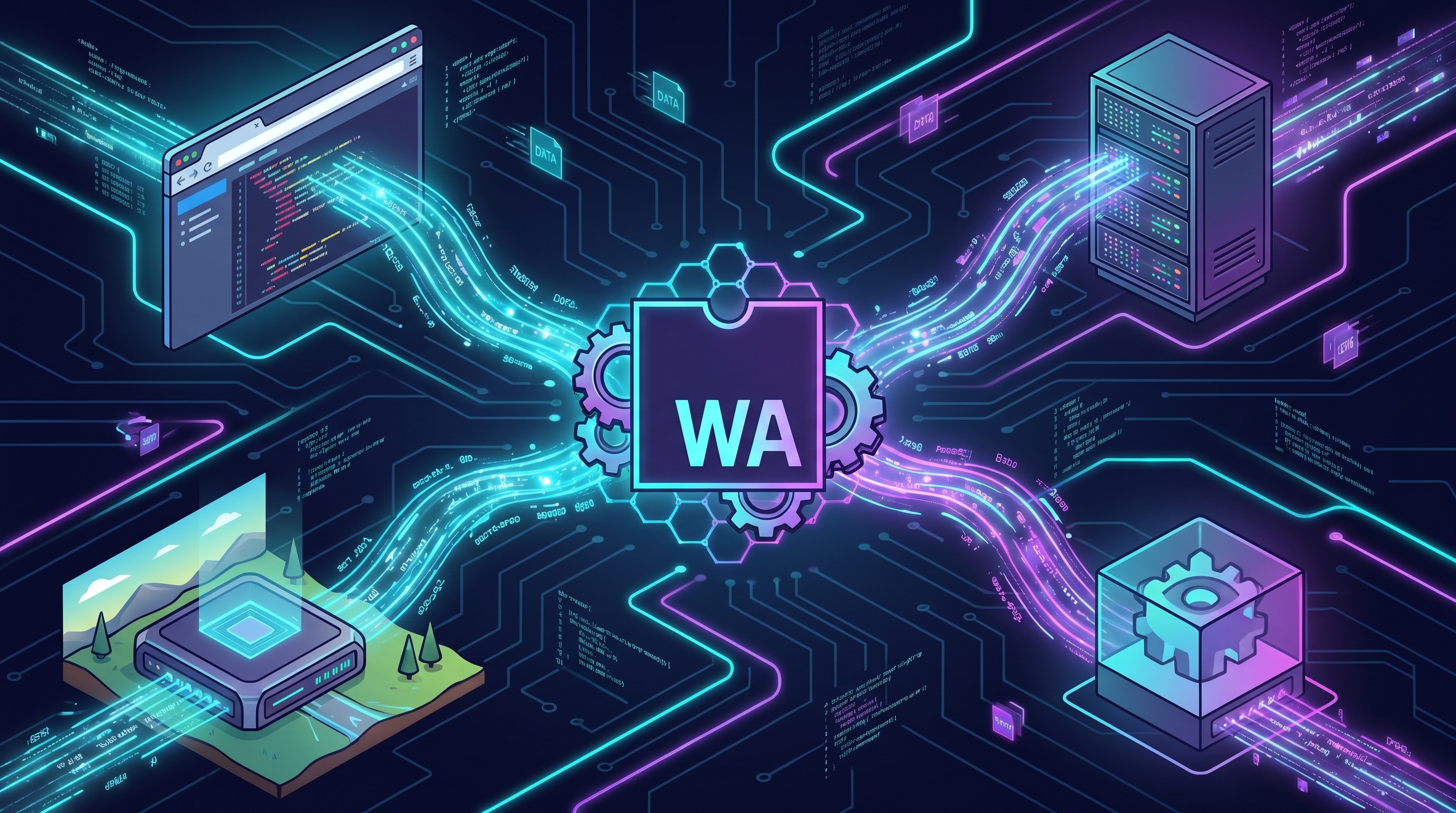
When WebAssembly first shipped in major browsers in 2017, the pitch was straightforward: run near-native code in the browser without JavaScript. Early adopters ported C++ game engines, Python interpreters, and image processing libraries to the web. It worked, but the use cases felt niche — most web applications did not need C-speed compute, and the JavaScript ecosystem was deep enough that WASM rarely replaced it for typical development.
The more compelling application turned out to be outside the browser entirely. Over the past two years, WebAssembly has emerged as a credible runtime for three distinct server-side contexts — serverless functions, plugin systems, and edge computing — where its security model and portability matter more than raw performance.
The Property That Makes WASM Different on the Server
The key characteristic is sandboxing by default. A WASM module runs in an isolated memory space with no access to the host system unless explicitly granted through the WebAssembly System Interface (WASI). It cannot read files, open network connections, or spawn processes without explicit capability grants from the host. For browsers this was a security requirement; for server environments it is an architectural advantage.
Compare this to the traditional plugin problem. When you want to run third-party code inside your application — a plugin, an extension, a user-defined function — the options have historically been painful. You either trust the plugin developer implicitly and expose your process to any bugs or malicious code, or you run plugins in a subprocess with full IPC overhead, or you implement complex capability whitelisting that is runtime-specific and hard to audit. WASM solves this with a single primitive: modules run in their own sandbox, and you define exactly which host functions they can call through a typed interface.
Serverless Functions: The Cold-Start Advantage
Cloudflare Workers was one of the earliest production bets on WASM for serverless. Workers run JavaScript and WASM in V8 isolates at Cloudflare's edge network, with the central claim that cold start times drop dramatically because WASM modules have no operating system to bootstrap. Cloudflare reports median cold starts under 5 milliseconds for Worker invocations, compared to 100–500ms for container-based Lambda functions.
Fastly took a similar approach with its Compute platform, which runs WASM exclusively and positions it as the replacement for VCL (Varnish Configuration Language). Developers write in Rust, Go, JavaScript, or any WASM-targeting language, compile to a module, and deploy it as a Fastly service — no containers, no provisioned capacity, no cold-start management.
Fermyon's Spin framework extends this approach to general application development. Spin lets you build microservices that compile to WASM and run without containers or Kubernetes. Each function is a module that starts in milliseconds, handles a request, and terminates. No warm container pool, no per-function sidecar infrastructure, no container image registry to maintain.
Plugin Systems: Where the Security Model Pays Off
Extism is an open-source plugin development kit that uses WASM to let developers embed third-party code safely. Rather than requiring plugins to be written in the host language, Extism lets plugins be compiled from any language that targets WASM — Go, Rust, Python, JavaScript. The host defines a small typed interface; the plugin talks only through that interface. A buggy or malicious plugin cannot escape the sandbox.
Grafana Labs adopted this model for backend plugins. Newer Grafana plugin types execute as WASM modules inside the Grafana backend, isolated from each other and from the Grafana process. This eliminates a class of supply-chain attacks where a compromised plugin gains full process access — a real concern in an ecosystem with hundreds of third-party contributions.
Envoy Proxy added WASM extension support for the same reason: a WASM module crash does not take down the proxy process or affect traffic flowing through other extensions. For edge infrastructure that must stay up, this failure isolation matters more than raw performance.
The Component Model: The Missing Piece Now Landing
The WASM ecosystem's most important recent development is the Component Model, introduced in WASI 0.2 in early 2024. Previously, WASM modules communicated through shared memory buffers — low-level and error-prone. The Component Model introduces typed interfaces that modules can implement and consume, enabling composition without shared memory.
In practical terms, this means you can define a typed interface and have plugins implement it regardless of their source language. A Rust host can call a Python or Go plugin through the same typed interface, with the WASM runtime handling translation. This solves the biggest friction point in WASM plugin systems: the requirement for FFI bindings or a shared runtime.
The Bytecode Alliance — Mozilla, Intel, Fastly, Microsoft, and Google — has been the primary organization advancing WASM outside the browser. Their Wasmtime runtime is the reference implementation for WASI 0.2 and what most production deployments build on.
Current Limitations Worth Knowing
WASM outside the browser is production-ready for specific workloads but not universally mature. Threading requires shared memory, which conflicts with the isolation model most serverless runtimes use — so most deployments are single-threaded, limiting applicable workloads. WASM GC (garbage collection), which lets managed-language runtimes compile to WASM without bundling their own GC, only shipped in major browsers in late 2023 and is not yet widely supported in server runtimes. Toolchain quality varies significantly: Rust and Go have the most mature WASM targets; Python and JavaScript work but with more operational complexity.
For developers building platforms that accept third-party code — API gateways, automation tools, observability products, developer marketplaces — WASM is now a serious architectural option for the plugin layer. The security model is real, performance is acceptable for request-scoped workloads, and the Component Model is making cross-language composition practical. The server-side use cases are where the architectural properties that make WASM interesting are most clearly differentiated from alternatives.