Why Every Major Country Is Building Its Own AI — The Sovereign AI Economy Explained
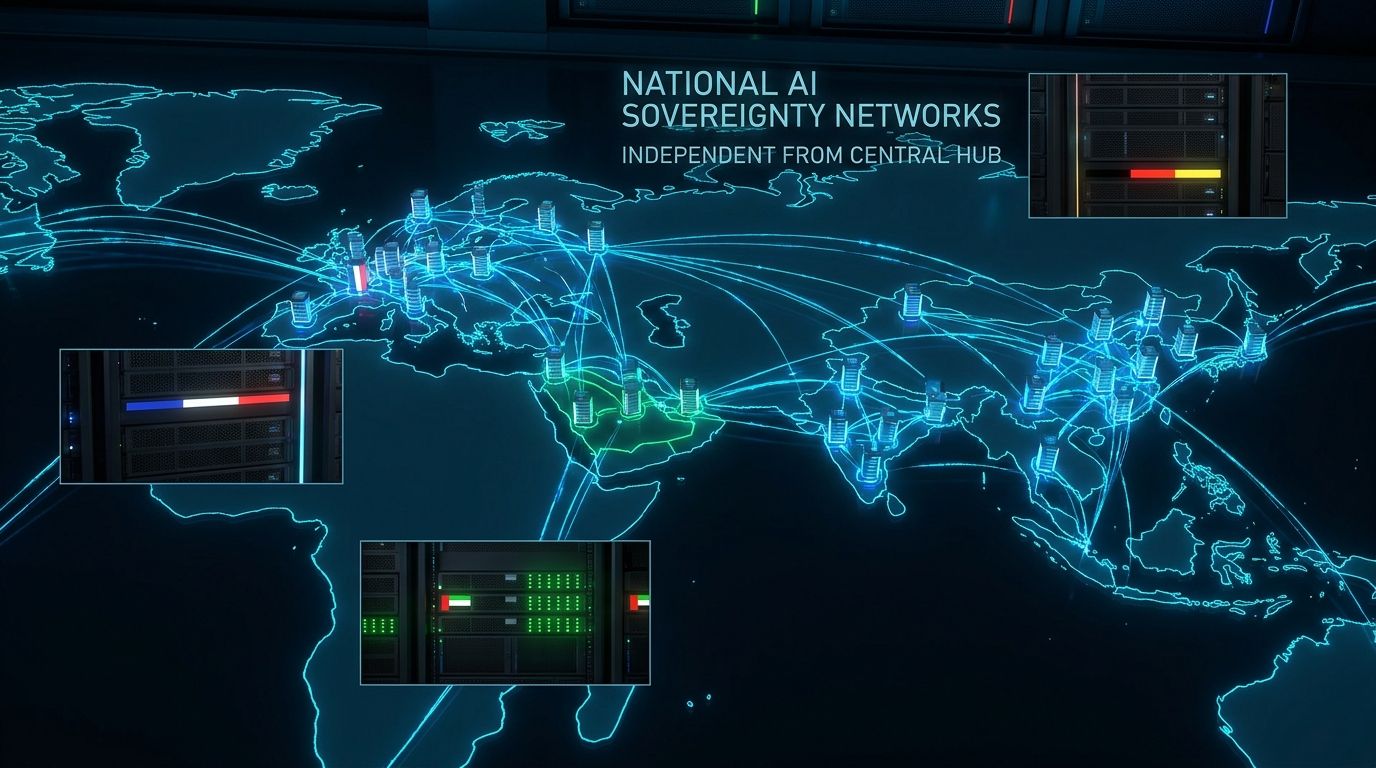
For the first three years of the generative AI era, the global story was essentially American. GPT-4, Claude, Gemini, Llama — the foundational models that defined the field were built by US companies or, in Meta's case, released by one. That framing understated what was already happening elsewhere. Since 2024, a distinct global dynamic has been accelerating: governments and regions are making substantial investments to ensure that AI infrastructure critical to their economies is not entirely dependent on a handful of American companies. The term of art is "sovereign AI."
Why Sovereignty Matters for AI
The rationale for sovereign AI is multi-layered. The most immediate concern is data residency and compliance: a government agency or regulated enterprise using a US AI provider must grapple with the reality that data may transit or be stored on infrastructure subject to US jurisdiction, with all the FISA, CLOUD Act, and national security letter implications that entails. For sensitive government workloads — tax records, health data, classified information, defence applications — this is not a theoretical concern.
The deeper strategic concern is dependency. The Huawei episode demonstrated that the US is willing and able to cut off access to US technology for geopolitical reasons. A country whose AI capability depends on OpenAI's API is, in a meaningful sense, exposed to the same kind of leverage. Developing domestic capability — even if it's less powerful than the frontier — provides insurance against that dependency.
The cultural and linguistic argument is more prosaic but practically significant. Large language models trained primarily on English-language internet data perform better in English than in other languages. Arabic, Persian, Turkish, and many other languages are underserved at the frontier. A model trained on a high-quality domestic corpus, with domain-specific knowledge of local law, culture, and context, may outperform a GPT-4-class model for specific local use cases even if it falls short on general benchmarks.
Europe: Mistral and the French Bet
Mistral AI has become the most prominent symbol of European AI ambition. Founded in 2023 by former DeepMind and Meta researchers, the Paris-based company raised $385 million at a $2 billion valuation in its Series B, followed by a $1.1 billion raise at a $6 billion valuation in mid-2024. The French government invested €109 million in the company's early rounds as part of its explicit ambition to maintain a European frontier AI competitor.
Mistral's approach is to produce capable open-weight models alongside commercial API offerings. Mistral 7B and Mixtral 8x7B were significant milestones in demonstrating that smaller, efficiently trained models could compete with much larger ones. Mistral Large 2, released in 2024, positioned the company as a genuine alternative to GPT-4-class models for enterprise customers. The company has partnerships with major European telecoms and cloud providers, and the French government has deployed Mistral models for several public administration use cases.
Germany's Aleph Alpha, an earlier AI sovereignty story, has pivoted its strategy. After raising over €500 million and positioning itself as Germany's answer to OpenAI with its Luminous model family, Aleph Alpha shifted in 2024 toward providing a sovereign AI platform and consulting rather than competing at the frontier model level. The company focuses on enterprise customers — Bosch, SAP, and German federal agencies — that need AI capability hosted entirely within EU jurisdiction, with full audit trails and data lineage. It's a narrower position than originally claimed, but arguably a more defensible one given the capital intensity of frontier training.
The Gulf States: Scale and Speed
The most aggressive sovereign AI investments in absolute terms are coming from the Gulf Cooperation Council states. The UAE made the earliest significant move with the Technology Innovation Institute (TII), an Abu Dhabi government research centre that released the Falcon model family — Falcon 40B was, briefly in 2023, the most capable openly available model. Falcon 3, released in late 2024, includes a competitive family of models from 1B to 10B parameters. TII's work has been significant for normalising the idea that non-US institutions can produce frontier-quality open models.
The UAE's commercial AI strategy runs through G42, the Abu Dhabi technology group that secured a landmark $1.5 billion investment from Microsoft in April 2024. The deal included commitments that G42 would migrate workloads off Chinese-made hardware — a geopolitical condition that reflected US concern about Chinese influence in Gulf AI infrastructure. G42 has subsequently partnered with OpenAI, Cerebras, and other US companies, positioning itself as a regional deployment and integration platform rather than a model developer.
Saudi Arabia's ambitions are larger in scale. The Kingdom announced plans in 2024 for over $100 billion in AI investment over five years, channelled through SDAIA (the Saudi Data and AI Authority), the Public Investment Fund, and newly created entities including Humain — a PIF-owned AI company launched in 2025 to develop and deploy Arabic-first AI systems. Saudi Arabia has also invested heavily in AI education infrastructure through KAUST and partnership programmes with leading US universities.
Asia: India, Japan, and the National Model Race
India launched its India AI Mission in 2024 with a ₹10,371 crore ($1.25 billion) commitment, focused on building domestic AI compute infrastructure and supporting Indian AI startups developing local models. Sarvam AI, an Indian startup developing Hindi-first multilingual models, has emerged as one of the more credible domestic players. The Indian government's compute buildout — a national AI compute cluster targeting 10,000+ GPUs — is intended to reduce dependency on US cloud providers for sensitive government AI workloads.
Japan's approach has been more distributed. PFN (Preferred Networks), the Toyota-backed AI company, has long pursued an independent research track. Sakana AI, founded by former Google researchers including David Ha, launched in 2023 with a focus on nature-inspired AI and has been developing foundation models with a Japanese cultural and linguistic emphasis. NEC and Fujitsu both have domestic LLM programmes aimed at Japanese government and enterprise deployments.
South Korea has NAVER's HyperCLOVA X, which at 82 billion parameters is one of the largest Korean-language models. Samsung and KT have their own programmes. The Korean government has a national AI strategy targeting 10,000 domestic AI companies by 2030.
What Sovereign AI Actually Means for the Market
Sovereign AI investments don't primarily compete with OpenAI and Anthropic at the consumer layer — they target specific government, regulated enterprise, and cultural-domain use cases where the case for a domestic alternative is strong on grounds other than raw capability. The competition is for procurement contracts, not for the ChatGPT user base.
The realistic near-term outcome is a tiered AI market: US frontier models for general-purpose capability where cost and performance are the main variables, and sovereign or regional models for use cases where data jurisdiction, language, cultural alignment, or regulatory compliance are the primary requirements. That's not a dystopian fragmentation scenario — it's roughly how the enterprise software market has always worked. The question is whether any sovereign programme produces a model capable enough to compete at the frontier, not just within protected procurement channels. France's bet on Mistral is the closest attempt to do exactly that.