Wi-Fi 7 Is Here. Your ISP Is Still the Bottleneck.
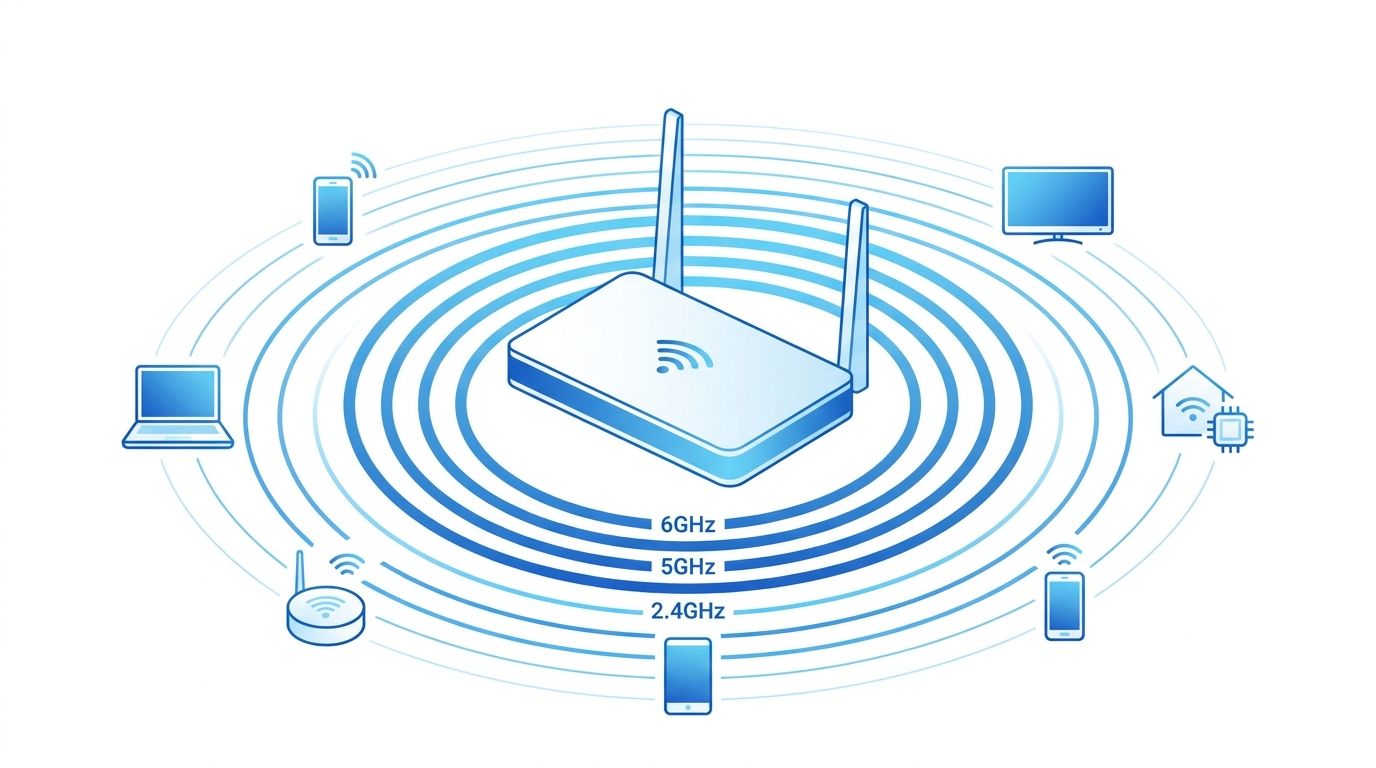
Wi-Fi 7 — formally IEEE 802.11be — is now shipping in consumer routers from Asus, TP-Link, Netgear, and others, with a wave of client devices including the latest Android flagships and Intel-based laptops supporting the new standard. The marketing claims are impressive: up to 46 Gbps theoretical throughput, dramatically lower latency, and a new multi-link operation feature that fundamentally changes how devices use wireless spectrum.
Most of those numbers are theoretical. For the majority of users, the real-world upgrade from Wi-Fi 6E to Wi-Fi 7 will be meaningful but not dramatic — at least until internet connections and home networks are reconfigured to take advantage of it.
What Multi-Link Operation Actually Means
The headline feature of Wi-Fi 7 is Multi-Link Operation (MLO), and it's genuinely new rather than just an incremental spec bump. Previous Wi-Fi generations allowed devices to connect on one radio band at a time — either 2.4 GHz, 5 GHz, or (with Wi-Fi 6E) 6 GHz. MLO lets a device maintain simultaneous connections on multiple bands and aggregate them, or dynamically switch between them based on congestion, interference, and application priority.
The practical implications are two-fold. First, aggregate throughput can exceed what any single band provides. A device connected on both 5 GHz and 6 GHz simultaneously can combine their bandwidth. Second, and arguably more important, MLO dramatically reduces latency jitter — the unpredictable variation in packet delivery times that causes lag in gaming, video calls, and real-time applications.
The 320 MHz Channel and 4K QAM
Wi-Fi 7 also introduces 320 MHz channel width in the 6 GHz band, doubling Wi-Fi 6E's maximum 160 MHz channels. Combined with 4096-QAM (4K QAM) modulation — up from 1024-QAM in Wi-Fi 6 — the peak theoretical throughput climbs substantially on a per-link basis. In practice, 320 MHz channels require clear, uncongested 6 GHz spectrum, which exists primarily in countries where regulators have made the full upper 6 GHz band available.
What You're Actually Limited By
Here's the honest accounting: a mid-range Wi-Fi 7 router delivering 5-10 Gbps of aggregate wireless throughput is capacity that most home internet connections can't saturate. Gigabit fiber — the fastest widely available residential service — feeds at 1 Gbps. Even 2.5 Gbps multi-gig plans, increasingly available in fiber-dense markets, leave most of the Wi-Fi 7 headroom untouched.
The upgrade makes more sense in specific scenarios: homes with many devices running simultaneously, professionals doing large local file transfers between NAS and workstations, or users with multi-gig fiber service. The wired backhaul constraint matters too — many mesh router systems use wireless backhaul where Wi-Fi 7's headroom pays off most.
Client Device Readiness
Qualcomm's Snapdragon 8 Elite and MediaTek Dimensity 9400 both include Wi-Fi 7 radios, meaning most 2025-2026 Android flagships support the standard. Intel's Meteor Lake and Lunar Lake laptop platforms ship with Wi-Fi 7. Apple has lagged slightly — the iPhone 16 line supports Wi-Fi 6E, with Wi-Fi 7 expected in the iPhone 17 generation or later.
Should You Upgrade Now?
If your current router is performing well and your internet connection is below 1 Gbps, the answer is probably not yet. Wi-Fi 7 hardware is still at premium pricing — entry-level routers start around $200-250, and capable mesh systems run $400-700. Early adopter pricing typically falls 30-40% within 12-18 months.
If you're building or renovating, or replacing a failing router anyway, Wi-Fi 7 is worth buying for future-proofing. The MLO latency improvements are real even at low throughput, the hardware will remain capable for 5-7 years, and multi-gig internet is coming to more markets quickly. The gap between what Wi-Fi 7 promises and what your ISP delivers isn't a reason to dismiss the upgrade — it's a reason to think of it as infrastructure that's ready ahead of schedule.