Amazon Launched 29 More Kuiper Satellites the Same Night Blue Origin's Rocket Exploded on the Pad
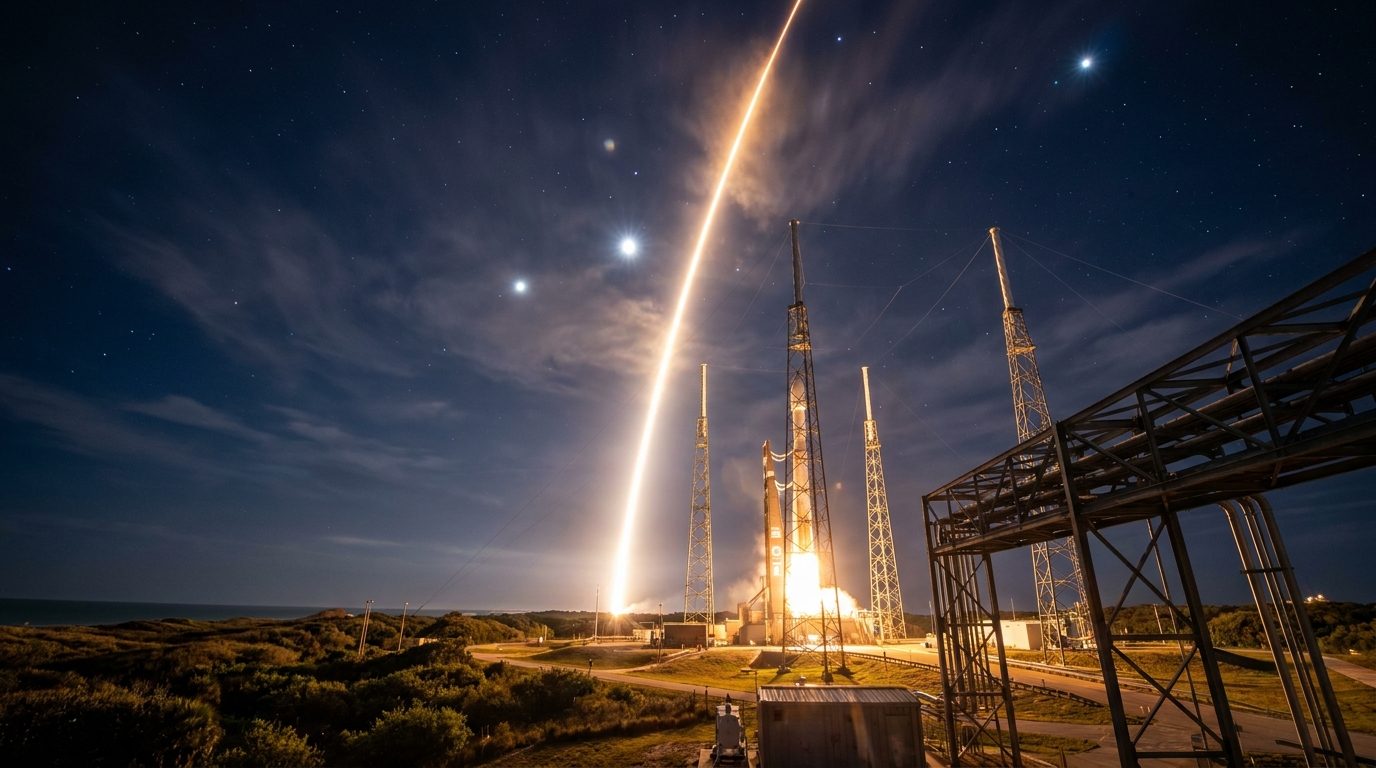
The evening of May 29, 2026, delivered a sharp irony to anyone watching the skies over Cape Canaveral. Roughly a mile from where smoke still billowed from the scorched remains of Blue Origin's New Glenn rocket, a United Launch Alliance Atlas V climbed confidently into the dark Florida sky, carrying 29 Amazon Project Kuiper broadband satellites toward low Earth orbit. Amazon's satellite internet ambitions received a significant boost and a serious blow within hours of each other.
The Successful Launch
ULA's mission, designated Amazon Leo 7 — or Leo Atlas 07 (LA-07) in ULA's internal nomenclature — lifted off from Cape Canaveral Space Force Station without drama. The Atlas V, one of the most reliable rockets in American spaceflight history, performed flawlessly, inserting all 29 Kuiper production satellites into their target orbit. The deployment was smooth, and Amazon confirmed contact with the new spacecraft following separation.
With this seventh batch of production satellites now in orbit, Amazon has accumulated more than 200 Kuiper satellites in space since its deployment campaign began in earnest. Each successful launch chips away at the enormous gap between where the constellation stands today and the roughly 3,200 satellites that Amazon plans to eventually orbit. That milestone now feels measurably closer — even if the path there just got more complicated.
The Blue Origin Shadow
Just hours before the Atlas V launch, Blue Origin's New Glenn rocket suffered a catastrophic failure during a static fire test on a nearby pad at the same Cape Canaveral complex — an event we covered in a separate report. The explosion was visually dramatic and structurally destructive, rendering that launch pad out of service for an unknown period.
The timing matters enormously for Amazon. The company had contracted 12 New Glenn launches with Blue Origin specifically for Kuiper satellite deployment. Those launches are now deeply uncertain. Blue Origin has not indicated a timeline for returning to flight, and the physical damage to its pad means even an optimistic recovery scenario is measured in months, not weeks. For a program that depends on launching hundreds of satellites per year to hit its commercial service targets, losing a dozen contracted flights — even temporarily — is a serious logistical problem.
Amazon has not yet commented publicly on how it plans to compensate for potential New Glenn unavailability, but the pressure to secure alternative launch contracts is now acute.
Where Kuiper Stands
Over 200 Kuiper satellites in orbit represents meaningful progress, but it is a fraction of what Amazon needs for a functional global service. The company's regulatory license from the FCC requires it to have half of its planned constellation — roughly 1,600 satellites — operational by July 2026. Whether Amazon can satisfy that requirement with its current trajectory, especially with New Glenn now sidelined, remains an open question.
The comparison to SpaceX's Starlink is sobering. Starlink has surpassed 7,000 operational satellites and serves millions of paying customers worldwide. SpaceX launches its own Starlink missions at a pace that no competitor has come close to matching — on the very same night as the Kuiper launch and the Blue Origin explosion, SpaceX launched another 29 Starlink satellites from a separate pad, demonstrating the relentless cadence that has made Starlink the dominant player in LEO broadband.
Amazon's commercial service target remains the end of 2026. At the current launch pace — and assuming alternative providers can partially fill the New Glenn gap — that timeline is still technically achievable, though increasingly tight.
Atlas V's Role
The Atlas V rocket that carried Amazon's satellites on May 29 is itself a vehicle in its final chapter. ULA's veteran workhorse, jointly developed by Boeing and Lockheed Martin before their launch businesses merged, is being phased out in favor of ULA's next-generation Vulcan Centaur rocket. The Atlas V has accumulated an extraordinary record of mission success over more than two decades of operation, and its continued availability for Kuiper missions has been a reliable backstop for Amazon's deployment schedule.
The transition to Vulcan Centaur is already underway, with the new rocket having completed its inaugural flights. Vulcan is designed to carry heavier payloads at lower cost, and Amazon has contracts with ULA for Vulcan launches as well. As Atlas V retires from service over the coming months, Vulcan will become ULA's primary vehicle for Amazon's constellation — assuming it can demonstrate the launch cadence needed to support Kuiper's aggressive schedule.
The Starlink Race
SpaceX's decision to launch 29 Starlink satellites on the same evening was not a coincidence of planning — it was simply another Tuesday for the world's most prolific launch provider. SpaceX regularly conducts multiple Falcon 9 launches per week from its facilities at Cape Canaveral and Vandenberg, and Starlink missions have become almost routine. The company's vertical integration — building and launching its own satellites on its own rockets — gives it a structural cost and cadence advantage that rivals cannot easily replicate.
The pace of LEO satellite deployment in 2026 is, by any historical measure, extraordinary. On a single evening, three separate launch events (one failure, two successes) occurred within miles of each other at Cape Canaveral, collectively involving dozens of satellites. The industrialization of low Earth orbit is proceeding faster than most observers predicted even five years ago.
For Amazon, the challenge is not merely technical. It is a race against a competitor that has a multi-year head start, proven infrastructure, and a manufacturing line that produces satellites faster than any other company on Earth.
What Comes Next
Amazon's Kuiper program is proceeding, and the successful Atlas V launch on May 29 is evidence that its deployment campaign is real and gathering momentum. But the Blue Origin partnership — once a cornerstone of Kuiper's launch strategy — is now a liability rather than an asset. Amazon will need to move quickly to secure additional capacity from ULA's Vulcan, from Arianespace, from Rocket Lab, or even from SpaceX itself if it wants to maintain any realistic path to its 2026 commercial service target.
The satellites that rode an Atlas V into orbit on May 29 will begin testing and commissioning in the coming weeks. They will eventually join Amazon's growing constellation, beaming broadband to customers on the ground. But the story of how Amazon gets from 200 satellites to 3,200 — and whether it can do so fast enough to matter in a market Starlink already dominates — will be defined by what happens in the months immediately ahead.
Originally reported by Spaceflight Now. Read the original article for additional details.
View original source