Blue Origin's New Glenn Rocket Destroys Its Own Launch Pad in Static Fire Test Gone Wrong
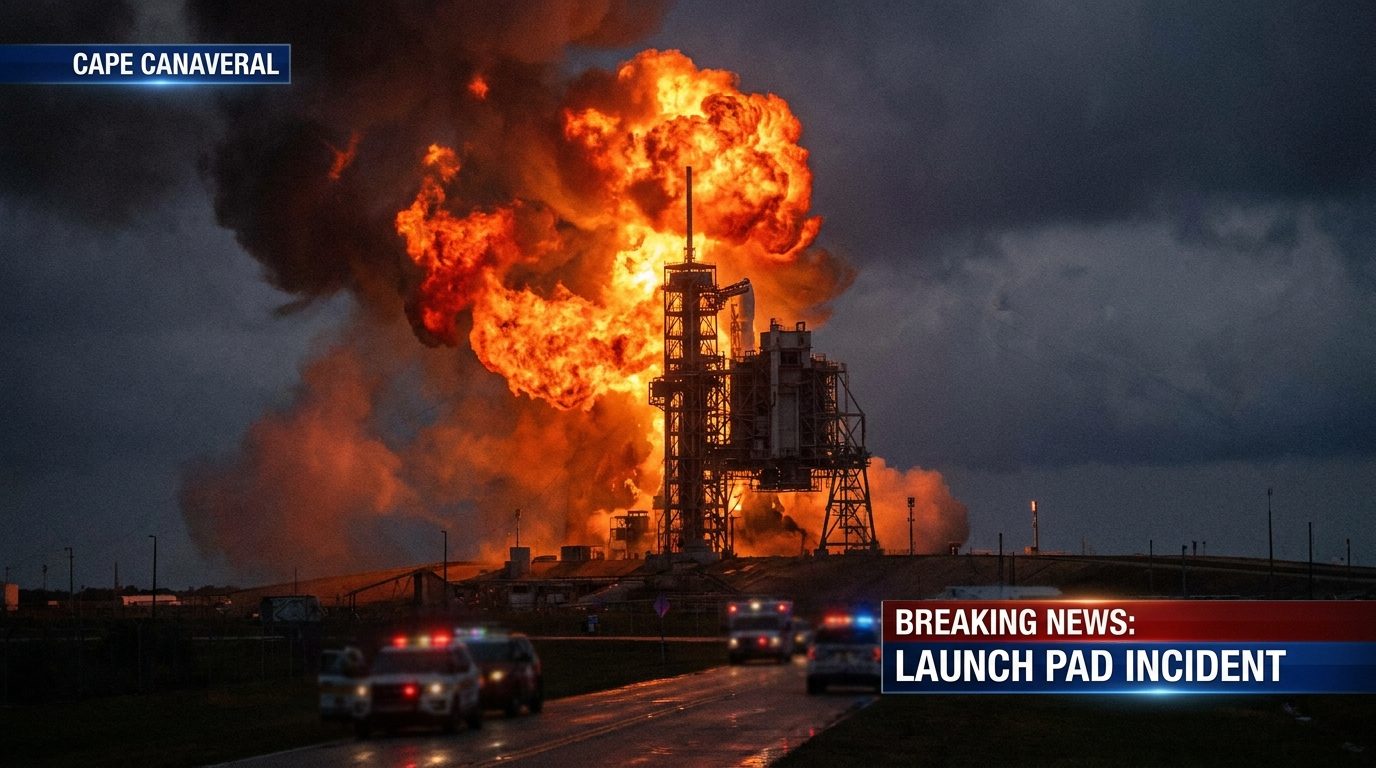
A catastrophic explosion tore through Launch Complex 36 at Cape Canaveral Space Force Station late on May 28, 2026, as Blue Origin's New Glenn rocket detonated during a routine pre-launch static fire test. The blast, which lit up the Florida coastline around 9 p.m. EDT, destroyed the first-stage booster — christened "No, It's Necessary" — along with the erector-gantry and at least one lightning protection tower at the pad. Remarkably, no personnel were injured. However, the incident has handed Blue Origin its third major failure in just six weeks, and the destruction of the launch infrastructure itself may prove more damaging than losing the rocket.
What the Cameras Showed
Eyewitness video and webcam footage from across the Space Coast captured the moment New Glenn's seven BE-4 methane-fueled first-stage engines ignited at approximately 9 p.m. local time. Within seconds, what should have been a controlled static fire — where engines are held down and tested at full thrust before a flight — became an uncontrolled inferno. A towering orange and red fireball rose hundreds of feet into the night sky, briefly turning darkness to daylight over the surrounding area.
As the flames subsided, the scale of the destruction became clear: the erector-gantry that had cradled New Glenn on the pad had collapsed, and at least one of the tall lightning protection towers flanking the complex was gone. The first-stage booster itself was a total loss. Launch Complex 36, which Blue Origin had spent years and hundreds of millions of dollars refurbishing for New Glenn operations, was now a field of debris.
Three Failures in Six Weeks
The May 28 disaster did not occur in isolation. It is the third consecutive major setback for Blue Origin's heavy-lift program in rapid succession, and the timeline makes for grim reading.
On April 19, 2026, the NG-3 mission suffered an in-flight anomaly shortly after launch. Investigators traced the failure to a cryogenic propellant leak that froze a hydraulic line in the second stage, causing the engine to lose thrust before the vehicle could reach its intended orbit. The mission was lost, and the Federal Aviation Administration immediately grounded New Glenn pending a full investigation.
After a review lasting just over a month, the FAA issued a return-to-flight authorization on May 22, 2026 — clearing Blue Origin to resume launch operations. That clearance came exactly six days before the static fire explosion on May 28.
It is important to note that the static fire test itself fell outside the scope of the FAA's licensed launch activities. As a result, the FAA will not lead the investigation into the pad explosion. The inquiry will instead be conducted by Blue Origin in coordination with the U.S. Space Force and other relevant federal agencies.
Project Kuiper Catches a Break, but Loses Time
The NG-4 mission was slated to carry 48 to 49 satellites for Amazon's Project Kuiper broadband constellation — the company's direct challenger to SpaceX's Starlink network. In a rare piece of good news amid the chaos, the Kuiper satellites were not on board the rocket at the time of the explosion. They were not lost in the blast.
But the schedule impact is severe. Amazon has contracted Blue Origin for 12 New Glenn launches to build out the Kuiper network, with options for up to 15 additional flights. With LC-36 now destroyed and New Glenn grounded indefinitely, those launches are in jeopardy. Amazon is almost certain to begin evaluating contingency providers. United Launch Alliance and its Vulcan Centaur rocket — which uses the same BE-4 engines made by Blue Origin — as well as other heavy-lift vehicles, are likely candidates to absorb some of the Kuiper manifest in the interim.
The Pad Problem
Industry observers have noted that losing the rocket, while costly, is in many ways the lesser problem. Rockets can be built in months. Launch pads take years.
LC-36 at Cape Canaveral had been extensively rebuilt by Blue Origin at enormous expense. The erector-gantry, the propellant loading infrastructure, the ground support systems — all of it must now be assessed and largely reconstructed. Estimates from launch industry analysts suggest that rebuilding a pad to operational status typically takes a minimum of six to twelve months, and that figure can extend considerably when the damage is as extensive as what occurred on May 28.
Until a new or repaired pad is operational, Blue Origin has no path to flight — regardless of how quickly the investigation concludes or how many rockets they build in their factory in Kent, Washington. The pad bottleneck is now the single largest constraint on New Glenn's return to service.
What Blue Origin and Bezos Said
Blue Origin released a statement confirming the explosion and emphasizing that all personnel had been accounted for and no one was injured. The company acknowledged that the investigation would take time and pledged full cooperation with relevant authorities.
Jeff Bezos, founder of Blue Origin, was characteristically brief but defiant in his public comments. He indicated the company would "rebuild whatever needs rebuilding and get back to flying" — a statement that signals Blue Origin has no intention of walking away from New Glenn or the LC-36 infrastructure, but which also implicitly acknowledges the scale of the reconstruction effort that lies ahead.
What Happens Next
The immediate priority for Blue Origin is conducting a thorough root-cause investigation into the static fire failure. Unlike the NG-3 anomaly, this incident occurred on the ground and not during a licensed FAA launch activity, which means the regulatory process will look different. Blue Origin, the U.S. Space Force (which manages Cape Canaveral Space Force Station), and relevant federal agencies will jointly lead the inquiry.
NASA is also watching closely. Administrator Jared Isaacman has publicly noted that the investigation will need to assess potential impacts on the Artemis program and long-term lunar ambitions, including Moon Base concepts that have been identified as partly dependent on New Glenn's heavy-lift capability. If New Glenn's development trajectory continues to slip, NASA may need to revisit which providers it relies on for deep-space logistics.
For Amazon, the path forward on Project Kuiper is likely to involve a multi-pronged approach: accelerating the use of alternative launch providers while simultaneously pressuring Blue Origin to accelerate its pad rebuild timeline. With SpaceX's Starlink already offering global broadband coverage and continuing to expand its constellation, every month of delay tightens the competitive window for Kuiper to gain meaningful market share.
Blue Origin has weathered setbacks before — the company spent years and billions of dollars developing New Glenn before its first flight. But three major failures in six weeks, culminating in the physical destruction of its primary launch facility, represent a challenge of a different magnitude. The road back to flight will be measured not just in investigations and hardware, but in the time it takes to rebuild concrete, steel, and the confidence of customers and partners who are watching closely.
Originally reported by Spaceflight Now. Read the original article for additional details.
View original source