Blue Origin's New Glenn Rocket Destroyed in On-Pad Explosion at Cape Canaveral
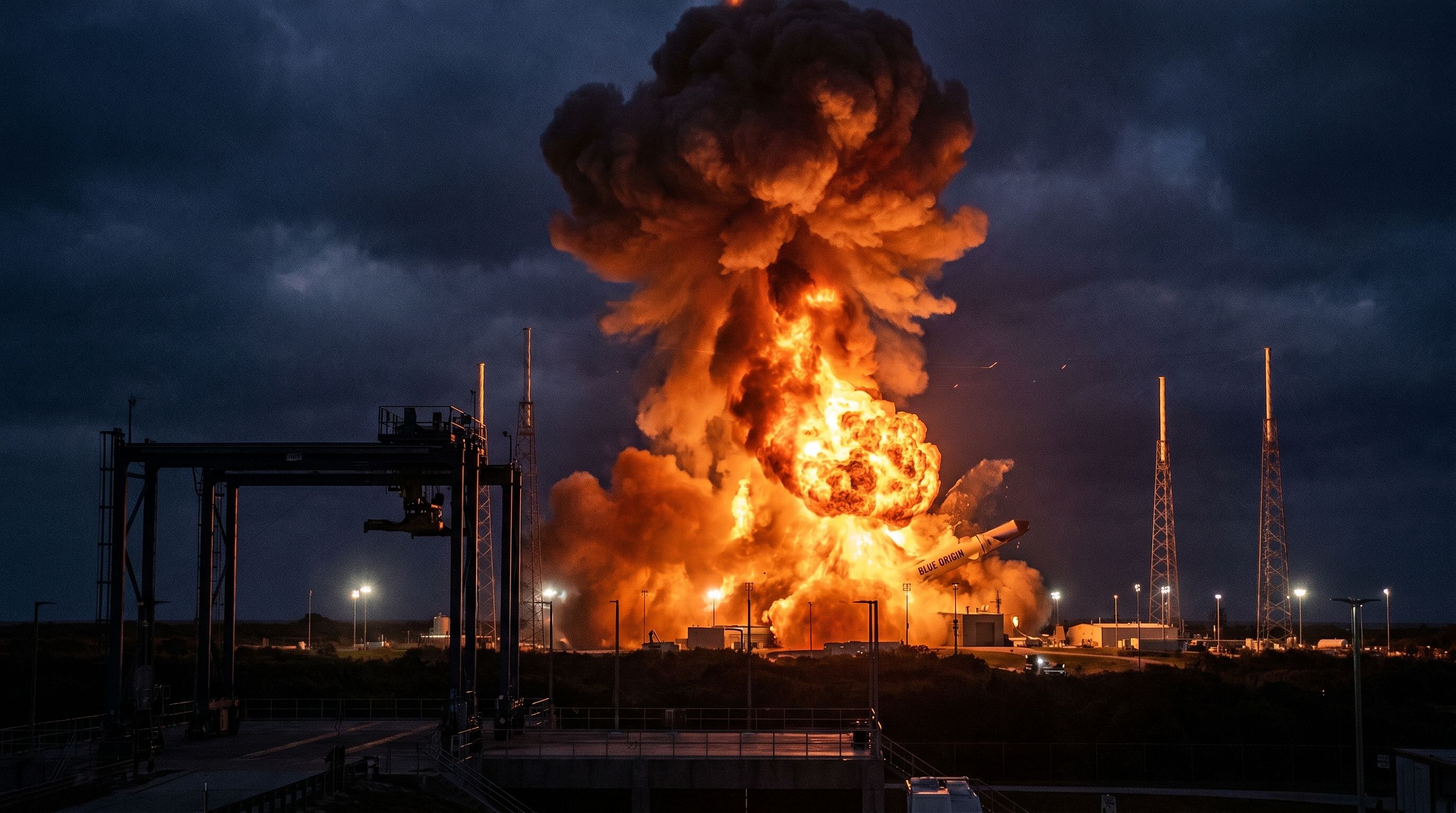
Blue Origin's New Glenn rocket is gone. On the evening of May 28, 2026, the 320-foot-tall vehicle was destroyed in a catastrophic explosion at Launch Complex 36A (LC-36A) at Cape Canaveral Space Force Station in Florida, during what should have been a routine static fire test of its seven BE-4 methane engines. The fireball was visible for miles and sent debris raining down over a wide area. No personnel were injured.
The vehicle had been stacked and prepared for its fourth flight — a mission intended to carry 48 of Amazon's Project Kuiper internet satellites to low-Earth orbit, planned for June. The Kuiper satellites were not aboard the rocket at the time of the test, safely held in a nearby integration facility.
What Happened
As engineers counted down to the brief engine burn, something went wrong at the base of the first stage. A fire ignited and spread rapidly through the vehicle's load of methane fuel and liquid oxygen, triggering a full detonation. The 86-foot upper stage was seen tilting and beginning to fall before the explosion fully consumed the rocket. Early reports from sources within the space industry indicate that the transporter-erector and at least one of the launch site's two lightning towers were destroyed or severely damaged beyond repair.
Jeff Bezos, Blue Origin's founder, confirmed on X that all personnel were safe. "Very rough day, but we'll rebuild whatever needs rebuilding and get back to flying," he wrote. NASA Administrator Jared Isaacman separately said the agency would assess impacts to its lunar programs as information became available.
The Fallout for NASA's Lunar Ambitions
The explosion could not have come at a worse time for NASA. Blue Origin had three near-term lunar missions riding on New Glenn: the Blue Moon Mark 1 commercial lander, targeted for late 2026; the VIPER lunar rover, scheduled for 2027; and two lunar rovers selected just this week to fly before Artemis IV. Both the Blue Moon Mark 1 and the larger Mark 2 lander — which will carry astronauts to the Moon as part of the Artemis human landing system — depended entirely on New Glenn as their ride.
With New Glenn grounded indefinitely, NASA's options are limited. SpaceX's Falcon 9 could absorb some payloads, but Starship — the other major lunar delivery vehicle — is itself under an FAA mishap investigation following a booster failure during its 12th test flight on May 22. The agency is effectively without either of its two planned heavy-lift lunar launch providers for the foreseeable future.
How Long Before New Glenn Flies Again?
Industry observers are not optimistic. After SpaceX's on-pad Falcon 9 explosion in September 2016, the vehicle was grounded for three-and-a-half months and the damaged pad at LC-40 remained out of service for over a year. Blue Origin's situation may be worse, given the apparent extent of damage to LC-36A infrastructure. Sources familiar with the situation suggest New Glenn will not fly again in 2026, and a first-half-2027 return would represent a best-case scenario.
Blue Origin does have a second pad, LC-36B, under construction nearby, which could accelerate the timeline. The company has also been developing a larger, more powerful variant of New Glenn with nine first-stage engines (the 9x4 configuration), and may choose to redirect resources toward completing that vehicle rather than restoring the destroyed 7x2 variant.
Bezos has personally funded Blue Origin with tens of billions of dollars over the company's 26-year history, so financial survival is not in question. But the reputational and programmatic damage from losing a vehicle on the pad — less than three months after an orbital mission failure in April — is considerable. As reported by Ars Technica, this is the most spectacular rocket destruction since the Soviet-era N1 failures of the 1970s.
Originally reported by Ars Technica. Read the original article for additional details.
View original source