Blue Origin's New Glenn rocket destroys itself and its launch pad in Cape Canaveral explosion
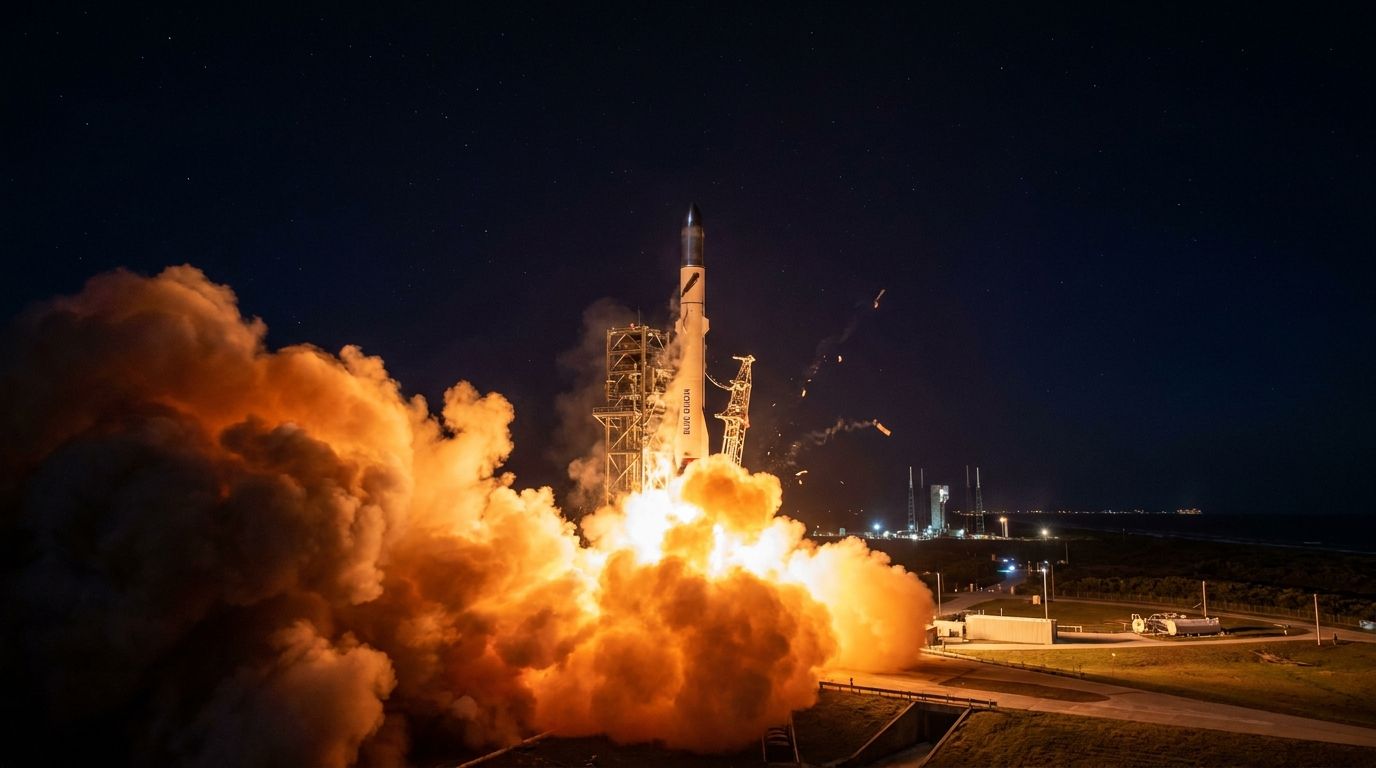
Blue Origin's New Glenn rocket was destroyed in a massive explosion during a static fire test at Cape Canaveral Space Force Station on the evening of May 28, 2026. The blast caused by an anomaly during the ignition sequence of the rocket's seven BE-4 methane-fueled engines sent a towering fireball into the Florida night sky, visible for miles around Cocoa Beach and the surrounding area.
What happened
Engineers were conducting a short pre-launch engine test, known as a static fire, in preparation for New Glenn's planned fourth flight: a mission to deploy 48 Amazon Leo internet satellites into orbit. As the engines began to ignite, something went wrong at the base of the 320-foot-tall vehicle. The first stage caught fire, the upper stage tilted and began to fall, and seconds later the entire stack exploded as its methane and liquid oxygen propellants ignited together.
Blue Origin confirmed all personnel were accounted for and no injuries occurred. Jeff Bezos, Blue Origin's founder, acknowledged the scale of the loss in a post on X: All personnel are accounted for and safe. It is too early to know the root cause but we are already working to find it. Very rough day, but we will rebuild whatever needs rebuilding and get back to flying. It is worth it. Elon Musk responded on X: Sorry to see this, I hope you recover quickly.
Infrastructure damage is severe
The explosion did not just destroy the rocket. Video captured by news helicopters showed extensive damage to Launch Complex 36A, the only New Glenn launch pad in existence. Sources cited by Ars Technica indicated that at least one of the two tall lightning towers may be unsalvageable, and the transporter-erector used to move New Glenn from its assembly building to the pad appears to have sustained severe damage as well. Debris was thrown far enough that the U.S. Space Force Eastern Range warned the public to avoid any wreckage washing ashore on nearby beaches.
Blue Origin has begun construction on a second pad, LC-36B, nearby. But that work is in its early stages, and analysts suggest that completing the new launch tower may actually prove faster than rebuilding the damaged primary site. A return to flight before the end of 2026 is considered extremely unlikely. Even a launch in the first half of 2027 would require a compressed recovery effort.
The ripple effects on NASA and Amazon
New Glenn was not just preparing for a commercial satellite run. It sits at the center of several critical national space programs. The rocket had been scheduled to carry Blue Origin's own Blue Moon Mark 1 lander to the lunar surface later this year, a mission that now has no path to hardware. New Glenn was also designated to deliver NASA's VIPER water-ice prospecting rover to the Moon in 2027. Just days before the explosion, Blue Origin had been selected to carry two lunar rovers to the surface on a NASA contract in advance of the Artemis IV crewed mission.
NASA Administrator Jared Isaacman acknowledged the setback, saying the agency would assess the implications for upcoming missions. SpaceX's Starship vehicle, currently grounded by the FAA following its own booster anomaly on May 22, shares the load as NASA's other heavy lifter for Artemis. With both vehicles now facing delays, NASA's timeline for sustained lunar operations is under renewed pressure.
Amazon's Project Kuiper, the company's satellite broadband constellation designed to compete with SpaceX's Starlink, faces delays to its deployment schedule. The satellites that were to fly on New Glenn's fourth mission are safe in a nearby integration facility, but a launch date is now undefined.
Context: the worst US pad explosion in a decade
The last comparable launch pad catastrophe in the United States was the September 1, 2016 explosion of a SpaceX Falcon 9 during a static fire test on Pad 40 at Cape Canaveral. That incident destroyed the Facebook Amos-6 satellite on the rocket and took the pad out of action for more than a year. SpaceX did not return to flight from Florida for three and a half months.
New Glenn had only flown three times. Its most recent mission in April 2026 ended in a partial failure when an upper-stage malfunction placed AST SpaceMobile's BlueBird 7 satellite in the wrong orbit. The FAA had cleared New Glenn to resume flights after reviewing Blue Origin's corrective actions, making Thursday's explosion a compounding blow coming just weeks after clearance was granted.
Blue Origin's larger next-generation rocket, the 9x4 New Glenn variant with nine first-stage engines, had been in active development as the intended fleet workhorse. The company may now redirect resources toward accelerating that program. Jeff Bezos has invested tens of billions of dollars in Blue Origin over its 25-year history; the company has the capital to recover, but the timeline is sobering. As reported by Ars Technica, New Glenn almost certainly will not fly again in 2026.
Originally reported by Ars Technica. Read the original article for additional details.
View original source