China Drafts a $295 Billion AI Data Center Build-Out — With Huawei Running 80% of the Hardware
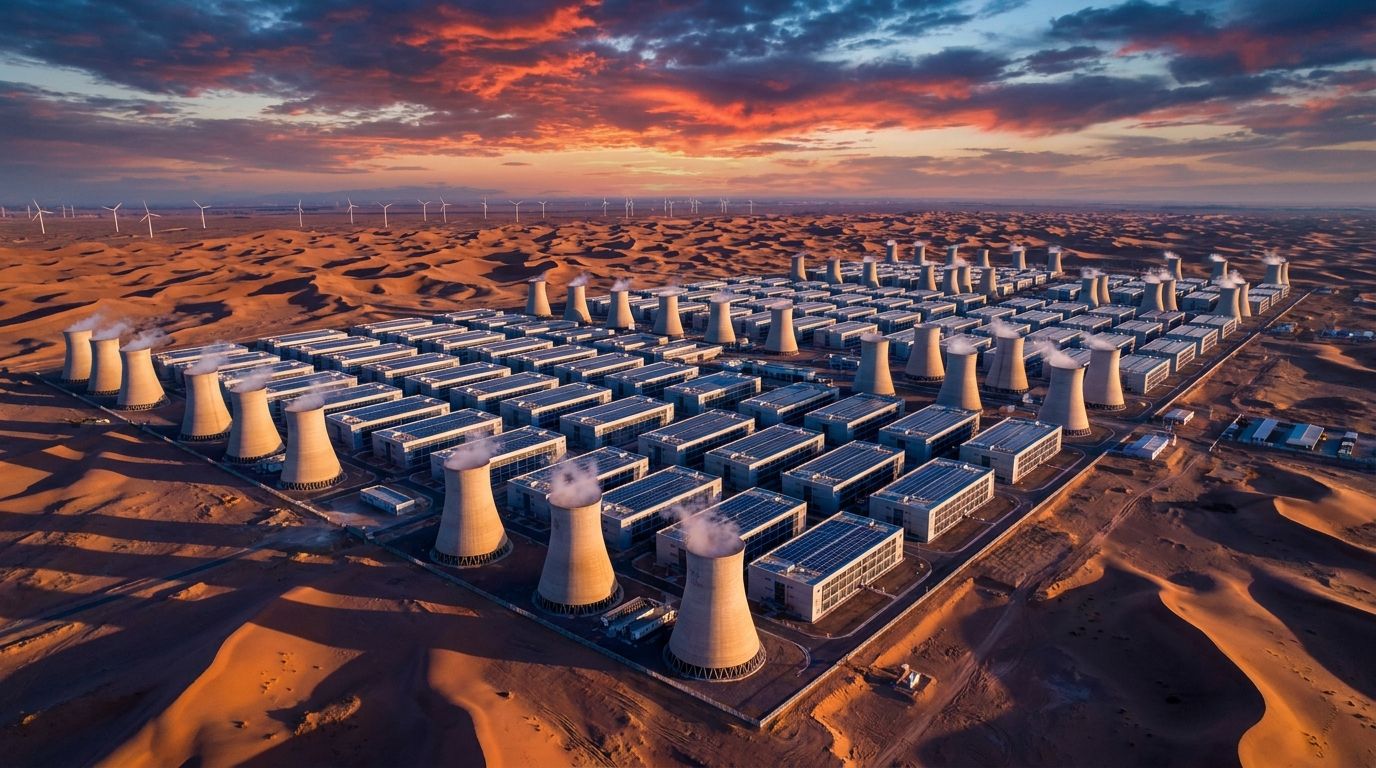
China is finalizing a five-year plan to invest 2 trillion yuan — approximately $295 billion — in a national network of AI data centers, Bloomberg reported on June 9. The blueprint, drafted by the National Development and Reform Commission (NDRC) and other key government ministries, calls for a nationwide grid of interconnected computing hubs to be operational by 2028.
The scale is striking. For comparison, the US CHIPS and Science Act allocated $52 billion for domestic semiconductor manufacturing. China's AI infrastructure plan is more than five times larger, and it targets not just chip production but the full stack of AI computing capacity: data center construction, power infrastructure, cooling systems, and the networking that ties compute clusters together.
The Domestic-First Mandate
The plan's most consequential provision is a requirement that at least 80% of core technology components — including AI chips — be sourced from domestic Chinese suppliers. The directive is explicit about who benefits: Huawei Technologies is positioned as the primary domestic alternative to Nvidia for AI accelerators.
Huawei's Ascend series chips have steadily improved. The Ascend 910C, which began volume shipments in late 2024, is reported to approach the performance of Nvidia's A100 in certain workloads, though it still lags the H100 and H200 by a significant margin on frontier model training. The $295 billion plan would represent a guaranteed customer base for domestic chip production at a scale that could accelerate Huawei's development roadmap through sheer volume procurement.
China Mobile and China Telecom, both state-owned telecommunications giants, are expected to operate the majority of the new data centers. The western regions — Xinjiang, Inner Mongolia, and Gansu — are being prioritized for their cheap land, lower temperatures, and access to renewable energy, particularly wind and solar. The infrastructure concentration echoes the US trend of building hyperscale data centers near hydroelectric power in the Pacific Northwest, but at a planned national-policy scale.
Nvidia's Complicated Position
US export controls have progressively tightened restrictions on Nvidia's most advanced chips to China since 2022. The H100, A100, and most recently the H200 are all subject to licensing requirements for Chinese buyers. Nvidia responded with China-specific downgraded versions — the H800 and A800 — but the Commerce Department subsequently restricted those too.
The situation remains fluid. In May 2026, the US approved H200 chip sales to ten specific Chinese firms under special licenses, suggesting selective access rather than an absolute ban. Meanwhile, Tom's Hardware reported in May 2026 that a Chinese cloud provider had procured 300 servers loaded with 115,000 banned Nvidia GPUs worth $92 million, with a supplier arrested on smuggling charges.
China's $295 billion plan makes clear that the long-term strategy is to make Nvidia irrelevant to Chinese AI infrastructure, regardless of what short-term workarounds exist. Even if individual companies continue acquiring US chips through grey-market channels, the state-funded backbone of China's AI compute layer will run on Huawei and domestic silicon.
What This Means for the Global AI Race
The plan accelerates a bifurcation that has been developing for three years: two separate AI infrastructure ecosystems, one anchored by US hyperscalers using Nvidia, AMD, and Google TPUs, and one anchored by Chinese state investment using domestic alternatives. The gap between them will narrow as Chinese chip performance improves and Chinese models increasingly train on domestic hardware.
For AI labs outside the US and China — in Europe, Southeast Asia, the Middle East — the bifurcation creates a genuine technology alignment question. Dependence on Nvidia means exposure to US export control decisions. Dependence on Huawei means exposure to a different set of geopolitical pressures and potential security scrutiny. Neither option is neutral.
The NDRC plan is still in draft form, per Bloomberg's sources. Final approval is expected in the coming weeks. Whether it deploys on schedule and at the stated funding level will depend on execution capacity that China has sometimes struggled with on infrastructure megaprojects. But the direction is unambiguous: Beijing has decided that AI compute infrastructure is as strategically important as semiconductor fabrication, and it is committing state resources at a scale commensurate with that judgment.
Originally reported by Bloomberg / The Next Web. Read the original article for additional details.
View original source