Samsung's new QD-OLED panel delivers 4K at 360Hz — and 680Hz in competitive mode
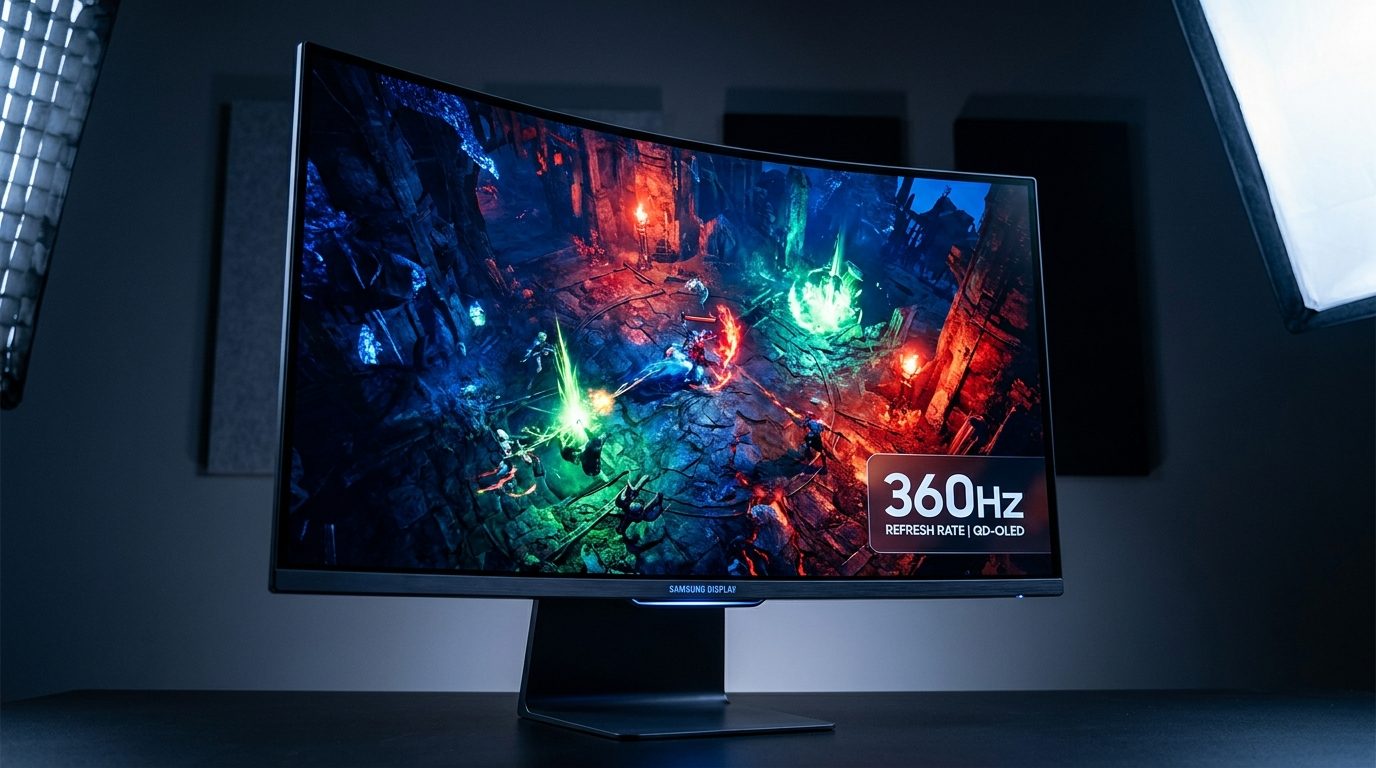
Samsung Display used Computex 2026 to announce a 31.5-inch QD-OLED panel that does something the display industry had been working toward for years: it combines 4K (3840×2160) resolution with a 360Hz refresh rate on a self-emissive panel. Until now, QD-OLED panels had topped out at either 4K with lower refresh rates — typically 144Hz — or 1440p at 240–360Hz. Combining the full pixel count of 4K with the extreme refresh rate of 360Hz on the same panel, without sacrificing HDR performance, is the technical achievement being demonstrated here.
The panel also supports a Dual Mode: at 1080p (FHD), the same display runs at 680Hz — a figure aimed squarely at competitive esports players who currently use 1080p TN or IPS panels to hit high frame rates. Samsung Display is not announcing specific monitors yet; it is showing the panel technology. Monitors from Samsung and partner brands are expected in late 2026 or early 2027.
Why 4K at 360Hz was so difficult
The challenge is not any single bottleneck — it is several that compound. Driving 3840×2160 pixels at 360 frames per second requires roughly 53 Gbps of display bandwidth, which pushes the limits of DisplayPort 2.1 and demands that every pixel switch state in under 2.8 milliseconds per frame. At the same time, OLED panels face an efficiency trade-off: the faster the pixels are driven, the more current must flow through each organic emitter, which accelerates degradation and requires higher drive voltages to maintain brightness.
Previous QD-OLED panels used a four-layer tandem OLED stack — a design that improved brightness and longevity compared to single-layer OLED by distributing the current load across multiple emitter layers. To reach 4K at 360Hz without burning through the organic materials faster than acceptable, Samsung Display needed more headroom in that stack.
Penta Tandem: what five layers change
The new architecture is called Penta Tandem — five stacked blue OLED emitter layers instead of four. Adding a fifth layer means each individual layer carries less current to produce the same total luminance. Lower per-layer current translates directly to three improvements: higher peak brightness (the panel is certified at VESA DisplayHDR True Black 600, meaning 600 nits peak with near-zero black levels), longer panel lifespan, and better power efficiency at the high drive frequencies needed for 360Hz operation.
The quantum dot color conversion layer — the "QD" in QD-OLED — sits on top of the blue OLED stack and converts blue light to red and green for the color subpixels. This part of the architecture is unchanged from previous QD-OLED generations. What Penta Tandem changes is the blue emitter supply underneath it, giving the panel the current headroom to sustain 360Hz drive rates across the full 3840×2160 pixel grid without compromising brightness or lifespan.
Dual Mode: 680Hz at 1080p
The panel's second operating mode addresses a different use case. In Dual Mode, the display runs at 680Hz with 1080p (1920×1080) resolution. The mechanism is pixel binning: four 4K subpixels are grouped into one effective 1080p pixel, which can be driven much faster because the bandwidth and switching demands are a fraction of 4K mode. At 680Hz, each frame occupies 1.47 milliseconds — a spec that matters in titles like Counter-Strike 2, Valorant, and Overwatch 2, where professional players use frame rates north of 500Hz to reduce the effective input lag between a mouse movement and the visual update on screen.
The practical significance: a player could use a single monitor for both competitive play (680Hz / 1080p) and everything else (360Hz / 4K), rather than owning separate displays for each purpose. Whether that trade-off is worth the premium this panel will command is a personal calculus, but the hardware now makes it technically possible on a QD-OLED for the first time.
V-stripe pixel structure: the text clarity fix
One persistent criticism of QD-OLED panels has been text rendering. Earlier QD-OLED generations used a triangular subpixel arrangement that, while optimised for color gamut and gaming, produced noticeably softer text compared to IPS LCD or VA panels with traditional RGB stripe subpixel layouts. In general desktop use — email, documents, code — the difference was visible and annoying to users sensitive to text quality.
Samsung Display's new panel uses a V-stripe subpixel pattern. The V-stripe arranges subpixels in a vertical orientation that is more compatible with standard ClearType and subpixel rendering algorithms in Windows and macOS. The result, based on Samsung's demonstrations, is significantly sharper text rendering than previous QD-OLED generations — bringing text clarity closer to IPS LCD standards while retaining the contrast and color advantages of self-emissive technology. This is not a minor cosmetic update; it addresses the most common reason productivity-focused buyers passed on earlier QD-OLED panels.
HDR: VESA DisplayHDR True Black 600
The panel carries VESA DisplayHDR True Black 600 certification — a tier specific to self-emissive displays like OLED that require a peak brightness of at least 600 nits combined with a true black level (effectively 0 nits, since OLED pixels turn off completely). For comparison, most HDR-capable IPS LCD monitors carry DisplayHDR 400 or 600 certifications that allow significantly higher black floor values because LCD panels cannot achieve true per-pixel dimming. The True Black designation signals that dark scenes will render as the technology intends: shadow detail in a black scene will not be washed out by panel backlight bleed.
Availability and pricing reality
Samsung Display is a panel manufacturer. What it showed at Computex 2026 (running June 2–5 in Taipei) is the panel itself — not a finished monitor product. Monitors using this panel are expected from Samsung's own display brand and from partners such as Asus, MSI, and LG, with availability projected for late 2026 or early 2027. No pricing has been announced for either the panel or finished monitors.
Pricing context from existing tiers is instructive: the best current 4K 144Hz QD-OLED monitors — Samsung's Odyssey OLED G8 and equivalents — retail for $800–$1,100. Top-tier 1440p 360Hz QD-OLED panels sit at $700–$900. A 31.5-inch panel that covers both 4K at 360Hz and 1080p at 680Hz, with a new five-layer architecture and improved subpixel rendering, will sit well above those price points. Estimates in the $1,200–$1,800 range for finished monitors would not be surprising, though the final number depends on what monitor manufacturers choose to bundle around it.
Where this fits in the market
The monitor panel market in mid-2026 has two clear tiers below this announcement: 4K at 144Hz (the current ceiling for mainstream high-resolution gaming monitors) and 1440p at 240–360Hz (the sweet spot for high-refresh gaming). Samsung's Penta Tandem panel does not slot between those tiers — it sits above both simultaneously, offering the resolution of the first and the refresh rate of the second in a single product.
The competitive framing matters. Nvidia's GeForce RTX 5090 and AMD's Radeon RX 9070 XT are the only consumer GPUs currently capable of consistently driving 4K at 360fps in less demanding titles; most games at 4K will run at frame rates well below the panel's maximum. That means early buyers will be purchasing ahead of the GPU market's ability to saturate the spec — which is typical of high-refresh, high-resolution panels at launch. The 680Hz / 1080p Dual Mode gives those buyers a practical path to fully utilizing the panel in competitive titles while the GPU generation catches up.
Originally reported by SamMobile. Read the original article for additional details.
View original source