SpaceX's IPO roadshow starts tomorrow — here's what a $1.75 trillion public offering actually looks like
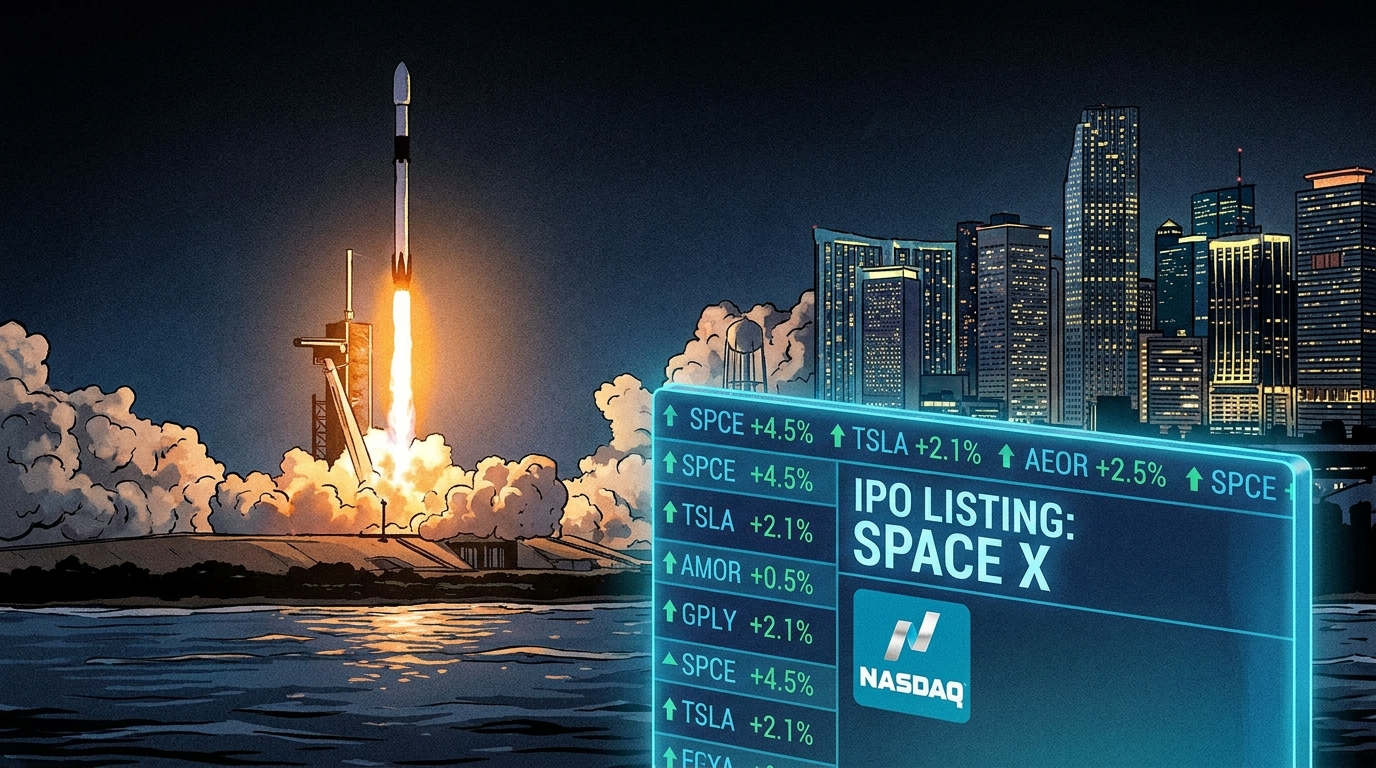
SpaceX's investor roadshow begins June 4, 2026. The company is targeting a Nasdaq listing on June 12 under the ticker SPCX, at $135 per share, with 555.6 million shares offered — raising approximately $75 billion at a valuation between $1.75 trillion and $2 trillion. If those numbers hold, this would be the largest public offering in history, nearly three times the size of Saudi Aramco's record $25.6 billion raise in 2019.
SpaceX officially disclosed its IPO plans on May 20, 2026, after confidentially filing a draft registration statement with the SEC on April 1. The timing is deliberate: SpaceX waited until its business metrics were strong enough to support a valuation that makes Musk's other public companies look modestly sized.
The business behind the valuation
SpaceX reported $18.67 billion in revenue for 2025, a number that reflects the company's scale across launch services, Starlink satellite internet, and government contracts. The less flattering figure: a net loss of $4.94 billion. At $1.75 trillion, the valuation implies a price-to-revenue multiple of roughly 94x — a premium that demands a strong forward earnings narrative.
The narrative centers on Starlink. The satellite internet division is SpaceX's only currently profitable business unit. With roughly 4.5 million subscribers globally as of early 2026 and monthly ARPU (average revenue per user) of approximately $120 for consumer tiers, Starlink's annualized revenue run rate exceeds $6 billion. The division is expanding: direct-to-cell partnerships with T-Mobile and other carriers, enterprise and maritime tiers, and government contracts at significantly higher price points. Starlink is what makes the valuation case coherent — the argument is that SpaceX is primarily being priced as a satellite internet and communications infrastructure company with a rocket business attached.
The offering is structured as all-primary — every dollar raised goes directly to SpaceX's balance sheet, not to existing shareholders. Elon Musk is subject to a 366-day lock-up period on his personal holdings. Up to 30% of shares are reserved for retail investors, an unusually high retail allocation for a deal of this size, which signals a deliberate strategy to create retail demand and media visibility around the listing.
The xAI complication
SpaceX's prospectus needs to account for a significant development: the company's merger with Elon Musk's xAI in early 2026. The merger brought xAI's Grok large language model and AI infrastructure under the SpaceX corporate umbrella, with stated plans to use IPO proceeds partly to fund AI infrastructure expansion. This creates a narrative that SpaceX is no longer purely a launch company or even a satellite internet company — it's now also an AI infrastructure company with a supercomputing division.
The merger complicates valuation. xAI was valued independently at approximately $50 billion in its last private round. Whether that value is additive to SpaceX's launch and Starlink valuation or whether it's already priced in is a question institutional investors will probe heavily during the roadshow. It also creates related-party complexity: Musk controls both companies, and the merger terms and ongoing governance need to satisfy SEC disclosure requirements for a public company.
The skeptic's case
At $1.75 trillion, SpaceX would be priced above Apple's market cap in early 2024 and above all but the largest publicly traded companies in the world. The skeptic's argument is straightforward: the valuation requires Starlink to achieve a scale of profitability that has not yet materialized, requires the launch business to maintain pricing power in a market where ULA, Blue Origin, and Rocket Lab are all competing, and requires the xAI integration to generate AI revenue that justifies a significant premium above the satellite internet story alone.
The net loss of $4.94 billion in 2025 is particularly notable given that SpaceX's launch cadence — over 130 launches in 2025 — is the highest in the world and generates substantial revenue. Heavy launch costs, Starship development spending, and the capital expenditure of building out Starlink's constellation at scale are the primary drivers. None of these cost lines are expected to decrease in the near term; Starship's operational ramp and continued Starlink satellite manufacturing require sustained capital investment.
The Fool.com analysis published June 2 noted that SpaceX had lowered its IPO valuation target by $200 billion from an earlier $1.95–2T range to the current $1.75T target — a signal that roadshow feedback from institutional investors is already tempering initial ambitions.
What happens after June 12
The retail allocation of 30% is likely to generate substantial demand from individual investors who have watched SpaceX's achievements — reusable rockets, Starlink's growth, Starship development — for years and have had no way to participate. That retail enthusiasm creates a floor under the IPO price and will likely drive strong opening-day trading volume.
The harder question is where SPCX settles after the initial enthusiasm fades and institutional investors do the quarterly earnings math. SpaceX will be reporting net losses for the foreseeable future. Its business is genuinely remarkable — the company has more launch capacity than any other entity on Earth, a growing satellite internet business, and now an AI division — but remarkable businesses still need to earn their valuations over time.
The roadshow runs this week. Trading begins June 12. It will be the most-watched market event of 2026.
Sources: Seeking Alpha; The Motley Fool; Morningstar
Originally reported by Seeking Alpha / Reuters. Read the original article for additional details.
View original source