SpaceX Begins IPO Roadshow Targeting $75 Billion — The Largest Public Offering in History
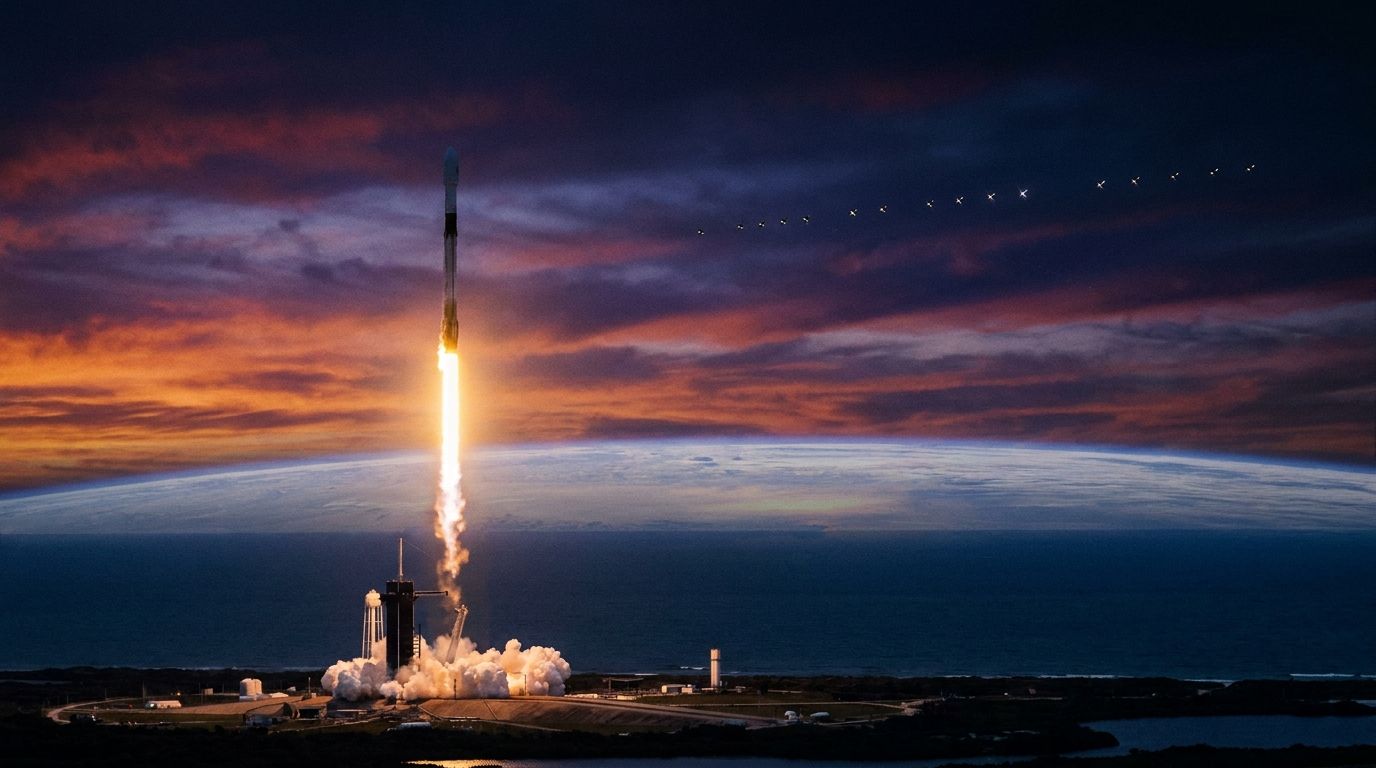
SpaceX launched its investor roadshow on Thursday, setting the terms for what the company is positioning as the largest initial public offering in history. The offer is fixed at $135 per Class A share — an unusual choice for a mega-IPO, eschewing the typical pricing range — with 555.6 million shares available, targeting $75 billion in proceeds. If underwriters exercise the full greenshoe overallotment option, the total rises to $85.7 billion, roughly triple what Saudi Aramco raised in 2019 to set the previous global record.
The implied post-IPO valuation is $1.77 trillion, which would make SpaceX the seventh-largest US company by market capitalisation, ahead of Tesla and Meta. Public trading is set to begin June 12 on the Nasdaq under the ticker SPCX. Goldman Sachs leads a syndicate of 21 banks.
The financial reality behind the headline
SpaceX's S-1 filing reveals a company that is profitable in one business and burning heavily in others. Starlink, the satellite internet service, generated $4.4 billion in operating income in 2025 and now serves 10.3 million subscribers across 164 countries — accounting for roughly 70% of total company revenue. Average revenue per user has been declining, from approximately $99 per month in 2023 to $66 in the first quarter of 2026, as the service expands into lower-income markets and adds promotional pricing.
The rest of the business is deeply unprofitable. The company reported a total net loss of $4.94 billion in 2025 and $4.28 billion in just the first quarter of 2026. A significant contributor: xAI, Elon Musk's AI company, which SpaceX absorbed in an all-stock deal in February 2026. xAI burned $6 billion in 2025, and its projected 2026 burn is $10 billion. AI capital expenditure in Q1 2026 alone was $7.72 billion, representing 76% of SpaceX's total capex for the quarter.
Fortune's analysis of the prospectus found that over three-quarters of the $75–85 billion in proceeds are already effectively committed — to debt repayment obligations and the EchoStar spectrum acquisition — leaving under $18 billion for the AI expansion and infrastructure build-out that headlines the use-of-proceeds language. Morningstar's fair value estimate for SpaceX is $780 billion, less than half the IPO valuation, with analyst Nicolas Owens stating that valuations above $1.5 trillion are "very likely" overvalued.
The demand picture
The market has not appeared to share Morningstar's hesitation. Early book-building was reportedly four times oversubscribed; subsequent rounds pushed that figure to between twelve and twenty times oversubscribed. BlackRock is reportedly in discussions to invest up to $10 billion. Institutional road shows included meetings at Starbase in Texas and xAI's Memphis facility. Up to 30% of the offering is allocated to retail investors — a deliberately high figure that reflects SpaceX's awareness of its brand loyalty among individual investors — accessible through Schwab, Fidelity, Robinhood, SoFi, and E*TRADE with a minimum of $100,000 per account at Schwab.
Secondary market pricing ahead of the IPO implies a first-day valuation of approximately $2.2 trillion. ARK Invest projects $2.5 trillion enterprise value by 2030, based on a 38% annual growth assumption.
Governance structure that investors should understand
Elon Musk holds 93.6% of the Class B shares, which carry ten votes each compared to one vote per Class A IPO share. Post-offering, he controls approximately 85% of total voting power despite owning roughly 42% of economic shares. SpaceX has qualified as a "controlled company" under Nasdaq's rules, opting out of independent director requirements. Harvard Law analysts cited "poor governance arrangements." Public shareholders will have essentially no ability to influence corporate direction.
The 38-page risk section of the S-1 is candid about the challenges. Musk simultaneously leads SpaceX, Tesla, xAI, Neuralink, and maintains a political advisory role, and is under active investigation by nearly a dozen federal agencies. SpaceX does not carry insurance on satellites, payloads, or launch vehicles. The Starship programme, central to both commercial satellite launches and the Mars architecture, has a documented history of dramatic failures. xAI integration carries model hallucination, data poisoning, and copyright litigation exposure.
What the IPO funds and what it signals
The stated deployment of proceeds — Starlink Mobile satellite expansion, AI infrastructure, Starship development — reflects the evolution of SpaceX from a launch company to something harder to categorise. The xAI integration and the $7.72 billion single-quarter AI capex figure make clear that the company Musk is taking public in 2026 is substantially different from the rocket company most investors have tracked since its founding. The prospectus projects potential AI revenue of up to $26.5 trillion contingent on placing data centres in space — a long-horizon bet that depends on technological developments that do not yet exist.
SpaceX's IPO is also widely described as the opening act of a "hot IPO summer" that may include trillion-dollar listings from Anthropic and OpenAI later in 2026. Whether those transactions materialise, and at what valuations, will depend substantially on how SPCX trades in its first weeks as a public company. At a $135 entry price and a valuation that Morningstar considers nearly double its fundamental worth, the SpaceX IPO is simultaneously one of the most anticipated listings in decades and one of the most fraught with financial risk for individual investors who buy in at open.
Originally reported by CBS News. Read the original article for additional details.
View original source