Differential Privacy Is the Only Mathematically Honest Answer to Data Anonymization
"Anonymized" data has a well-documented problem: it isn't. In 2006, researchers Arvind Narayanan and Vitaly Shmatikoff de-anonymized the Netflix Prize dataset — a dataset Netflix had stripped of names and personal identifiers — by cross-referencing it with public IMDb reviews. AOL released "anonymous" search query logs in 2006; a New York Times reporter identified user No. 4417749 as Thelma Arnold of Lilburn, Georgia, from her queries alone. A 2013 MIT study found that GPS traces stripped of names can re-identify individuals with 95% accuracy using just four location points.
Differential privacy offers something categorically different: a mathematical guarantee — not a policy promise, not a compliance checkbox — that no individual's data can be inferred from a dataset's outputs. Apple and Google have been running it in production for years. The US Census Bureau used it for the 2020 Census. Here's what it actually means.
The Core Idea in Plain Language
Differential privacy asks a specific question: if one person's data were added to or removed from a dataset, would the output of a query change in a detectable way? If no individual's presence or absence meaningfully changes what an algorithm reveals, that algorithm is differentially private.
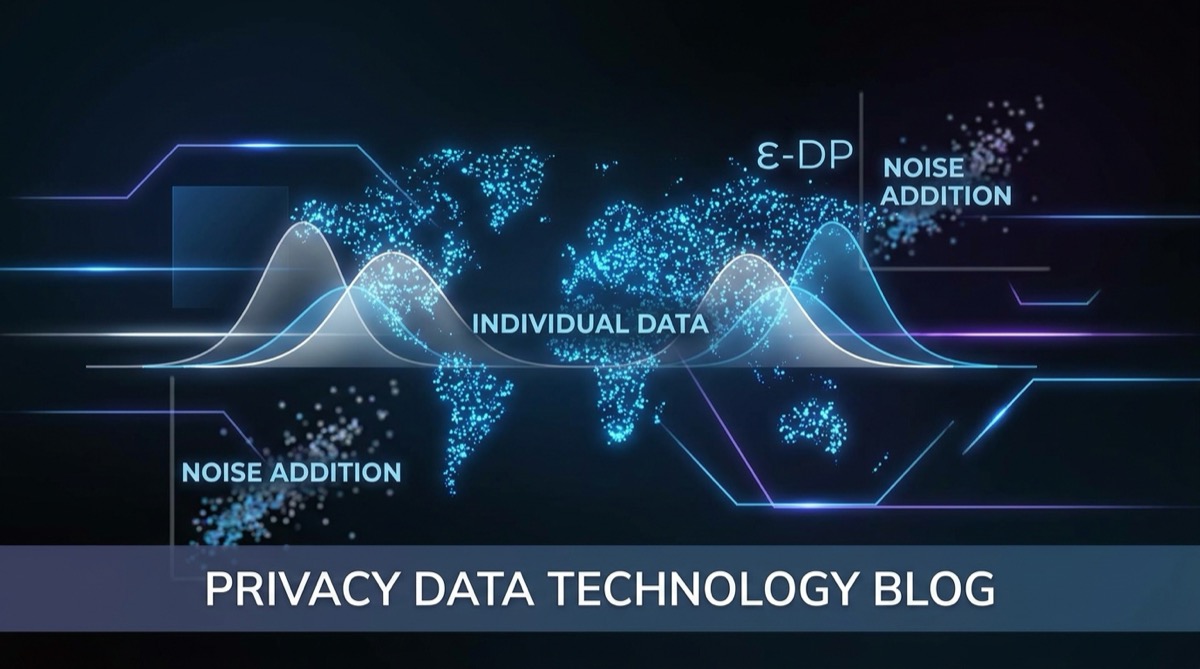
The formal definition: an algorithm M is ε-differentially private if for any two datasets D1 and D2 differing in exactly one record, and any possible output set S:
P[M(D1) ∈ S] ≤ e^ε × P[M(D2) ∈ S]
The parameter ε (epsilon) is called the privacy budget. Smaller epsilon means a stronger privacy guarantee — but it also means the algorithm must add more noise to its outputs to mask individual contributions. Larger epsilon means less noise, higher accuracy, weaker privacy.
In practice, typical production values sit between ε = 1 and ε = 10. Apple uses ε = 2–8 depending on the type of statistic being collected. Google uses similar ranges. These numbers aren't arbitrary — they represent a deliberate engineering tradeoff between how much individual privacy is preserved and how useful the resulting statistics are.
How Apple Uses It — Local Differential Privacy
Apple applies differential privacy at the device level. This is called local DP — noise is added on your iPhone before any data ever leaves the device. Apple's servers never see your raw data; they only receive a randomized version that, when aggregated across millions of users, reveals population-level patterns without revealing individual behavior.
Apple has disclosed specific use cases:
- Emoji frequency: Which emoji are used most, and in what contexts
- New word suggestions: Which words users type that aren't in Apple's dictionary (used to improve QuickType)
- Safari crash patterns: Which URLs and page structures cause browser crashes
- Health app trends: Aggregate health metric distributions, without individual health records
The mechanisms Apple uses include RAPPOR (originally developed by Google), their own Count Mean Sketch (CMS) algorithm, and Hadamard Transform-based methods for high-dimensional frequency estimation. The result: Apple can determine that "emoji X is used by approximately N% of users" without ever constructing a profile of which users specifically use that emoji. The privacy guarantee is per-user and mathematically enforced — not a matter of Apple policy or server-side access controls.
How Google Uses It — Central Differential Privacy
Google takes a different approach: central DP. Raw data is collected on Google's servers, but when queries are run against that data, noise is added to the query results before they're used internally or surfaced publicly.
Disclosed use cases include:
- Google Maps popular times and wait times: Aggregated visit patterns with DP noise applied to prevent inferring individual location histories
- YouTube metrics: View counts, engagement rates, and trending data processed with DP guarantees
- Android usage statistics: App usage patterns, crash frequencies, battery consumption signals
Google has open-sourced their implementation as the Google Differential Privacy Library on GitHub, implementing Laplace and Gaussian mechanisms — the two standard noise-addition techniques in the DP toolkit. Their RAPPOR protocol for client-side collection is also open-source and used by Chrome for collecting browser metrics at scale.
The key difference from Apple's approach: central DP requires trusting Google's servers with raw data before anonymization. Local DP (Apple's method) requires no trusted server — but it requires approximately 100x more users to achieve the same statistical accuracy, because each individual's data is much noisier before it even arrives at the aggregation layer.
The Census Bureau and Federal Use
The US Census Bureau applied differential privacy to the 2020 Census — making it the first national census in history to use formal privacy guarantees. The decision was driven by a specific threat: database reconstruction attacks. Researchers had demonstrated that publishing detailed census tables (without DP) allowed near-complete reconstruction of individual-level records by solving the combinatorial constraints implied by the published statistics.
The 2020 redistricting data used a total privacy budget of ε ≈ 17.14 — relatively weak privacy by DP standards, but chosen to preserve accuracy for small geographic areas where population counts must be correct for congressional apportionment.
This tradeoff became politically contentious. Academic researchers — including some statisticians — filed objections claiming the DP-introduced noise distorted small population counts, affecting minority communities disproportionately. The Census Bureau defended the decision as a necessary response to demonstrated reconstruction vulnerabilities, arguing that publishing "exact" census data would expose millions of individuals to re-identification risk. The debate exposed a genuine tension: in small communities, even modest noise can move counts across thresholds that matter legally and politically.
Federated Learning + DP: The Combined Approach
Federated learning trains ML models on distributed data — instead of raw data moving to a central server, model gradient updates move from devices to the server. No individual's raw data is ever transmitted.
Combining federated learning with differential privacy closes the remaining privacy gap: each device adds calibrated noise to its gradient update before sharing it. Even if an adversary intercepts every gradient update from every device during training, they cannot reconstruct any individual's data.
Production deployments:
- Google Gboard: Next-word prediction trained across millions of Android devices using federated learning + DP. The model improves without Google ever seeing individual typing patterns.
- Apple Siri: Voice model improvements using on-device federated learning with local DP applied to audio feature vectors.
- Meta content recommendations: Personalization signals processed with DP to limit what individual-level inference is possible from model weights.
The privacy guarantee in this setting is per-training-round, and it accumulates across rounds — a critical point that's often glossed over in marketing descriptions of these systems.
The Limitations Nobody Talks About
Differential privacy is mathematically rigorous but not a magic shield. The limitations are real:
- Composition: Privacy budgets compound. If you run 100 DP queries on the same dataset, each with
ε = 0.1, the total privacy cost isε = 10— not 0.1. Most deployed systems don't account for this correctly. Advanced composition theorems (Rényi DP, zero-concentrated DP) help, but require careful bookkeeping. - Local vs. central accuracy gap: Local DP is architecturally stronger — no trusted server required — but achieving the same statistical accuracy as central DP requires roughly 100 times more users contributing data. For niche queries on small populations, local DP often produces statistics that are too noisy to be useful.
- Epsilon calibration is not standardized: There is no industry standard for what epsilon value is "good enough." Apple's
ε = 2and another company'sε = 2may operate under different threat models, different sensitivity calculations, and different composition accounting methods — making direct comparisons misleading. - High-dimensional data: DP noise that's negligible when computing a single aggregate statistic (like average age across 10 million users) can completely destroy utility when applied to high-dimensional individual predictions. This is why DP is much easier to deploy for aggregate analytics than for personalized recommendations or fine-grained classification tasks.
Why "Anonymization" Without DP Is Not a Privacy Guarantee
Both GDPR and CCPA explicitly exempt "anonymized" data from their compliance requirements. This creates a significant loophole: companies routinely claim datasets are anonymized when they've simply removed direct identifiers — names, email addresses, Social Security numbers — without applying any formal privacy mechanism.
The academic literature is unambiguous: removing direct identifiers is not anonymization in any technically meaningful sense. Quasi-identifiers (age, zip code, gender) are sufficient to re-identify 87% of Americans uniquely, according to Latanya Sweeney's foundational research. Behavioral data — location traces, purchase histories, browsing patterns — is even more re-identifiable because it encodes unique behavioral fingerprints that persist even after obvious identifiers are stripped.
Differential privacy is the only approach in the field where "this data is anonymous" is a provable mathematical claim rather than an assertion made by a compliance team. The guarantee doesn't depend on an adversary not being clever enough; it holds against adversaries with arbitrary auxiliary information and unlimited computational power.
The Honest Engineering Answer
Differential privacy doesn't solve all privacy problems. It solves one specific problem very well: ensuring that aggregate statistics about populations cannot be used to infer records about individuals. It does not protect against consent violations, data breaches at rest, insider threats, or the collection of data that shouldn't be collected in the first place.
But for any organization that collects user data and wants to extract insights from that data without exposing individuals — product analytics, health research, financial modeling, behavioral patterns — DP is the honest engineering answer. The privacy guarantee is in the math, not in a policy document or a trust relationship with a vendor.
The alternative is collecting data, removing names, calling it "anonymized," and hoping nobody ever runs a de-anonymization attack. Given that the tools for doing so are freely available, increasingly automated, and demonstrably effective against datasets that were considered safely anonymous just a decade ago — that hope is not a strategy.