Silicon-Carbon Batteries Are Changing What We Expect From Smartphones
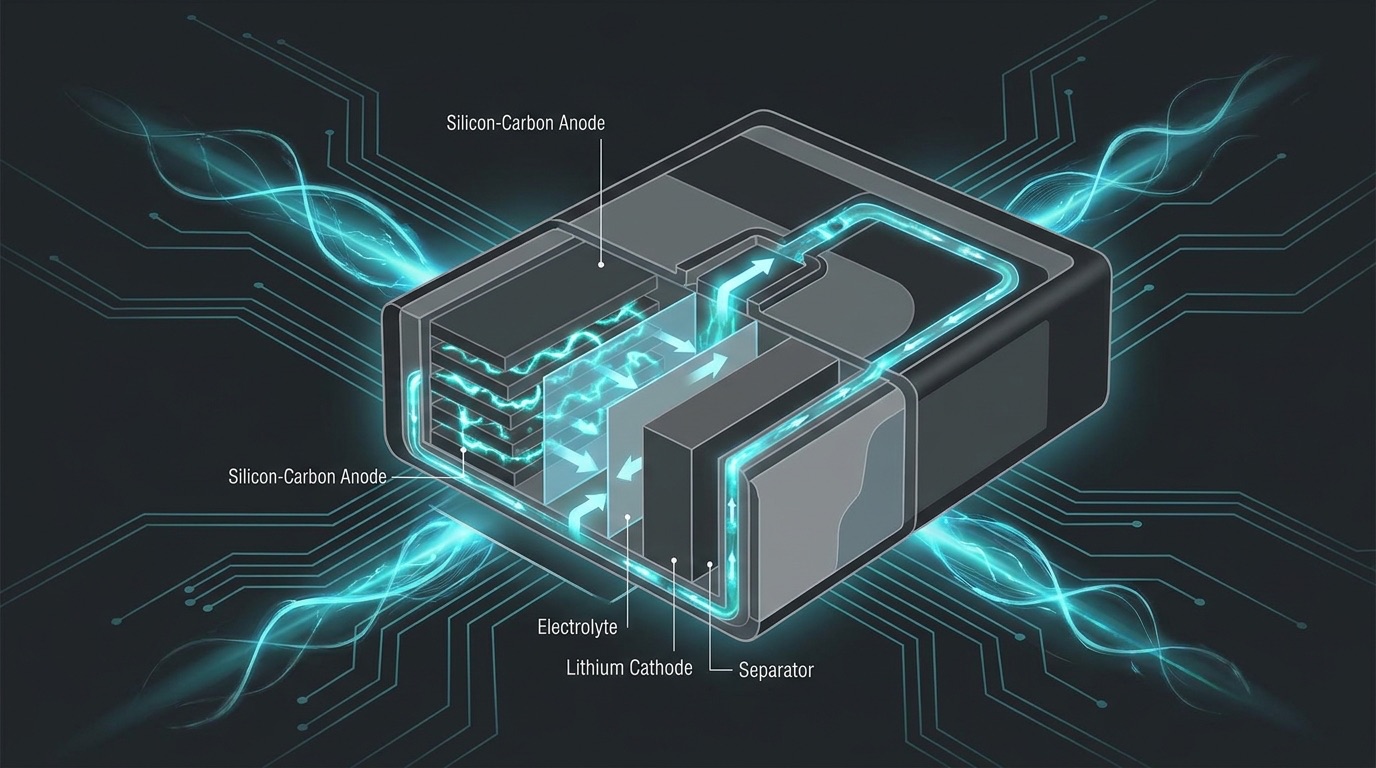
A phone with a 7000mAh battery that is thinner than last year's 4500mAh model. That is not a marketing claim — it is what silicon-carbon anode technology is making possible right now. OnePlus, Honor, Xiaomi, and soon Samsung are shipping devices where the old graphite anode has been partially or fully replaced by silicon-carbon composite material, and the numbers are genuinely different: 20–40% more energy in the same physical volume.
What Changed in the Anode
Conventional lithium-ion batteries store charge in a graphite anode. Graphite is reliable and stable, but its theoretical energy capacity tops out at around 372 mAh per gram. Silicon stores roughly ten times more — 3579 mAh/g in theory. The problem engineers have wrestled with for two decades is that silicon expands by up to 300% when it absorbs lithium ions during charging, then contracts during discharge. That mechanical stress cracks the anode, fragments it, and rapidly destroys capacity.
The silicon-carbon solution wraps nanoscale silicon particles inside a carbon matrix. The carbon shell is elastic enough to buffer expansion, conductive enough to maintain electrical contact, and structurally stable across hundreds of cycles. Real-world Si-C cells typically use a blend — silicon content varies by manufacturer from around 5% to over 20% — because pure silicon anodes remain too fragile for consumer products today.
Devices Shipping with Si-C Now
OnePlus
OnePlus has been the most aggressive early adopter. The OnePlus 13 ships with a 6000mAh silicon-carbon battery and supports 100W wired charging, reaching a full charge in under 40 minutes. The OnePlus 13s pushes that to 7000mAh — the largest capacity in a flagship-class device as of mid-2025 — while keeping the body under 8.5mm thick. That combination was not achievable with graphite chemistry.
Honor
Honor's Magic7 Pro uses a 5850mAh silicon-carbon cell paired with 100W wired and 80W wireless charging. Honor calls its implementation "Mega Capacity Battery" and claims a two-day battery life in moderate use. What is notable is the wireless charging speed — silicon-carbon cells can handle higher charge currents than older graphite formulations, enabling fast wireless charging that was previously impractical at those power levels.
Xiaomi
Xiaomi's 15 Ultra carries a 6000mAh silicon-carbon battery with 90W wired and 80W wireless charging. The 15 Pro keeps the same capacity at a lower 90W ceiling. Xiaomi's focus has been on combining Si-C with advanced thermal management so the battery and processor can both run at peak load simultaneously without throttling.
Samsung
Samsung has been more cautious. The Galaxy S25 series retained conventional chemistry, but Samsung has confirmed silicon-carbon integration is planned for the Galaxy S26 Ultra, targeting a cell above 6000mAh. Given Samsung's manufacturing scale, that announcement will define the mainstream adoption curve.
Real-World Tradeoffs
Higher energy density does not come free. There are three genuine tradeoffs buyers should understand.
- Cycle degradation is faster than graphite at the same silicon content. Early silicon-dominant cells dropped to 80% capacity inside 300 cycles. Modern Si-C composites have improved substantially — manufacturers typically rate their cells at 80% capacity retention after 800–1000 cycles — but that is still meaningfully worse than premium graphite cells rated for 1200+ cycles. In practical terms: a heavy user charging daily may notice capacity decline more noticeably after two years.
- Heat generation during fast charging increases. Silicon-carbon anodes absorb lithium faster than graphite, which enables high charge rates — but that speed generates heat. Sustained 100W+ charging sessions produce measurable surface temperatures. All three manufacturers listed above use multi-zone thermal management with dedicated heat pipes routed away from the anode stack.
- Manufacturing yields are still maturing. Si-C cells cost more to produce than graphite equivalents. That cost is currently absorbed into flagship pricing; mid-range Si-C devices are expected in volume by late 2026.
Fast Charging and Silicon-Carbon
This is where silicon-carbon provides an underappreciated advantage. Because silicon absorbs lithium ions faster than graphite, Si-C anodes are structurally better suited to high charge currents. A graphite cell being charged at 100W is being pushed toward its limits; a well-designed Si-C cell at the same rate has more headroom. This is why OnePlus can offer 100W charging into a 7000mAh cell without the aggressive charge-curve tapering that older large-battery phones required to protect the anode.
The interaction also shapes the charge curve differently. Si-C phones tend to reach 50% charge faster and maintain higher acceptance rates through 70–80% before tapering — which means the "15-minute top-up" use case is significantly more useful than on equivalent graphite devices.
Maximizing Si-C Battery Longevity
The degradation characteristics of silicon-carbon cells respond differently to charging habits than graphite:
- Keep charge between 20% and 85% for daily use. Silicon expansion stress is highest at the extremes. Most Si-C phones now include a "optimized charging" mode that caps at 80% automatically — use it.
- Avoid sustained 100W charging when the battery is above 80%. Let the phone's own charge controller manage the taper, but if your device allows charge speed selection, drop to 50W for overnight charging.
- Heat is the primary enemy. Do not charge while gaming or running navigation at full brightness. The combination of fast charging heat and processor load heat compounds degradation.
- Full discharge to 0% is more damaging than with graphite. Silicon contracts fully at low states of charge, stressing the carbon matrix. Charge before you hit 15%.
- Use manufacturer software battery health tools after 18 months. OnePlus, Honor, and Xiaomi all expose battery health metrics in settings — track them and recalibrate if the reported capacity diverges from real-world use.
What to Expect in 2026–2027
The trajectory is clear. As silicon content in commercial anodes increases from today's 10–15% range toward 25–30%, energy density will continue climbing. Industry analysts project mainstream flagship phones at 7000–8000mAh by 2027 with no increase in device thickness. Solid-state electrolytes, when they arrive in mass production, will further stabilize silicon anodes by eliminating the liquid electrolyte that degrades when silicon particles fracture.
More immediately, expect Si-C to reach mid-range price points by Q3 2026. When a $400 phone ships with a 6500mAh silicon-carbon cell and 65W charging, the conversation about "battery anxiety" will look different. The baseline is moving fast — and the brands moving it fastest right now are not the ones that historically defined the category.