Wi-Fi 7 is entering enterprise networks — and MLO is the feature that actually matters
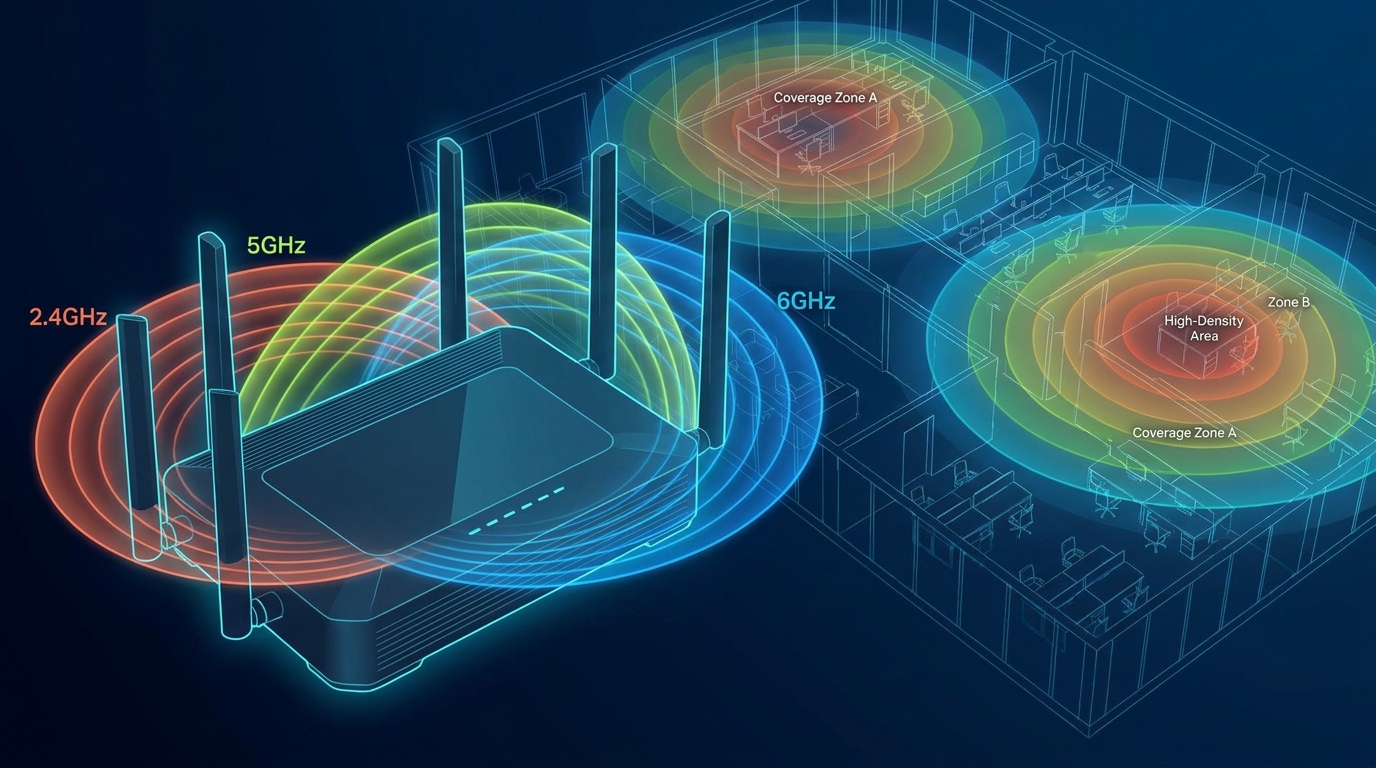
Wi-Fi 7 access points from Cisco, Juniper Mist, Aruba, and Ruckus are now in production enterprise deployments. The certification wave that started in 2024 has translated into real procurement cycles, and the question has shifted from "should we evaluate Wi-Fi 7?" to "where do we deploy it first?" The honest answer involves understanding what Wi-Fi 7 actually changes — and what it doesn't.
The marketing emphasis on 46 Gbps theoretical throughput is real but mostly irrelevant to day-to-day enterprise performance. What matters is Multi-Link Operation (MLO), a fundamental architectural change in how the radio protocol works, and the one capability that has no direct equivalent in prior Wi-Fi generations.
What MLO actually does
Every Wi-Fi generation before 802.11be operated with a single radio link at a time. Even 802.11ax (Wi-Fi 6/6E) devices capable of operating on multiple bands would pick one band and stay on it until a band-steering event moved them — a process that typically caused a brief disconnection. The client and access point could not transmit and receive simultaneously across bands.
MLO changes that. A Wi-Fi 7 client and access point can establish simultaneous connections across 2.4 GHz, 5 GHz, and 6 GHz concurrently. Those links can be used for load balancing, bandwidth aggregation, or redundancy — or all three at once. A video call packets goes over 6 GHz for low latency; bulk file transfer goes over 5 GHz to aggregate bandwidth; the 2.4 GHz link stays active as a fallback if interference appears on the others. The transition between bands happens without any disconnect because the connection was never dropped from the other bands.
The Wireless Broadband Alliance ran Phase 2 field trials in real enterprise environments in March 2026, and the numbers are concrete: MLO delivered uplink throughput improvements of up to 116% under interference conditions and up to 139% in clean spectrum. Uplink latency for real-time traffic dropped by up to 66%. Downlink throughput improved by 42–75% depending on interference level. These are not lab results — they came from working enterprise sites with real traffic loads.
The two flavors of MLO and where the industry actually is
There are two modes of MLO: Enhanced Multi-Link Single Radio (eMLSR) and Simultaneous Transmit and Receive (STR). eMLSR uses a single radio that switches rapidly between bands, sharing a common RF chain. STR uses genuinely separate radios for each band, allowing true parallel operation. The throughput ceiling of STR is higher, but the hardware complexity is significantly greater.
In 2026, eMLSR is what's actually shipping in enterprise client devices. Laptops with Intel Wi-Fi 7 chipsets and phones with Qualcomm FastConnect 7900 support eMLSR. True STR remains a roadmap item for most client categories. This means the real-world benefits are the reliability and latency improvements rather than raw throughput aggregation — which, for enterprise use cases, is exactly the right trade.
Infrastructure requirements you can't skip
Deploying Wi-Fi 7 APs without upgrading the wired backhaul is a common mistake. Wi-Fi 7 APs require multi-gigabit uplinks to fully utilize MLO's bandwidth aggregation. That means 2.5GbE or 5GbE switch ports at minimum, with 10GbE preferred for high-density areas. Most enterprise switches deployed before 2022 don't have multi-gigabit copper ports at sufficient density.
Power is the other constraint. Wi-Fi 7 APs draw more power than Wi-Fi 6 equivalents — up to 30W or more — which requires 802.3bt (PoE++) ports rather than the 802.3at (PoE+) ports that were standard in Wi-Fi 6 deployments. Many existing PoE switches are not 802.3bt capable, and retrofitting requires either switch replacement or midspan injectors.
Cabling matters too: Cat6a supports 10GbE over 100 meters, while Cat6 is limited to 1GbE at that distance. Dense deployments where cable runs are long may need recabling to take full advantage of multi-gigabit AP uplinks.
Where the 6 GHz band situation stands
Wi-Fi 7's wide 320 MHz channels in the 6 GHz band are key to its throughput claims, but spectrum availability varies significantly by region. The US, Canada, Brazil, and South Korea have allocated the full 1,200 MHz of 6 GHz spectrum. The EU and UK have only 500 MHz of 6 GHz, which limits channel width and constrains the benefit. China and Russia had not allocated 6 GHz for unlicensed Wi-Fi as of early 2026.
For enterprises operating across multiple regions, this creates a product selection complication: an AP optimized for the US 6 GHz allocation may not have the same channel configuration options in Europe. Most enterprise vendors ship globally compatible firmware that adjusts automatically, but radio planning and expected throughput need to account for regional differences.
Which environments see the biggest return
The ROI case for Wi-Fi 7 is strongest in specific environments: high-density venues where hundreds of clients compete for airtime (conference centers, stadiums, hospitals), manufacturing floors with latency-sensitive industrial control systems, financial trading environments where millisecond latency variations affect application performance, and healthcare settings with real-time monitoring devices.
For standard office environments with predictable desk-based work, Wi-Fi 6E still performs well and the upgrade cost may be hard to justify until the next natural refresh cycle. The calculus changes if the wired switching infrastructure is also due for replacement — combining that upgrade with Wi-Fi 7 APs reduces the total cost of two separate projects.
The device fleet matters enormously. MLO's benefits require Wi-Fi 7 client devices. An enterprise that upgrades to Wi-Fi 7 APs but whose laptop fleet runs on Wi-Fi 6 hardware will see no MLO benefit until devices refresh. Most enterprise laptop cycles run three to five years, which means a 2026 AP deployment may not see its full MLO return until 2028–2030 as client hardware catches up. Planning for this lag is part of any honest Wi-Fi 7 business case.