AI-Powered Phishing Has Quietly Made 'Check for Grammar Mistakes' Useless Advice
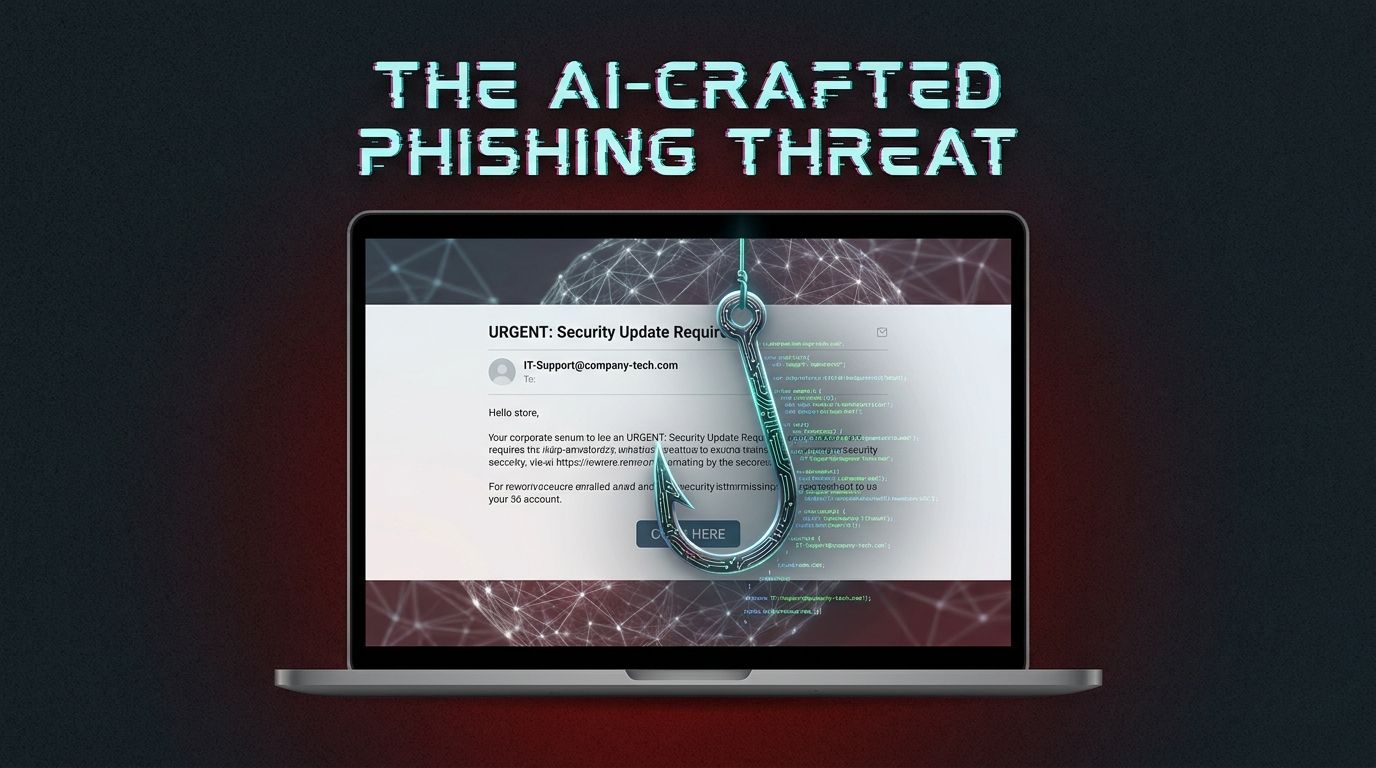
The most repeated piece of anti-phishing advice for the last twenty years has been some version of "look for bad grammar and misspellings." It's been printed on laminated cards, included in annual security training, and used to justify clicking on what turned out to be a legitimate-looking message. In 2026, this advice is not just outdated — it's actively misleading.
Generative AI has quietly removed the linguistic tell that allowed non-specialists to identify phishing emails. The question now isn't whether an attacker can write a convincing email — they can, instantly, for free, in any language. The question is what detection and defense look like when the content of an attack is indistinguishable from legitimate communication.
What Changed and When
The inflection point was the wide availability of capable LLMs in late 2023 and 2024. Security researchers at IBM X-Force and Proofpoint both published analyses in early 2024 showing that phishing emails generated with GPT-4 and Claude were rated as more credible by human evaluators than emails written by human threat actors — in most languages, including English.
The cost implications are significant. A human threat actor writing targeted spear-phishing emails — researched, personalized, contextually relevant — can produce maybe 50 per day with reasonable quality. An LLM-powered phishing campaign can generate 50,000 personalized emails per hour, scraped from LinkedIn profiles, company websites, recent news mentions, and prior breach data. The unit economics of targeted phishing have collapsed.
Vishing (voice phishing) has seen a parallel transformation. Real-time voice cloning tools — including ElevenLabs' API, open-source alternatives, and several commercial products — can clone a voice from 30 seconds of audio. The UK's Financial Conduct Authority documented a 340% increase in AI voice fraud incidents between 2023 and 2025. Several documented cases involved attackers cloning executives' voices for business email compromise calls, convincing employees to authorize wire transfers.
The Anatomy of a Modern AI-Assisted Phishing Campaign
The current state-of-the-art attack chain doesn't resemble the Nigerian prince email. A typical high-value campaign breaks down into phases:
Reconnaissance. Automated tools scrape LinkedIn, GitHub, company blogs, press releases, and breach databases to build a profile of each target: their role, their reports, their recent projects, their communication style, their technology stack.
Personalization. An LLM ingests the target profile and generates a contextually appropriate pretext — an invoice referencing a real vendor relationship, a follow-up on a project the target worked on, a DocuSign request using their actual manager's name and correct title.
Delivery. The email is sent from a domain that is either compromised or crafted to pass DMARC/SPF/DKIM checks. QR codes have replaced URLs in a significant percentage of campaigns — QR codes don't trigger URL reputation checks in email gateways, and they move the target off the corporate network entirely.
Credential harvest or payload delivery. The landing page mirrors the target organization's actual SSO page. Real-time adversary-in-the-middle proxying captures session tokens, bypassing password-only authentication even when the target enters correct credentials.
What Doesn't Work Anymore
Legacy security awareness training built on spotting grammar errors, verifying URLs, and checking sender domains is increasingly ineffective — not because employees aren't trying, but because the attacks have evolved past those signals.
QR code phishing was specifically designed to evade this training: the email often contains no URL, no attachment, and no suspicious formatting. The call to action is simply to scan a QR code with a phone. This takes the target off the corporate network, through their personal device, bypassing corporate email gateway inspection and endpoint DLP entirely.
Deepfake video is emerging in executive impersonation for high-value targets. Several documented incidents in 2024–2025 involved convincing live video calls where an attacker used real-time deepfake generation to pose as a CFO or CEO, requesting access or authorization. Hong Kong authorities documented a case where a finance worker was convinced to transfer $25 million following what appeared to be a legitimate video call with senior management.
What Actually Reduces Risk
The security controls that remain effective share one characteristic: they don't rely on the employee correctly identifying a sophisticated attack.
Hardware security keys. FIDO2-compliant hardware tokens (YubiKey, Google Titan Security Key) are phishing-resistant by design — they're cryptographically bound to the specific domain, so they will not authenticate against a lookalike site regardless of how convincing the email was. This is the single most reliable individual defense against credential phishing.
DMARC enforcement at p=reject. Properly configured DMARC blocks spoofed emails from domains you own from reaching inboxes. Many organizations still have DMARC at p=none (monitoring only) years after deployment. Full enforcement significantly raises the cost of impersonating your domain.
Zero-trust network access. If a compromised credential can only access one specific application via network policy, a successful phish results in limited blast radius rather than full lateral movement. This architectural choice is more impactful than any amount of awareness training.
Behavioral AI detection. Modern email security platforms (Abnormal Security, Darktrace, Microsoft Defender for Office 365 P2) use behavioral baselines to flag anomalies: an email from a known contact referencing an account number never seen in prior communications, a DocuSign request on an invoice 4x the vendor's typical amounts. This detection doesn't read the email the way a human does — it's looking at metadata, relationship graphs, and timing patterns that AI-generated phishing doesn't currently spoof well.
Privileged access management. The goal of most sophisticated phishing is credential theft followed by lateral movement. PAM systems (CyberArk, BeyondTrust) that require additional authentication for sensitive operations — even when you're already authenticated — add a layer the initial phish can't bypass.
The Awareness Training Worth Keeping
Not all training is obsolete. The concepts worth retaining: call to verify unexpected financial requests through a separate channel you initiated; treat QR codes in emails like URLs and inspect the destination; understand that urgency and authority are social engineering tools, not signs of legitimacy.
The concept to retire: any advice that implies a convincing email is safe to act on. In 2026, a completely legitimate-looking email is no longer evidence of anything.
Organizations that understand this shift are rebuilding security awareness programs around recognizing the pattern of phishing — urgent request, uncommon action, unfamiliar context — rather than the content. The content will always look legitimate now. The pattern sometimes won't.