Commercial space stations are under construction — and the ISS retirement clock is already running
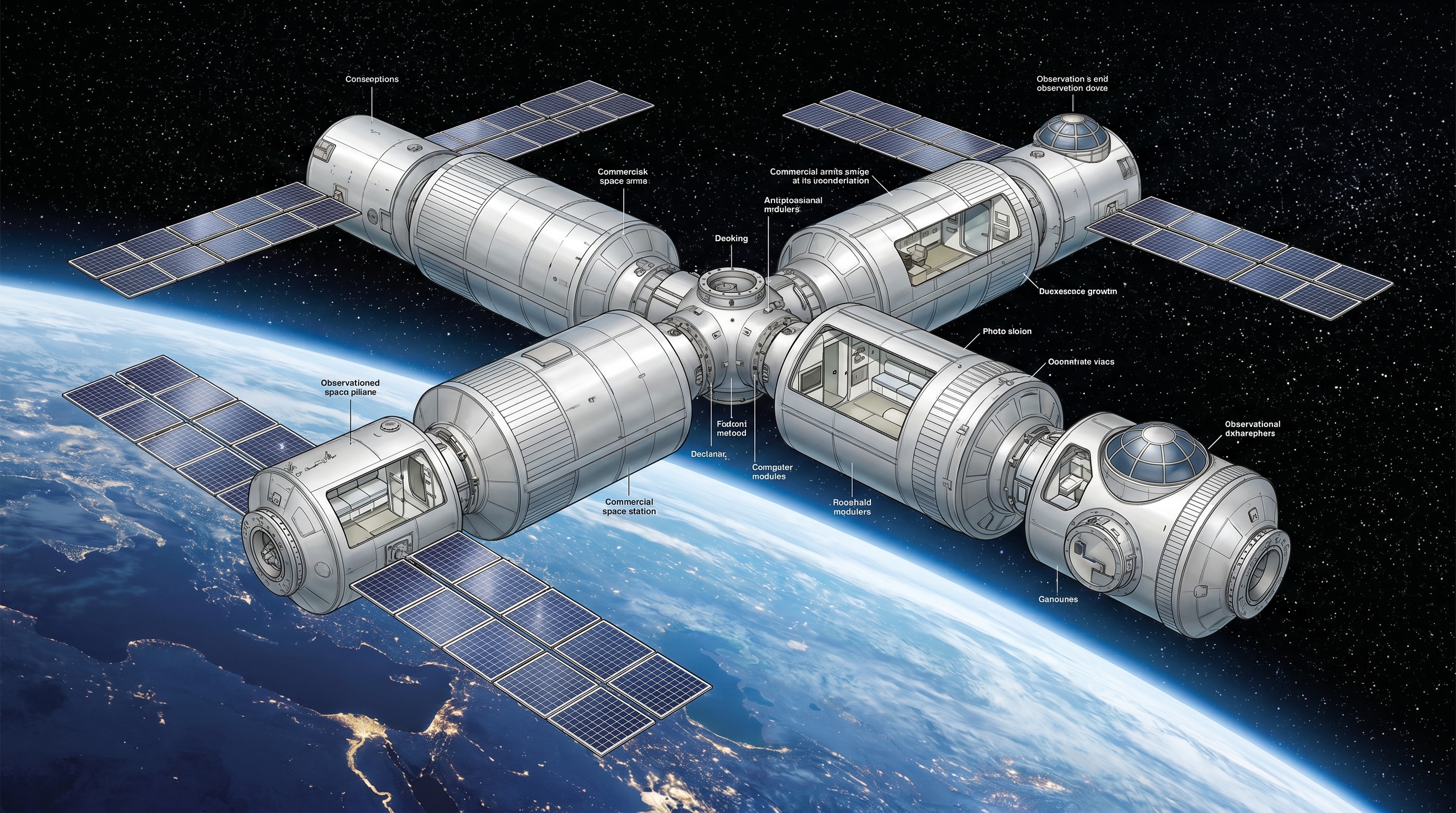
The International Space Station has a decommissioning date. Sometime between 2030 and 2032, NASA will guide it into the Pacific Ocean, ending three decades of continuous human presence in low Earth orbit. What comes after it is no longer a speculative question — it is an engineering project already underway at four separate companies, each racing to have crewed commercial stations operational before the ISS deorbits.
The transition window is tighter than it appears. The ISS needs at least two to three years of overlap with its replacements to allow for crew transfer, research migration, and operational validation. That means the first commercial stations need to be crewed and proven by 2027 or 2028 at the latest — a deadline that is already creating real schedule pressure across the industry.
The Four Stations in the Race
Axiom Space is furthest along. Rather than building a standalone station from scratch, Axiom has NASA approval to attach modules to the ISS while it is still operational. The plan is to add three to four modules over time, then detach the Axiom segment as a free-flying station after ISS retirement. This approach uses the ISS as a temporary scaffold during assembly, reducing up-front capital requirements and de-risking the transition. Axiom has already flown four private astronaut missions to the ISS and holds a NASA commercial crew agreement worth $228 million. Its first module was delayed from 2024 into 2026, and the attachment timeline is the most closely watched milestone in the commercial space sector right now.
Sierra Space's Starlab is taking a different approach. Rather than incremental module-by-module assembly, Starlab is designed as a single large inflatable habitat that launches in one piece. The station targets a 2028 launch on a Vulcan Centaur rocket. Sierra Space's LIFE (Large Integrated Flexible Environment) habitat technology uses flexible materials to create a pressurized volume much larger than what fits in a conventional rocket fairing, inflating to full size after reaching orbit. At full deployment, Starlab's pressurized volume would rival the ISS in usable research space. Starlab holds one of NASA's Commercial Low Earth Orbit Destinations (CLD) contracts — NASA's mechanism for funding and de-risking commercial successors before committing to purchase services.
Blue Origin's Orbital Reef, co-developed with Sierra Space and Boeing, was one of the two original CLD awardees. The concept is modular and mixed-use: research lab, manufacturing platform, and commercial destination for private astronauts. Boeing contributes a science module; Blue Origin provides the station core and service module. The project's timeline has been less publicly visible than Axiom or Starlab, and Boeing's recent operational challenges add real uncertainty to its delivery schedule. Orbital Reef was targeting 2030 operations, which gives it essentially no buffer if either partner experiences further delays.
Northrop Grumman is developing its own modular station concept with fewer public milestones, targeting the post-ISS market primarily through established government and research relationships rather than commercial tourist traffic.
Why 2030 Is a Hard Constraint
NASA's CLD program commits to buying services from commercial stations rather than owning hardware. This represents a fundamental shift from the ISS model, where NASA owned the US segment and all associated systems. The commercial model puts operational and financial risk on private companies while letting NASA redirect budget toward Artemis lunar missions and Mars architecture.
The ISS is genuinely aging. The station's structural truss sections are showing increased stress fracture rates. Russian-segment air leaks have required ongoing patching since 2019. Multiple Extended Operations Assessments have concluded the ISS can be operated safely through 2030 with maintenance, but confidence drops sharply past that date. The actual retirement is not entirely within NASA's control — it depends on Russian participation, which has become substantially less certain since 2022, and on congressional budget allocations that have historically been unreliable.
Russia has stated intent to launch its own ROSS (Russian Orbital Service Station) but that program faces severe delays. If Russia withdraws from ISS operations before US commercial successors are ready, the transition timeline compresses further.
The Commercial Market Beyond Government Contracts
Each consortium is betting that government anchor tenants will not be the only customers. Pharmaceutical companies have run microgravity protein crystallization experiments on the ISS to develop drug candidates that cannot be cleanly crystallized in Earth gravity. ZBLAN optical fiber — which forms perfect amorphous structures in microgravity but develops stress cracks during Earth-based manufacture — has demonstrated commercial viability in small production runs. In-space manufacturing of specialty semiconductors, biological tissue printing, and certain optical materials are all at the stage where commercial station access could validate or disprove the economic case.
Private astronaut tourism is proven at current price points. Axiom's four private missions ran at prices reportedly starting around $55 million per seat. The more transformative market — in-space manufacturing at production scale — remains speculative but close enough to justify ongoing capital investment.
What the Next 18 Months Will Determine
Three developments will define the transition. First, whether Axiom successfully attaches and demonstrates its first module — this is the critical path milestone for the entire ecosystem. Second, whether NASA's CLD contracts survive upcoming budget cycles; the Artemis program has historically drawn down commercial LEO funding when it faces cost overruns. Third, whether any commercial station can demonstrate crewed free-flying operation before the ISS retires. If the ISS retires on schedule and no commercial successor is crewed and operational, there will be a gap in continuous human spaceflight for the first time since November 2000. That outcome is not yet the likeliest scenario, but it is no longer unthinkable.