SpaceX Lists on NASDAQ on Friday at a $1.75 Trillion Valuation — the Largest IPO in History
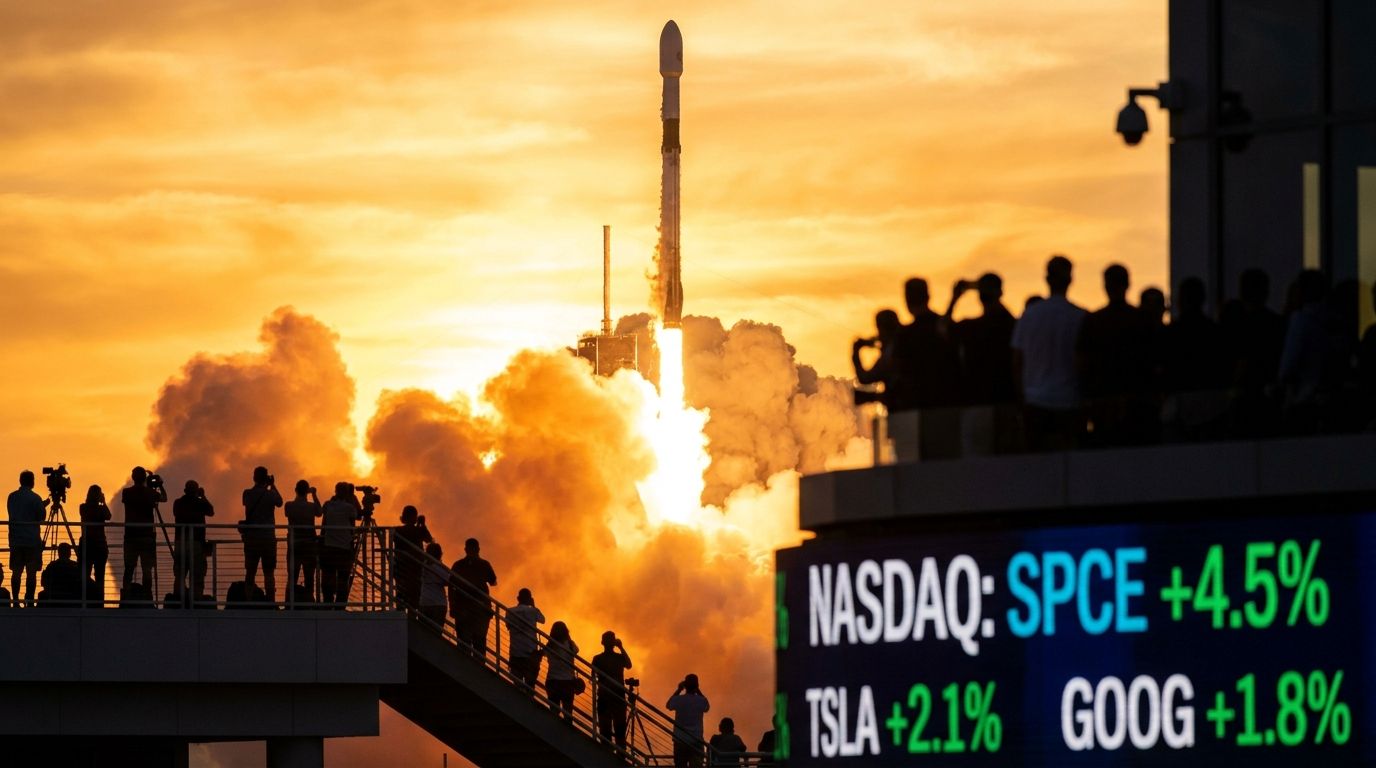
SpaceX is going public on Friday. The company filed its final prospectus with the SEC on Tuesday, confirming a June 12 listing on NASDAQ under the ticker symbol SPCX at $135 per Class A share. At that price, the company will raise approximately $75 billion — the largest initial public offering in history, topping Saudi Aramco's $29.4 billion raise in 2019 by a factor of more than two.
The implied valuation at the IPO price is $1.75 trillion, which would make SpaceX one of the five most valuable publicly traded companies in the United States from its first day of trading. Investor demand for the offering reportedly exceeded $250 billion, roughly 3.3 times the available shares — a level of oversubscription more commonly seen in small-cap offerings than a company at this scale.
What investors are actually buying
SpaceX's revenue in 2025 was $18.7 billion, up from $11.8 billion in 2023. The company lost $4.9 billion in 2025, a figure dominated by capital expenditure on Starship development and the rapid expansion of the Starlink satellite internet constellation. Starlink is the financial engine: the service now has over 7 million subscribers globally and is generating annualized revenue of approximately $12 billion, with unit economics that improve as satellite production costs continue to fall.
Government contracts — from NASA, the US Department of Defense, and allied foreign governments — accounted for approximately 20% of 2025 revenue. The remaining 80% is split between Starlink consumer and enterprise subscriptions and commercial launch services, where SpaceX commands around 60% global market share following the retirement of United Launch Alliance's Atlas V and the difficulties experienced by competitors including Arianespace and Rocket Lab at the heavy-lift end of the market.
Up to 30% of the IPO shares are reserved for retail investors through a direct allocation program, an unusual structure that SpaceX's bankers — Goldman Sachs and Morgan Stanley are leading the offering — attributed to the company's desire to give individual investors access alongside institutions.
The xAI merger changes the story
A significant complication for investors analysing SpaceX is the February 2026 merger with xAI, Elon Musk's AI company. The combined entity encompasses SpaceX's launch and satellite operations, xAI's Grok AI models and API business, and the Starlink global compute network — which xAI is repurposing to offer AI inference capacity to enterprise customers alongside its satellite internet service.
SpaceX's prospectus projects xAI will represent 70% of the combined business's revenue by 2030, an extraordinary claim given that xAI's current revenue is a fraction of Starlink's. The projection is predicated on continued rapid growth in enterprise AI demand and Starlink's ability to offer low-latency compute at the network edge — positions that are plausible but involve substantial uncertainty.
Elon Musk will retain approximately 82.4% of the combined company's voting power through a dual-class share structure, meaning public shareholders will have minimal ability to influence corporate direction. The prospectus is candid that Musk's other commitments — Tesla, the Department of Government Efficiency role he held through early 2026, and his general tendency toward high-distraction public activity — represent risk factors for governance continuity.
The valuation question
At $1.75 trillion, SpaceX is priced at roughly 94× its 2025 revenue. For comparison, NVIDIA — the current AI infrastructure darling — trades at approximately 28× forward revenue. The SpaceX multiple is defensible only if the xAI AI inference business grows as projected, and if Starlink continues its subscriber growth trajectory in markets where terrestrial broadband is either absent or significantly worse.
The bear case is that SpaceX is a capital-intensive industrial company dressed in AI-era valuation clothes: it burns billions annually on rocket development, faces eventual competition in LEO internet from Amazon Kuiper (which launched its first commercial constellation in 2025), and has a governance structure that concentrates all decision-making power in a single person whose attention is demonstrably divided.
The bull case is that no other company has demonstrated the ability to reduce the cost of access to space by the margins SpaceX has achieved — and that the combination of low-cost global satellite internet and AI inference at the network edge represents an infrastructure position with no near-term comparable. Whether Friday's opening price reflects the bull or bear case will be one of the more closely watched market events of 2026.
Originally reported by PBS NewsHour. Read the original article for additional details.
View original source