WebAssembly Escaped the Browser. In 2026, It's Quietly Becoming the Runtime for Everything
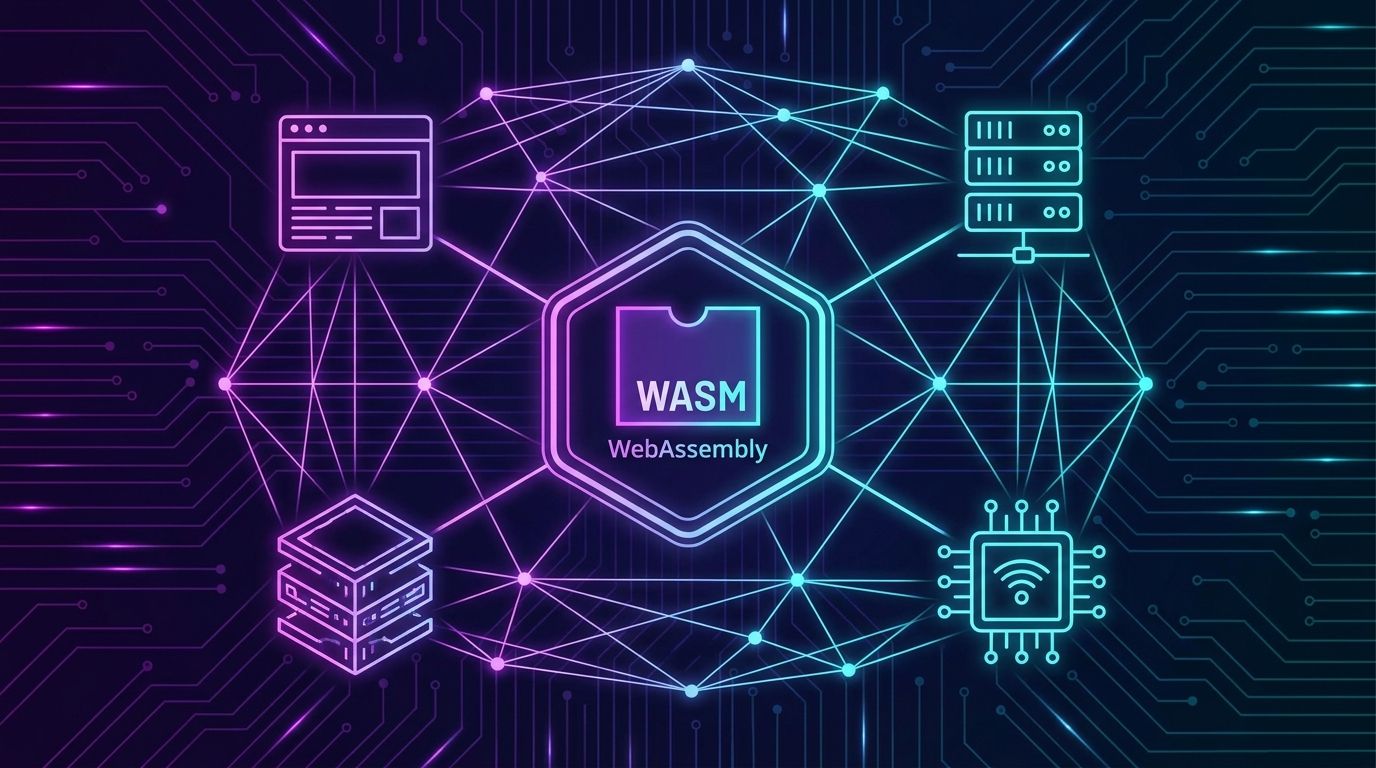
When WebAssembly shipped in 2017, the pitch was straightforward: a binary instruction format that web browsers could run at near-native speeds, enabling applications that JavaScript alone couldn't handle. Figma ported its rendering engine to WASM and made complex design software viable in the browser. AutoCAD Web used it to run decades-old C++ code without rewriting anything. The browser use case was real, and the technology delivered.
What nobody quite predicted was that the most consequential uses of WebAssembly would happen outside the browser entirely.
How WASM escaped the sandbox
The key development was WASI — the WebAssembly System Interface, proposed by the Bytecode Alliance in 2019 and reaching a stable 2.0 specification in 2024. WASI gave WebAssembly modules a standardised interface for interacting with the host system: reading files, making network connections, accessing environment variables. This sounds mundane, but it had a profound implication: a WASM module compiled with WASI support could run anywhere a WASI runtime existed — not just in a browser, but on a server, at the edge, on an IoT device, in a database engine.
Solomon Hykes, the creator of Docker, framed the significance clearly in a post that became widely cited: "If WASM+WASI existed in 2008, we wouldn't have needed to create Docker. That's how important it is." The promise was a universal portable binary — compile once, run everywhere, with a security sandbox built in.
Where WASM is running in 2026
Edge computing and serverless functions. Cloudflare Workers has supported WASM since 2018, but in 2026 it's the primary runtime for performance-critical edge functions. Fastly Compute, Fermyon Spin, and Wasmer Edge all run WASM workloads at globally distributed edge nodes. The appeal is a combination of startup time (sub-millisecond cold starts, vs 50–200ms for a Node.js function), security isolation (each module runs in its own sandbox with explicit capability grants), and portability (deploy the same binary to any provider).
Database extensibility. SingleStore, DuckDB, and several other databases now support user-defined functions written as WASM modules, allowing custom logic to run inside the query engine with access to vectorised operations and without the overhead of a round-trip to an external process. PostgreSQL's WASM UDF support, stabilised in 2025, opened this capability to the most widely deployed open-source database in the world.
Plugin systems. Zed (the code editor), Extism (a plugin framework used by dozens of applications), and an increasing number of developer tools use WASM as their plugin runtime. The advantage over traditional native plugin systems is isolation: a misbehaving plugin cannot crash the host process or access resources outside its capability grants. This is the model Shopify uses for its custom app extensions and that Figma uses for its plugin ecosystem.
Portable CLIs and tooling. The WASM component model (standardised in 2024) enabled composition: you can build a CLI tool as a set of WASM components that import and export typed interfaces, then compose them together regardless of what language they were originally written in. A Rust component can call a Python component's interface without either knowing the other's implementation language. This is enabling a new generation of language-agnostic tooling.
The component model changes the calculus
The WASM component model deserves special attention because it solves a problem that has plagued polyglot software for decades. Previously, if you wanted to call a library written in Rust from Python, you had to deal with FFI, shared memory, serialisation overhead, or subprocess calls. The component model replaces all of this with a type-safe, language-agnostic interface definition language (WIT — WebAssembly Interface Types) that compilers for Rust, Python, JavaScript, Go, C, and others can target.
The result is that a developer can write a high-performance string processing library in Rust, expose it as a WASM component with a typed WIT interface, and call it from Python with no FFI boilerplate. The binary runs in a sandbox, the interface is type-checked at the boundary, and the same component works everywhere the WASM runtime exists.
What's still missing
WASM's growth outside the browser comes with genuine limitations. Garbage collection support only reached stable status in 2024, which previously made it awkward for languages like Python and Java that depend on GC. Threads and shared memory work but have caveats around atomic operations that differ by platform. The toolchain story has improved dramatically — wasm-pack, cargo-component, and componentize-py all exist — but the experience still lags native development in terms of debugging, profiling, and error messages.
Performance is near-native for CPU-bound work but not for workloads that rely heavily on OS services: file I/O through WASI is slower than native, and the capability model's security grants add overhead compared to direct syscalls. For latency-critical paths, these gaps matter.
The trajectory
The trend line is clear. Wasmtime (maintained by the Bytecode Alliance) is embedding in everything from cloud providers to CLI tools to databases. The component model is gaining adoption faster than any previous WASM specification. Browser vendors are aligned on future features including garbage collection, stack switching for coroutines, and exception handling improvements.
WebAssembly will not replace containers or native binaries for all workloads. But for the specific use cases where portability, security isolation, and sub-millisecond startup times matter — edge functions, extensible applications, portable tooling, sandboxed plugins — it has already become the default choice. The next five years of its development will likely make it unrecognisable compared to the browser-focused binary format it started as.