Agentic NPCs Are Breaking the Rules of Game Design
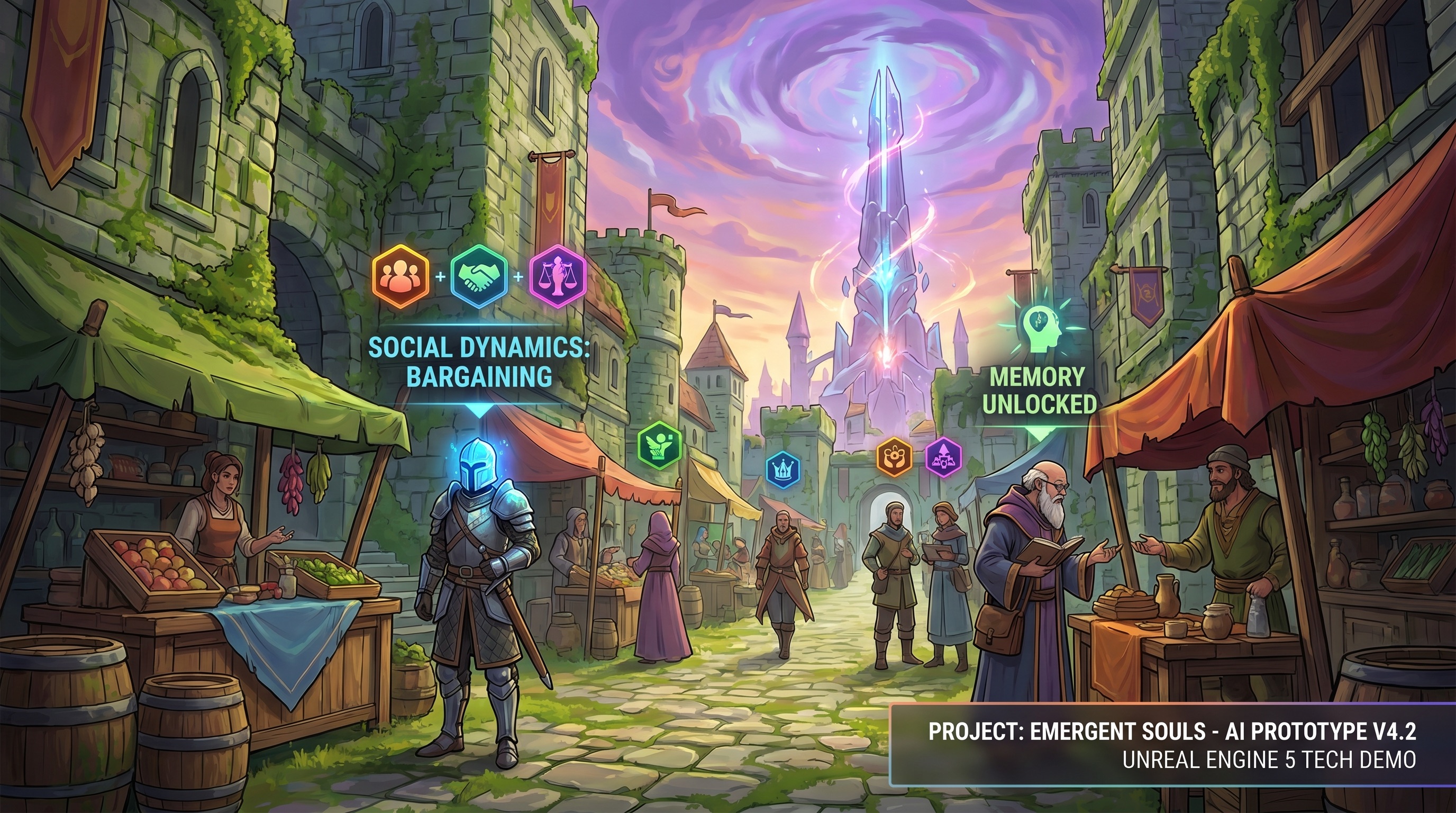
For three decades, the non-player character (NPC) in video games has been a sophisticated but ultimately static machine: a character with scripted responses, branching dialogue trees, and behavioral states that a player can learn to predict and exploit. The quest-giver who offers the same speech regardless of how many times you've saved the town. The guard who patrols the same route indefinitely. The merchant who sells from the same inventory whether you've bought everything or nothing.
That model is being replaced. Agentic AI systems, built on the same language model and reinforcement learning architectures that power conversational AI, are enabling NPCs that remember interactions, form relationships with other characters, develop preferences, and respond to situations without scripted rules for every scenario. The change is architectural, not incremental, and it's forcing game designers to rethink assumptions they've held since the medium existed.
What Makes a Character "Agentic"
An agentic NPC has a goal hierarchy, a memory system, and a decision-making layer that operates independently of scripted rules. Rather than checking conditions ("if player has completed quest X and has faction standing above Y, play dialogue Z"), an agentic NPC asks: what does this character want, what does it know, and what action best serves its goals given current circumstances?
NVIDIA's demonstration workflows for autonomous game characters, built on small language models running locally on RTX hardware, show NPCs that maintain context across hours of gameplay: remembering that a player insulted them three sessions ago, that a rival NPC recently acquired a resource they wanted, that the player character has a reputation for betrayal. This isn't fetched from a global event log — it's held in a character-level memory that shapes behavior organically.
The social dimension is equally important. When multiple agentic NPCs share a world, they interact with each other outside the player's view. Merchants form price agreements. Guards share information about suspicious activity. Factions develop alliances based on accumulated history. The player enters a world that has been evolving in their absence — a fundamentally different experience from returning to a frozen state.
The Level Design Problem
Traditional level design is built around predictability. A designer places a resource at a location because players will reliably want to travel there. A quest is structured around NPCs who will reliably provide specific information. An enemy camp is designed knowing the guards will patrol their scripted routes.
Agentic NPCs undermine these assumptions. If merchants set their own prices based on supply and demand, the designer can't guarantee a player will have the resources needed to progress. If guards share information and adapt patrol routes, stealth sequences designed for specific gameplay patterns may become trivially easy or unfairly hard. If factions evolve based on their own history, quest lines that depend on specific faction states may never trigger.
Game designers adapting to this model report a shift from designing content to designing systems. Rather than authoring the specific events a player will experience, they define the initial conditions, the goals characters hold, and the constraints on their behavior — then let emergent interactions generate the actual gameplay. The designer's role becomes closer to a simulation architect than a storyteller.
The Market Is Moving Fast
The AI in gaming market is valued at $10.1 billion in 2026, projected to reach $75.1 billion by 2033 — a 7.4x increase reflecting both creative and productivity applications. Game studios surveyed by GDC in 2026 reported 90% adoption of AI tools in some part of their workflows. The majority is in asset generation and quality assurance, but NPC AI is the fastest-growing application category by investment.
Google's Dreamlands and Atlas AI Studio have made 3D environment generation and NPC behavior prototyping accessible to studios that lack proprietary AI research capacity. What previously required a dedicated AI research team can now be implemented using platform-level tools. This democratization is particularly significant for mid-size studios, which lack the resources of Rockstar or Ubisoft but compete for the same players.
Emergent Narratives and Their Limits
The most compelling use cases for agentic NPCs are games where emergent narrative is a design goal: open-world RPGs, city builders, survival games. In a game where no two playthroughs are supposed to be the same, characters with genuine agency serve the design intent. Dwarf Fortress has operated on related principles for twenty years; what's changed is that language model integration makes the results legible to players rather than expressed only in cryptic system logs.
The limits are real. Agentic systems are computationally expensive, which constrains how many characters in a world can operate at full agent fidelity simultaneously. Content safety is an unsolved problem: a character optimizing for its own goals may produce dialogue or behavior that violates player expectations or platform content policies. And some genres — narrative games with authored stories, competitive multiplayer — don't benefit from emergent AI behavior in the same way.
The studios solving these problems are building hybrid systems: core narrative characters with authored behavior for plot-critical interactions, agentic behavior for ambient world population, and selective agent activation based on player proximity and scene importance. The goal isn't AI everything — it's using AI to make the world around the authored story feel genuinely alive.
The Disclosure Tension
GDC's 2026 report found 52% of game industry professionals believe generative AI is having a negative impact on the industry — up from prior years. The concern isn't primarily about NPC behavior AI, which has broad acceptance. It's about undisclosed use of generative AI for art assets, voice performances, and narrative writing — areas where creative workers have contractual and ethical stakes in disclosure.
Platform holders and publishers are moving toward mandatory AI disclosure requirements for commercially released games. The distinction between "AI-assisted NPC behavior" (broadly accepted) and "AI-generated creative assets without disclosure" (increasingly contested) is one the industry is still working through. For game designers, the near-term challenge is navigating that distinction while integrating tools that don't come with clear categorical boundaries.