Inside the Humanoid Robot Gold Rush: What Is Actually Working in 2026
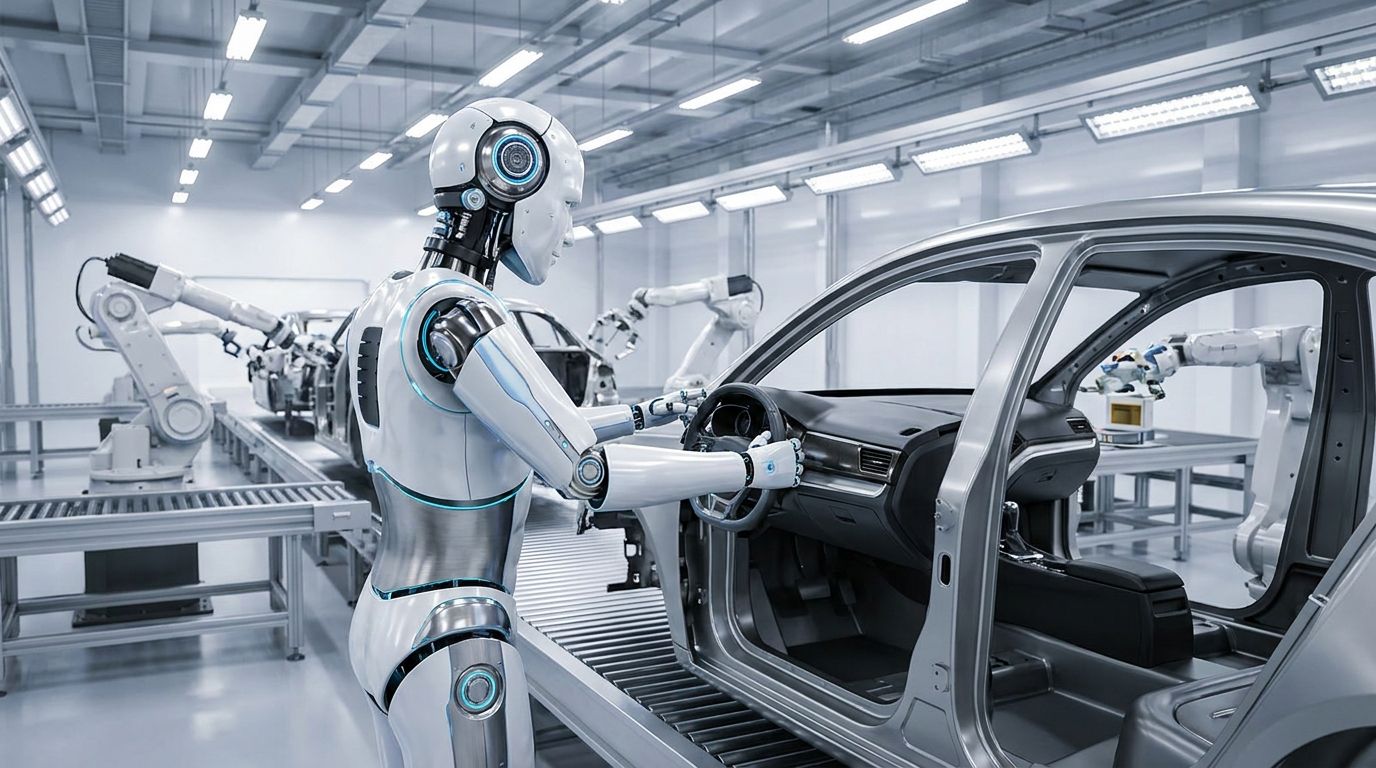
In November 2025, a Figure 02 humanoid robot logged the end of an eleven-month production deployment at BMW's Spartanburg plant in South Carolina. The robot had worked ten-hour shifts, five days a week, loading sheet-metal parts onto welding fixtures for BMW X3 production. Over the course of the pilot: 1,250 hours of runtime, 90,000 parts handled, and a contribution to approximately 30,000 completed vehicles.
Those are real numbers, independently verifiable, from a real factory running real production. They are also, in the broader context of a factory that produces hundreds of thousands of vehicles annually, a very narrow slice of the work. Figure 02 did one task. It did it in a structured, predictable environment where every part arrived in the same orientation at the same position. The robot that is succeeding in BMW's factory is not the autonomous humanoid of science fiction demonstrations. It is a highly specialised tool that happens to be shaped like a person.
Understanding what humanoid robots actually are in 2026 requires holding two things simultaneously: the genuine progress is real, and the gap between current capability and transformative deployment is also real.
What is actually deployed
The clearest verified deployments are concentrated in two companies. Agility Robotics' Digit — a bipedal robot built for warehouse logistics — has moved over 100,000 totes at GXO Logistics facilities and is running in Toyota Canada automotive parts plants, where seven units feed totes of components to assembly lines. Amazon, which has a strategic relationship with Agility, has deployed Digits across multiple fulfilment centres. Exact unit counts have not been disclosed publicly.
Figure AI's BMW deployment represents the most data-rich published account of a humanoid doing precision manufacturing work. The successor, Figure 03, is planned for rollout at BMW's Leipzig plant from summer 2026. Figure AI's Series C funding round closed at over $1 billion in September 2025 at a $39 billion valuation — a figure that reflects investor expectations, not current revenue.
Boston Dynamics' fully electric Atlas, unveiled at CES in January 2026, has its entire 2026 production run committed to Hyundai Motor Group and Google DeepMind. Hyundai is already deploying Atlas units for car-parts sorting in live production. The company's long-term target is 25,000 Atlas units across its plants, with mass production of 30,000 per year planned by 2028 from a dedicated robotics factory. Additional customers are not expected until 2027.
Tesla's claims around Optimus are harder to verify. Elon Musk stated in January 2026 that over 1,000 Optimus Gen 3 robots were on live production lines at Tesla's Fremont facility, performing battery module assembly and parts kitting. Other accounts from the same period suggest the robots were primarily present for data collection rather than productive work. No independent verification of Tesla's KPI claims has been published. The Gen 3 production ramp was scheduled for summer 2026; high-volume production is targeted for 2027.
What the robots can do, and what they cannot
The tasks that humanoid robots are reliably performing in production in 2026 share a common profile: repetitive, defined motions in structured environments where objects arrive in predictable positions and orientations. Tote moving between fixed points. Sheet metal loading onto fixtures with known geometry. Parts kitting from organised bins. Feeding assembly lines at set cadences. These are genuinely valuable tasks — they represent a significant fraction of physical labour in logistics and light manufacturing — and they represent a small fraction of what humans can do.
The failure modes are instructive. A Forbes analysis from April 2026 found an 88% failure rate for humanoid robots on common household tasks in unstructured real-world environments — in contrast to roughly 90% success rates in controlled simulation. The gap between simulation and reality remains substantial for anything that requires handling novel objects, navigating unexpected obstacles, or adapting to surfaces with variable friction.
Battery life constrains operational deployment. Current humanoids run between one and four hours on a charge under active operation. Industrial robots have 95 to 99% uptime as a standard expectation; humanoids are nowhere near that figure yet. Throughput on complex tasks cannot yet match automotive production-line speeds.
The economics
The cost picture is changing rapidly. Unitree's G1 — a Chinese-manufactured humanoid — retails at $13,500, making it by far the lowest-priced option with meaningful capability. 1X Technologies offers its NEO robot at $20,000 or $499 per month under a Robotics-as-a-Service model. Tesla's stated target price at production scale is $20,000 to $30,000. Boston Dynamics' industrial Atlas is estimated at over $200,000, though Hyundai's volume relationship may change the effective price at scale.
IDTechEx forecasts an average 68% price reduction by 2030, from roughly $115,000 to $37,000. Morgan Stanley estimates that a humanoid robot operating at $5 per hour can match the productivity of two human workers at $25 per hour — a payback period of twelve to twenty-four months for repetitive tasks in US manufacturing contexts. A Unitree G1 at $13,500 can theoretically pay for itself in under three months in high-labour-cost markets where it can perform its limited but real task set reliably.
The China factor
Any honest accounting of the humanoid robot market in 2026 must address China's position in it. Chinese manufacturers shipped approximately 80% of the world's humanoid robots in 2025. AgiBot scaled from 1,000 deployed units in 2025 to 10,000 by March 2026. BYD targeted 20,000 units for 2026. Unitree shipped 5,500 units in 2025 with a target of 10,000 to 20,000 in 2026. Bank of America projects roughly 90,000 humanoid units shipped globally in 2026 — a market dominated by Chinese production.
Western companies have the brand recognition, the funding narratives, and the enterprise relationships. Chinese companies have the manufacturing scale, the supply chain integration, and the price points. The competitive dynamics of this market will be shaped by who can close the gap between those two sets of advantages — and by whatever regulatory constraints eventually apply to the deployment of AI-driven physical systems.
The regulatory gap
Existing industrial robot safety standards were written for fixed-position, bounded robotic arms. They do not adequately cover mobile, AI-driven humanoids that navigate shared workspaces with humans. ISO announced a working group for mobile robots with active stability control in May 2025. The EU AI Act classifies most embodied AI as high-risk, with compliance obligations taking effect from August 2026. Safety incidents — including a Unitree robot that flailed violently during testing in a Chinese factory in May 2025 due to a software oversight in its balance algorithm — have underscored why these standards matter.
Gartner has predicted that fewer than 20 companies will successfully scale humanoid robots to actual production by 2028, and that a "hype crash" is likely as the gap between investment levels and near-term deployment reality becomes more visible. The prediction is plausible. The $23 billion invested in robotics startups in 2026 represents an enormous bet on a technology that, in its current state, works narrowly and well — and fails broadly and conspicuously outside that narrow envelope.
The companies that have earned the right to claim "deployment" in 2026 — Agility at Amazon and GXO, Figure at BMW, Boston Dynamics at Hyundai — are the ones with verified hours and verified parts counts. The rest are in pilot, in funding mode, or in the complicated space between the two. The gap between that honest current state and the transformative potential the technology genuinely holds is where the most interesting story in physical AI is currently living.