Robôs Humanoides Estão no Chão de Fábrica em 2026: O Que Realmente Está Acontecendo
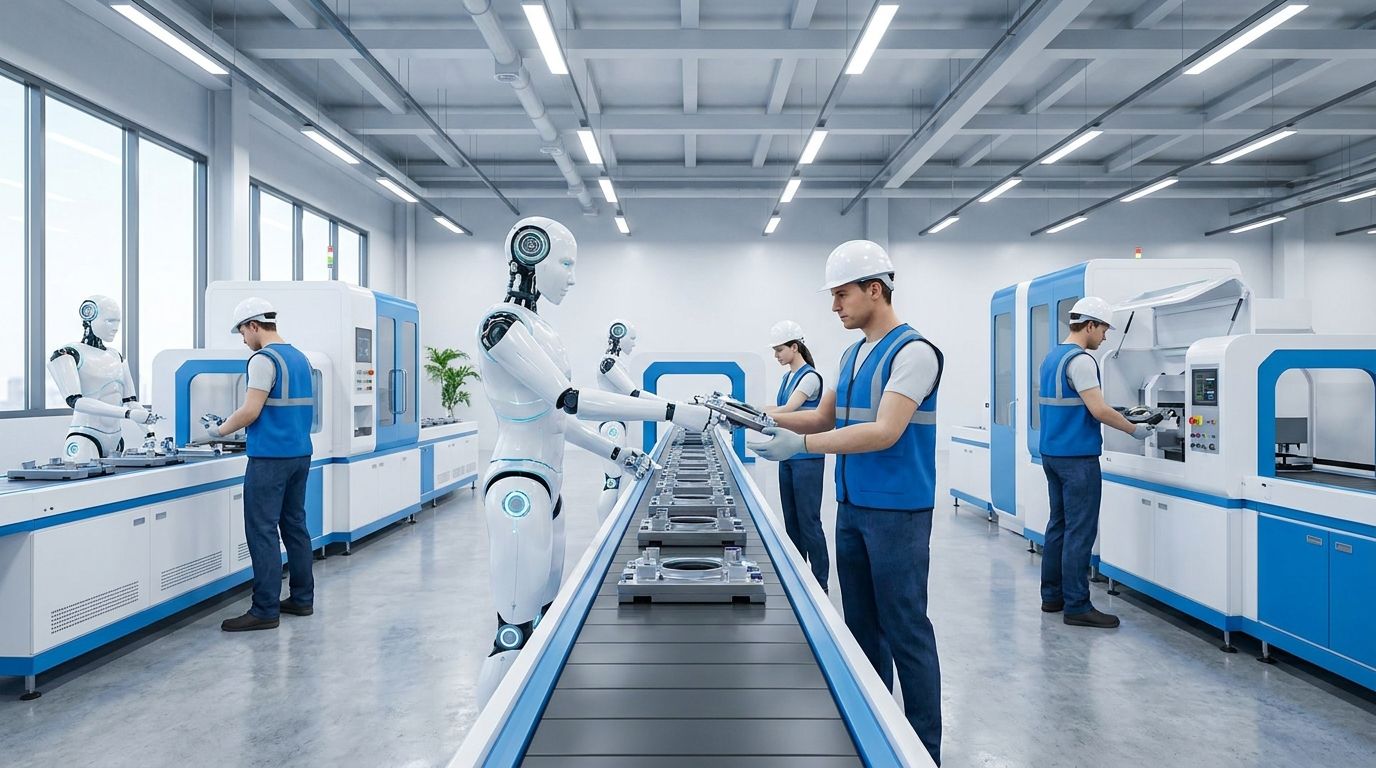
The question of when humanoid robots would enter the real workforce has been asked, and dismissed, and asked again, for most of the past decade. The common answer from skeptics was always some variation of "five to ten years away" -- a timeframe that implied perpetual imminence without commitment. That answer has expired. In 2026, humanoid robots are not five years away from the factory floor. Several thousand are already there, doing actual work, and the companies deploying them are placing orders for tens of thousands more.
Who Is Deploying What
Boston Dynamics unveiled its production-ready electric Atlas robot in January 2026, specifically designed for industrial automation rather than research demonstration. The robot can lift up to 50 kilograms and operate for approximately four hours on a swappable battery. The initial production runs for 2026 are fully committed: Hyundai's Robotics Metaplant Application Center has reserved the first fleet, alongside Google DeepMind. Hyundai Group has placed an order for over 25,000 Atlas units across its Hyundai and Kia plants, with U.S. production scaling by 2028. This is the largest recorded order for humanoid robots, and it comes from a buyer who builds cars for a living and needs robots that work reliably in that environment.
Figure AI has passed 10,000 deployments in partner warehouses, with active installations at BMW's manufacturing facility in Spartanburg, South Carolina. The tasks are component insertion and material transport -- precise, repetitive work that does not require creative problem-solving but does require dexterous hands and spatial reasoning. BMW reports a 15% improvement in line efficiency at the Spartanburg site. That number is early and will shift, but it is a real measurement from a real deployment, not a projection from a demo environment.
Tesla's trajectory is different in character. The company has produced over 50,000 Optimus Gen 3 units as of Q1 2026, primarily deployed within its own Gigafactories in Austin, Shanghai, and Berlin. These robots are doing internal work -- pick-and-place operations, battery cell sorting, light assembly -- but Tesla has characterized them primarily as learning platforms rather than production workers. The honest assessment is that Optimus is currently collecting data and building capability more than it is generating economic output. Tesla's conversion of the Fremont factory for humanoid robot production in Q2 2026 suggests the company is serious about scale, but the first genuinely productive external deployments are more likely to land in late 2026 or early 2027.
What These Robots Can and Cannot Do
The capabilities of current commercial humanoid robots are narrower than their marketing suggests and more substantial than their critics acknowledge. The tasks they perform reliably in 2026 share a profile: repetitive, structured, physically demanding, and well-defined. Material handling, component transport, pick-and-place operations on known objects, and assembly of parts with known geometry. These tasks are valuable -- they represent a significant portion of factory and warehouse labor -- but they do not require the open-world adaptability that would allow robots to take on the full breadth of human work.
The hard frontier is dexterity and unstructured manipulation. Picking up a known object in a known location from a known orientation is a solved problem. Picking up an unknown object from a pile, or handling objects with variable shapes and weights, or operating in environments that change unpredictably -- these remain active research problems. The Boston Dynamics Atlas, the Figure 02, and the Tesla Optimus Gen 3 are all better at these tasks than any robot available three years ago. None of them can do what a warehouse worker does when something unexpected happens.
The Labor Economics
The deployment decisions being made right now are driven by labor economics as much as by technology capability. In markets facing persistent labor shortages for physical work -- automotive manufacturing, logistics, food processing -- the calculus for humanoid robots is changing. The robots available today cost roughly $30,000 to $80,000 per unit with ongoing software and maintenance costs. For tasks that a human worker would cost $50,000 to $70,000 per year in wages and benefits, the break-even period on current hardware is measured in one to three years depending on utilization rate. As unit costs drop with production scale, that math becomes more compelling at lower cost points.
The labor-replacement framing, while economically accurate for some scenarios, is also incomplete. The deployments showing the most positive early results are in settings where robots are handling the highest-repetition, highest-injury-risk tasks alongside human workers who shift to supervisory or more variable-task roles. BMW's Spartanburg result comes from a collaborative model, not a replacement model. The near-term trajectory of humanoid robots in the workplace looks more like a reallocation of what humans do than a wholesale substitution.
The Software Layer Nobody Is Talking About
The hardware of humanoid robots gets the attention, but the software decisions being made right now will determine which companies lead in five years. NVIDIA's Cosmos 3, launched at Computex 2026, is an open-world foundation model for physical AI -- a system that can reason about physical environments, generate training data for robot behavior, and enable robots to adapt to new tasks without exhaustive manual programming. The companies deploying robots that are learning from real-world operation and feeding that data back into improved models are building a compounding advantage. The robots of 2028 will be considerably more capable than those of 2026 not primarily because the hardware improved, but because the models running on them will have been trained on millions of hours of real physical interaction data that only companies with large active fleets will have access to.