Signal vs WhatsApp in 2026: Both Use the Same Encryption — the Differences Are Everything Else
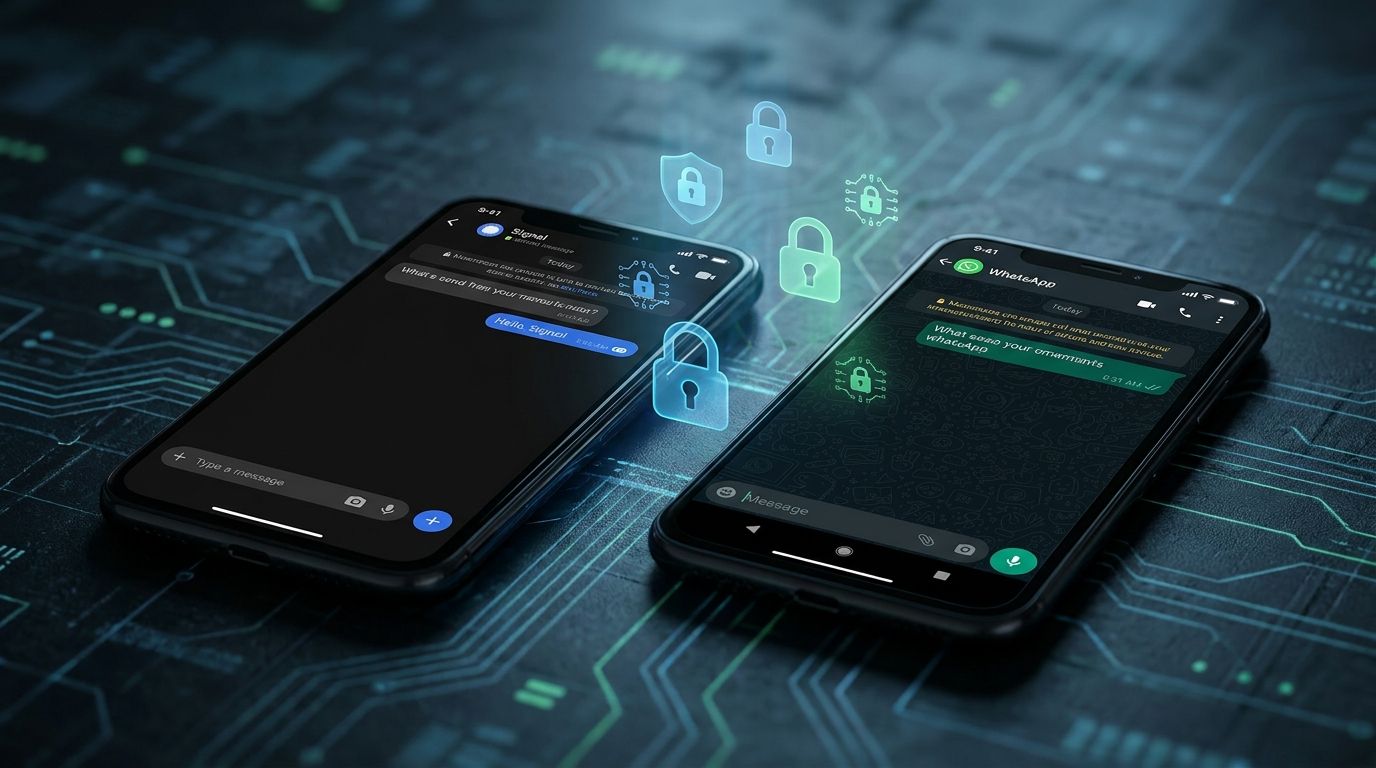
The most common misconception about Signal and WhatsApp is that WhatsApp "isn't really encrypted." It is. WhatsApp has used the Signal Protocol — the same open-source end-to-end encryption standard developed by Signal's founders — since 2016. Every message, call, and file sent through WhatsApp is encrypted in transit with the same cryptographic primitives as Signal.
The distinction between the two apps is not whether your messages are encrypted in transit. It is what data is collected around those messages, who has access to it, and what the company's relationship with advertisers and law enforcement looks like. These distinctions are significant and worth understanding precisely.
What both apps do the same
End-to-end encryption of message content, voice calls, video calls, and file transfers is functionally equivalent between Signal and WhatsApp. Both use the Signal Protocol's Double Ratchet algorithm, which provides forward secrecy (each message is encrypted with a unique key; compromising one key does not compromise past messages) and break-in recovery (the encryption self-heals after a session interruption).
Neither company — in the standard configuration — can read the content of your messages. Law enforcement requests for message content from either Signal or WhatsApp produce the same result: the company cannot comply because they do not possess the plaintext.
The metadata question
This is where the paths diverge significantly. Metadata — who communicates with whom, when, how often, and from where — is not encrypted by the Signal Protocol. It is a byproduct of routing messages through any server infrastructure.
Signal has been engineered to minimise metadata collection as a design goal. Signal's server architecture uses sealed sender (the server doesn't know who sent a message to whom, only that a message was delivered to a particular recipient), private contact discovery (Signal learns whether your contacts are on Signal without seeing your contact list), and private groups (the Signal server does not know the membership or content of group chats). When US federal law enforcement has subpoenaed Signal's records, the company has been able to provide only: account creation date, and date of last connection. That is the totality of what Signal stores.
WhatsApp collects substantially more metadata. WhatsApp's privacy policy discloses collection of: contact lists, profile pictures, status information, group participation, device identifiers, IP addresses, approximate location, frequency of use, battery status, and more. This data is shared with Meta's family of companies (Facebook, Instagram) for advertising purposes. It is also subject to Meta's data retention policies and law enforcement access frameworks.
A 2021 US federal court filing made public in 2023 revealed that the FBI's legal demands to WhatsApp can yield: source and destination phone numbers for a specified account, date and time of each message, and the phone number of the account that sent or received the message. The message content is still inaccessible — but the social graph, timing patterns, and communication frequency are not.
Backups: the critical difference most users miss
The encryption guarantee applies to messages in transit. What happens to messages at rest — specifically in cloud backups — has historically been a major practical difference between the two apps.
WhatsApp's default backup behaviour stores encrypted backups to Google Drive (Android) or iCloud (iOS). Until 2021, these backups were not end-to-end encrypted: Google and Apple could theoretically access them, and law enforcement could request them via the cloud providers. WhatsApp introduced optional end-to-end encrypted backups in 2021, but this feature requires users to opt in and manage an encryption key. As of 2026, end-to-end encrypted backups are the default in new WhatsApp installations — a significant improvement — but users who have been on the platform for years may have legacy backup configurations that are not fully encrypted.
Signal does not back up messages to third-party cloud services. Local device backups on iOS are excluded from the system backup if made through Signal's settings. Users who want to transfer chat history to a new device must do so directly via Signal's device-to-device transfer feature, which keeps the data within the user's control throughout.
Business model and its implications
Signal is a 501(c)(3) nonprofit funded by donations and grants. Its technology is entirely open-source, audited by the security community, and its business model has no advertising component. There is no commercial incentive to collect data beyond what is operationally necessary.
WhatsApp is a subsidiary of Meta, which derives virtually all its revenue from targeted advertising. WhatsApp itself does not currently run ads within chats, but it serves as a data source for Meta's advertising profiles. Meta has been explicit about plans to expand WhatsApp for Business monetisation and, over time, to surface advertising within the Business tools ecosystem.
The business model difference matters because it shapes what each company is incentivised to do with user data over time. Signal's incentive structure is aligned with user privacy. Meta's is aligned with maximising the informational value of its user base for advertising and platform purposes.
Interoperability and the EU Digital Markets Act
The EU's Digital Markets Act, which designated Meta as a gatekeeper in 2023, required WhatsApp to open its messaging infrastructure to interoperability requests from third-party messaging providers by March 2024. Signal is among the apps that can request interoperability with WhatsApp under this framework.
The technical challenge is substantial: any interoperability that crosses the Signal/WhatsApp boundary involves metadata being shared between the two systems' infrastructure, which compromises some of Signal's metadata-minimisation properties. Signal has been cautious about the interoperability terms, specifically concerned about metadata exposure in cross-platform message routing. As of mid-2026, limited interoperability is functional but Signal has not aggressively promoted cross-platform messaging, partly for this reason.
The practical choice
For users whose primary concern is message content confidentiality, both apps provide adequate protection in the standard configuration. If your threat model is a criminal actor intercepting messages in transit, or a company insider reading your conversations, either app is fine.
If your concern is metadata — your social graph, your communication patterns, your contact list being used to build an advertising profile or handed to law enforcement — Signal is the substantially stronger choice. If your concern is backup security specifically, make sure WhatsApp's end-to-end encrypted backups are enabled and that you have your encryption key backed up securely.
The network effect reality is that WhatsApp has approximately 3 billion monthly active users and Signal has approximately 80 million. For most people, Signal's privacy properties are offset by the practical problem that most of the people they want to message are not on it. That network gap has not materially closed in the years since Signal's privacy advantages became widely discussed, which suggests that for the majority of users the metadata distinction is either not salient or not worth the friction of switching.